India's allocation of Lok Sabha seats among states has remained tied to 1971 population figures through a constitutional freeze, even though constituency boundaries were later readjusted within states. That freeze was always meant to end after 2026 — and the bill designed to end it could push the house to 850 seats, bundle in a faster timeline for women's reservation, and reopen a fight between North and South India that has been building for years. It already failed once, in April. Whether it even comes up for a vote again this month is, as of this week, disputed by the government's own minister.
The story in 60 seconds
- The allocation of Lok Sabha seats among states was frozen using 1971 population figures through the 42nd Amendment, then protected until figures from the first census after 2026 are published.
- The Delimitation Bill, 2026, introduced alongside the Constitution (131st Amendment) Bill and the UT Laws (Amendment) Bill, would let Parliament grow to a maximum of 850 seats (815 from states, 35 from Union Territories) and would base the new seat count on the 2011 Census rather than waiting for a fresh one.
- The same package delinks the 33% women's reservation in the Lok Sabha and state assemblies from the constitutional requirement to wait for a post-2023 census — letting it take effect off this 2011-based delimitation instead, ahead of the 2029 general election.
- The constitutional amendment was negatived in the Lok Sabha on April 17, 2026. The companion bills were introduced but did not pass, so none of the package became law.
- Five southern states — Tamil Nadu, Karnataka, Andhra Pradesh, Kerala and Telangana — oppose the bill, arguing it converts their decades of successful population control into a shrinking share of Parliament.
- Reports of an August special session were publicly denied by Parliamentary Affairs Minister Kiren Rijiju. Until an official parliamentary schedule confirms a fresh sitting, reintroduction remains unverified.
AI SummaryAI-generated summary, reviewed by editors
India's 2026 delimitation package proposed an 850-seat constitutional ceiling, while the government illustrated an 816-seat house. Its core amendment was defeated in April. Here is the law, the North–South argument and the verified status.
Switch to Shorts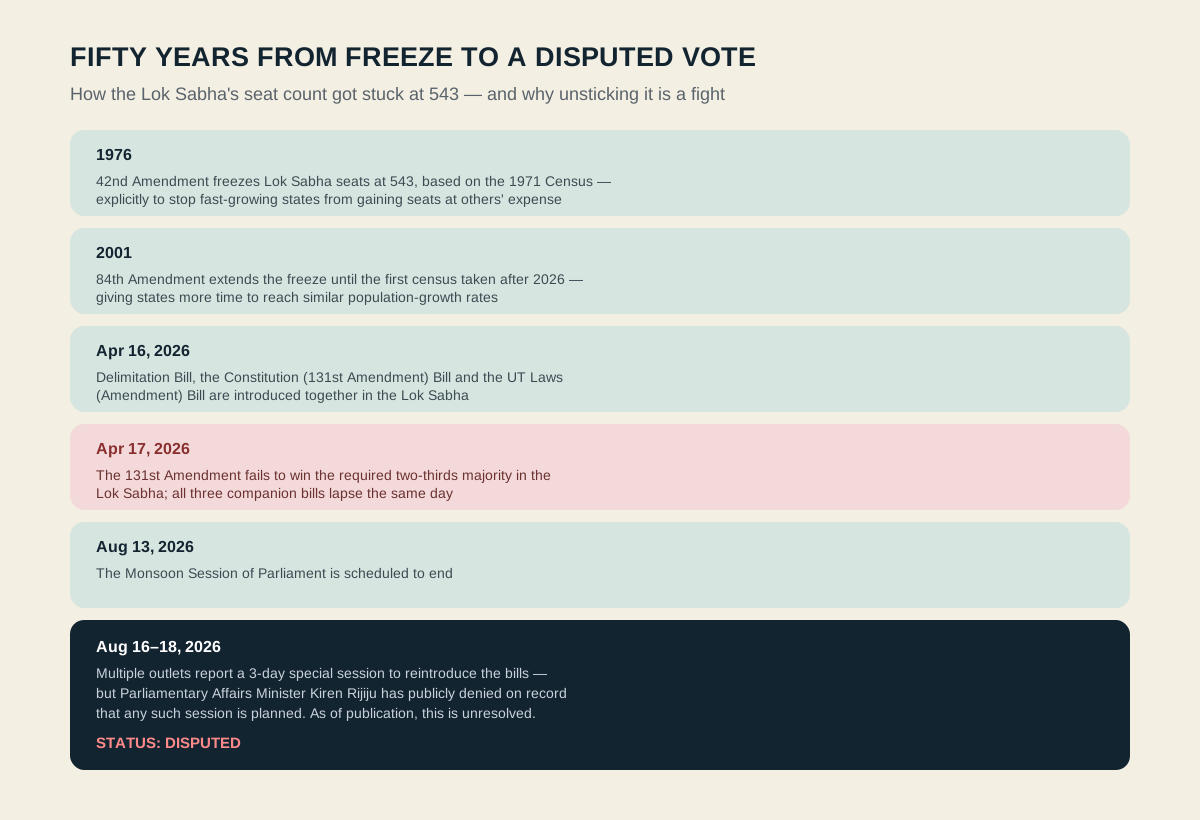
Why interstate seat allocation still rests on 1971 population figures
Delimitation — the redrawing of constituency boundaries and the recalculation of how many seats each state gets — is supposed to happen after every census, so Parliament keeps reflecting where India's population actually lives. It hasn't happened at the national level since 1976, and that gap is not an oversight; it is a deliberate constitutional choice.
By the mid-1970s, some states were controlling their population growth through family-planning programmes while others were not. If delimitation had proceeded normally, the states growing fastest would have kept gaining Lok Sabha seats, while states that slowed their growth would have effectively been punished with a shrinking share of Parliament — even though slowing population growth was national policy. To prevent that outcome, the 42nd Constitutional Amendment in 1976 froze every state's seat count at its 1971 Census level. The 84th Amendment in 2001 extended that freeze further, until the first census taken after 2026 — explicitly to give slower-growing states more time and to avoid rewarding states that hadn't gotten population growth under control.
That freeze was always going to expire eventually. The Delimitation Bill, 2026 is the government's attempt to decide what happens next — and the states that benefited most from the freeze are the ones now most alarmed by its removal.
What the Delimitation Bill, 2026 actually proposes
Three bills were introduced together in the Lok Sabha on April 16, 2026: the Delimitation Bill itself, the Constitution (131st Amendment) Bill, and the Union Territories Laws (Amendment) Bill. Together, they would raise the maximum size of the Lok Sabha from its current constitutional ceiling of 550 to 850 — 815 seats elected from the states and 35 from Union Territories, against 543 total seats today.
The more contested design choice is which population data to use. Rather than waiting for a fresh census — the next one is expected around 2027, delayed from its normal 2021 date — the bill proposes basing the new delimitation on the 2011 Census, the most recent one actually completed. It also changes the constitutional language so that Parliament itself decides which census to use for a given delimitation exercise, rather than the Constitution requiring the latest available one by default. Critics have pointed out that this is not a neutral technical fix: which census year you pick determines how much each state's population — and therefore its seat count — has grown or shrunk relative to the others.
The women's-reservation trigger bundled into the same bill
The 106th Constitutional Amendment Act, 2023 — the Nari Shakti Vandan Adhiniyam — guaranteed one-third of Lok Sabha and state assembly seats for women, but tied its implementation to two conditions: a census conducted after 2023, and a delimitation exercise carried out using that census. In practice, that meant women's reservation could not take effect until after India's next full census and a delimitation based on it — a timeline stretching well past the 2029 general election.
The 2026 package changes that sequencing. By enabling delimitation off the existing 2011 Census now, rather than waiting for a fresh one, it would let women's reservation take effect off this delimitation instead — years earlier than the 2023 Act's original design implied. Opposition MP Shashi Tharoor argued in the Lok Sabha debate that this amounts to the government holding the aspirations of Indian women hostage to a much more contentious bill, since the two are now legally inseparable: without the Delimitation Bill passing, the faster path to women's reservation doesn't exist either.
Round one: why the April 2026 attempt already failed
This is not a new proposal. Union Minister Arjun Ram Meghwal introduced all three bills in a short special session on April 16, 2026. But the Constitution (131st Amendment) Bill — the piece that actually authorises the seat expansion and the new delimitation basis — is a constitutional amendment, which under Indian law requires a two-thirds majority of members present and voting in the Lok Sabha, not a simple majority. It did not get one. The amendment was negatived in the Lok Sabha on April 17, 2026. The Delimitation Bill and UT Laws Bill were introduced but did not pass; without the constitutional change, the package could not take effect.
That failure is why any second attempt needs either a larger coalition than the government currently commands on this specific vote, or enough opposition abstentions to change the arithmetic. Nothing about the underlying vote-counting problem from April has been resolved — which is part of why even the existence of a follow-up session is contested.
The North-South math, and why it's disputed
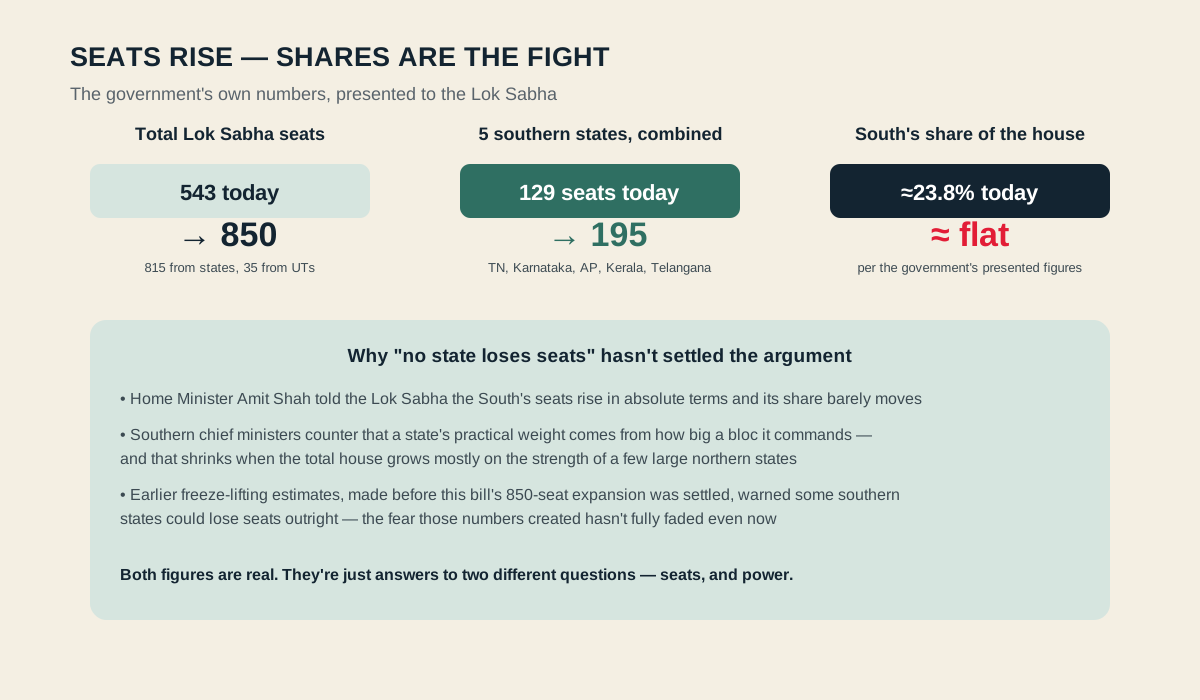
Replying to the Lok Sabha debate on the bills, Home Minister Amit Shah presented figures meant to defuse the southern states' core objection: under the government's illustrative 816-seat house, the five southern states' combined Lok Sabha representation would rise from 129 seats to 195, while their share of the total house would stay close to its current level, at roughly 23.8%. By this framing, no southern state loses a single seat in absolute terms — every state's count goes up, because the whole house is getting much bigger.
Southern state governments have not been reassured. Kerala Chief Minister Pinarayi Vijayan has said the bill penalises states that sincerely implemented the National Population Policy of 1976 while rewarding states that lagged on population control. Tamil Nadu Chief Minister M.K. Stalin has led sustained public opposition and taken the issue directly to the Centre. Part of the disagreement is about numbers that predate this specific 850-seat design: earlier, less generous freeze-lifting projections — made before the government settled on this scale of expansion — warned that a state like Kerala could see its 20 seats fall to as few as 13 or 14 under a stricter population-only formula. Those older projections are not what the current bill proposes, but the alarm they created has not fully faded, and they explain why the South's objection predates this specific bill by years.
Even accepting the government's own numbers, the disagreement doesn't fully dissolve. Absolute seats and voting power are not the same thing. A southern bloc that holds 129 of 543 seats today can be a more decisive swing factor in a closely divided house than a nominally larger bloc of 195 out of 850 — especially if the extra 307 seats are concentrated in a smaller number of large northern states whose own blocs grow even larger. Both sides are citing real numbers. They are just answers to two different questions: how many seats does the South get, and how much does the South's vote actually decide.
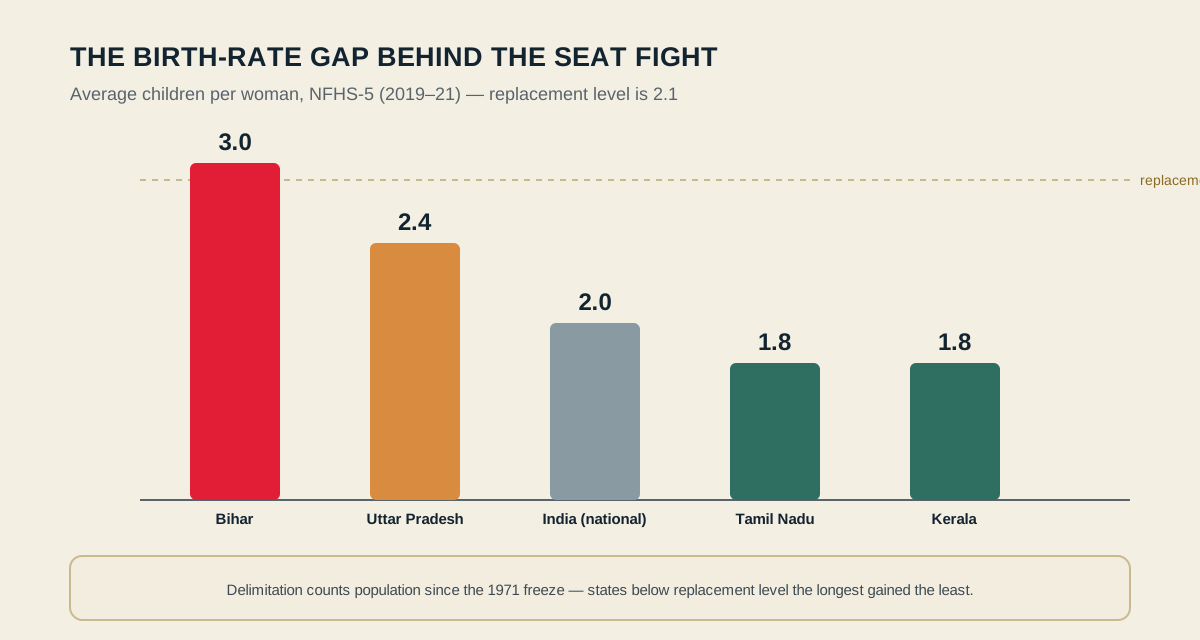
The demographic data behind this argument is not disputed. The National Family Health Survey-5 (2019–21) recorded India's national Total Fertility Rate at 2.0 children per woman, just below the population replacement level of 2.1. Bihar, at 3.0, and Uttar Pradesh, at 2.4, remain above replacement level. Tamil Nadu and Kerala have been at 1.8 — well below replacement — for years, among the earliest states in India to complete this demographic transition. Because delimitation measures population growth since the 1971 freeze, the states that reduced fertility earliest and furthest are, by definition, the ones whose population — and whose claim on additional seats — grew the least.
Why reports of a fresh session remain unconfirmed
Here is where the story stops being settled history and becomes a live, disputed question. Through the first week of August 2026, multiple outlets reported that the Centre was planning a three-day special Parliament session, running roughly August 16 to 18, immediately after the Monsoon Session concludes on August 13 — timed to reintroduce the Delimitation Bill package before Parliament's calendar moves on.
Union Parliamentary Affairs Minister Kiren Rijiju has directly and publicly contradicted those reports. In an on-record statement, he said: "No proposal to extend any dates of Parliament Session, no Special Session from August 16 to 18 on Women's Reservation and Delimitation Bills." That is not a vague deflection — it is a specific, dated denial of the specific, dated reports. Neither side has produced anything since that fully settles the question, and different outlets still disagree on even the proposed dates, with some citing August 16 and others August 17 as the reported start.
Claim versus evidence
- Confirmed: The Lok Sabha's seat count has been frozen at 543 since 1976, specifically to prevent population-growth differences between states from changing their relative representation.
- Confirmed: A near-identical bill package was introduced on April 16, 2026, and its core constitutional amendment failed to secure a two-thirds Lok Sabha majority the next day, causing all three bills to lapse.
- Confirmed, government figures: Under the government's illustrative 816-seat allocation, the figures presented in Parliament show the five southern states' combined seats rising from 129 to 195, with their share of the total house roughly unchanged.
- Disputed: Whether "no absolute seat loss and a roughly flat share" means southern states retain the same practical political weight — southern chief ministers argue relative bargaining power still shifts North as the house grows.
- Unconfirmed: Reports of an August 16–18 special session were denied by the Parliamentary Affairs Minister. An official parliamentary schedule is the decisive evidence for any fresh sitting.
- Not yet law: The constitutional amendment was negatived and neither companion bill has passed Parliament; none of the proposed changes is law.
What to watch next
Three things will determine what happens next: whether the government formally reintroduces a revised package; whether it can secure the special majority that the constitutional amendment failed to win in April; and whether a new design changes either the census basis or the representation guarantees that southern states contest. Until a bill and an official sitting appear on Parliament's record, those remain future possibilities rather than scheduled events.
Frequently asked questions
What is delimitation?
Delimitation is the process of redrawing electoral constituency boundaries and recalculating how many seats each state gets in Parliament and state assemblies, normally done after each census so representation tracks population.
Why hasn't India done a national delimitation since 1976?
Two constitutional amendments — the 42nd in 1976 and the 84th in 2001 — deliberately froze each state's seat count, to stop states with faster population growth from gaining Lok Sabha seats at the expense of states that had slowed theirs, and to give every state more time to reach similar growth rates.
Would any state actually lose Lok Sabha seats under this bill?
Based on the figures the government has presented to the Lok Sabha, no state's absolute seat count would fall — the total house grows enough that every state's raw number goes up. Southern states dispute whether that preserves their relative political influence in a much larger house.
How is this connected to women's reservation?
The 2023 law guaranteeing one-third of seats to women had tied its start date to a post-2023 census and a delimitation based on it. This bill would let that reservation begin off the 2011-based delimitation instead, years sooner, but only if the Delimitation Bill itself passes.
Has any part of this actually become law yet?
No. The only attempt so far — introduced April 16, 2026 — failed to pass the Lok Sabha the following day. As of publication, whether or when it will be reintroduced is itself disputed.
Kerala offers a useful test of how projections get misreported as outcomes. Our Kerala seat-number fact-check separates its current 20 seats, the government’s 30-seat illustration and lower independent models.
Seat arithmetic is only one layer of the process. Our Delimitation Commission explainer shows who drafts boundaries, how objections are heard and why no national 2026 Commission was formed.
We separately checked the government’s central numerical assurance. Read our claim-by-claim review of Amit Shah’s 129-to-195 seat illustration.
For students and new electors, our first-time voter guide separates the confirmed Census 2027 schedule from uncertain 2029 and 2034 predictions.
For international context, compare India’s proposal with US reapportionment, Germany’s 630-seat reform and EU degressive proportionality.
For the reservation dimension, see how delimitation can change SC and ST seat counts and constituency locations.
The bottom line
The Delimitation Bill is not really a fight about arithmetic — both sides can produce numbers that are technically accurate. It is a fight about what representation is actually for: whether a state's voice in Parliament should track its raw population, its policy performance, or some negotiated balance between the two. India built a fifty-year pause into its Constitution rather than answer that question. The Delimitation Bill, 2026 is the first serious attempt to answer it since — and as of this week, India doesn't yet know whether Parliament will even get the chance to vote on it again this month.
Sources
- The Delimitation Bill, 2026 — PRS Legislative Research
- The Constitution (131st Amendment) Bill, 2026 — PRS Legislative Research
- Union Home Minister Amit Shah replies in Lok Sabha to the discussion on the Delimitation Bill, 2026 — Press Information Bureau
- Kiren Rijiju dismisses reports of special Parliament session — Republic World
- Delimitation Bill penalises states that implemented population policy, says Kerala CM — The News Minute
- Delimitation Bill explained: why is it triggering a North-South political battle in India? — WION
- Vital Stats: National Family Health Survey-5 — PRS Legislative Research
Full forms
- NFHS — National Family Health Survey
- PRS — PRS Legislative Research
- PIB — Press Information Bureau
- TFR — Total Fertility Rate
- UT — Union Territory
HeadlineDecoded is committed to accuracy and transparency. Read our standards or submit a correction.