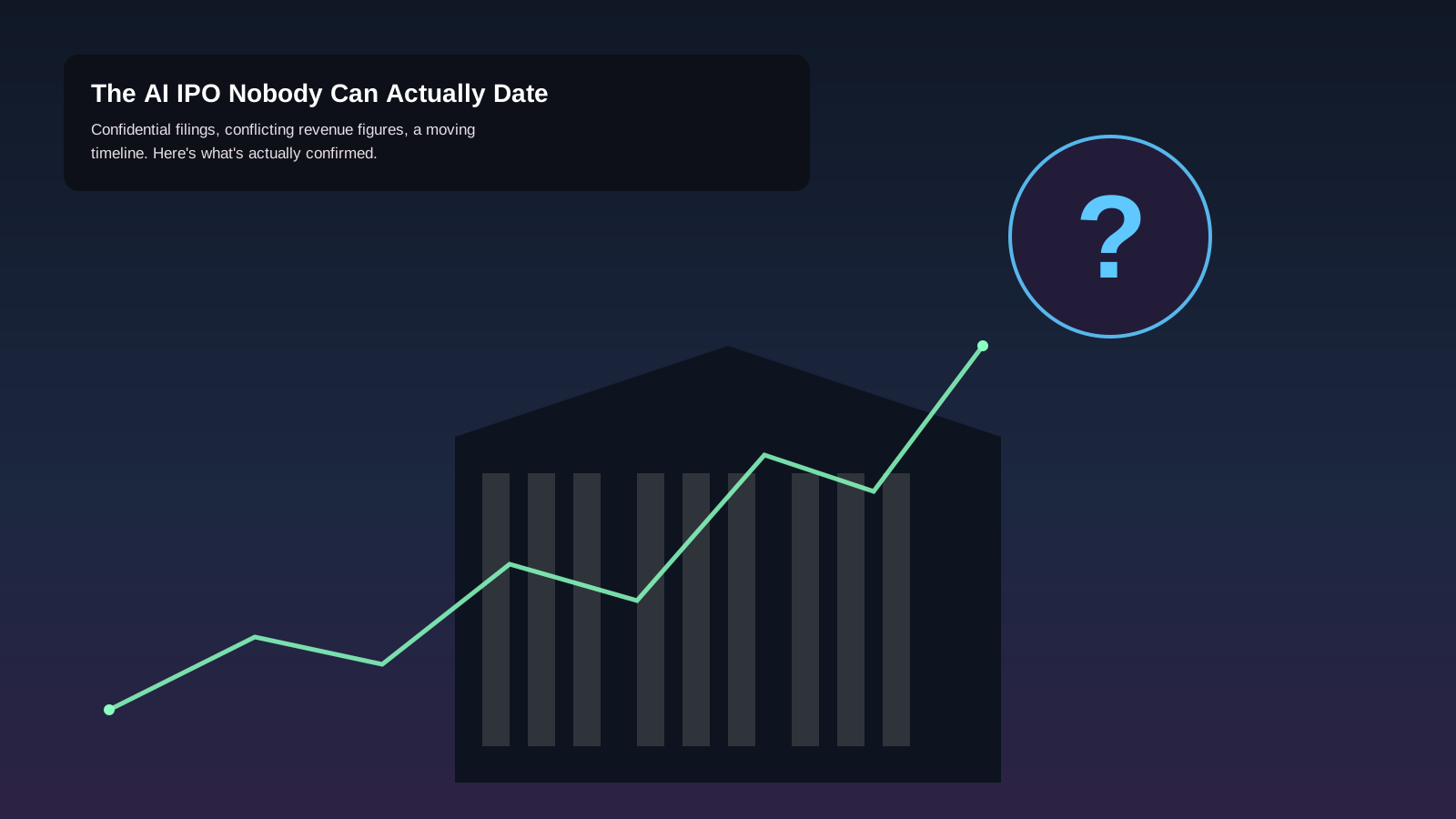
Search "OpenAI IPO" this week and you'll get a genuinely confusing pile of headlines — some say a public listing is imminent, others say it's been pushed to 2027, some cite a $40 billion revenue run-rate, others put it closer to $13 billion in booked revenue against a $20 billion-plus loss. The honest answer to "when is OpenAI going public and how big is it really" is: less is confirmed than the coverage volume suggests. Here's what actually is.
The story in 60 seconds
- OpenAI filed a confidential draft S-1 with the SEC on June 8, 2026 — no ticker, exchange, or date has been announced.
- The company is valued at $852 billion after a $122 billion round closed in March 2026.
- OpenAI completed its shift to a Public Benefit Corporation on October 28, 2025, with its founding nonprofit retaining control — a well-documented structural fact, unrelated to IPO timing.
- OpenAI itself says it has not decided when, or definitively whether soon, it will list.
- Revenue figures and listing-timing claims vary widely by source — we're flagging that spread rather than picking one number and presenting it as settled.
AI SummaryAI-generated summary, reviewed by editors
Every week brings another headline about when OpenAI will go public, at what valuation, and whether Anthropic will beat it there. Most of those headlines are built on the same handful of confirmed facts, stretched over a lot of guessing. Here's the sorted version: what OpenAI has actually confirmed, and what's still ju
Switch to Shorts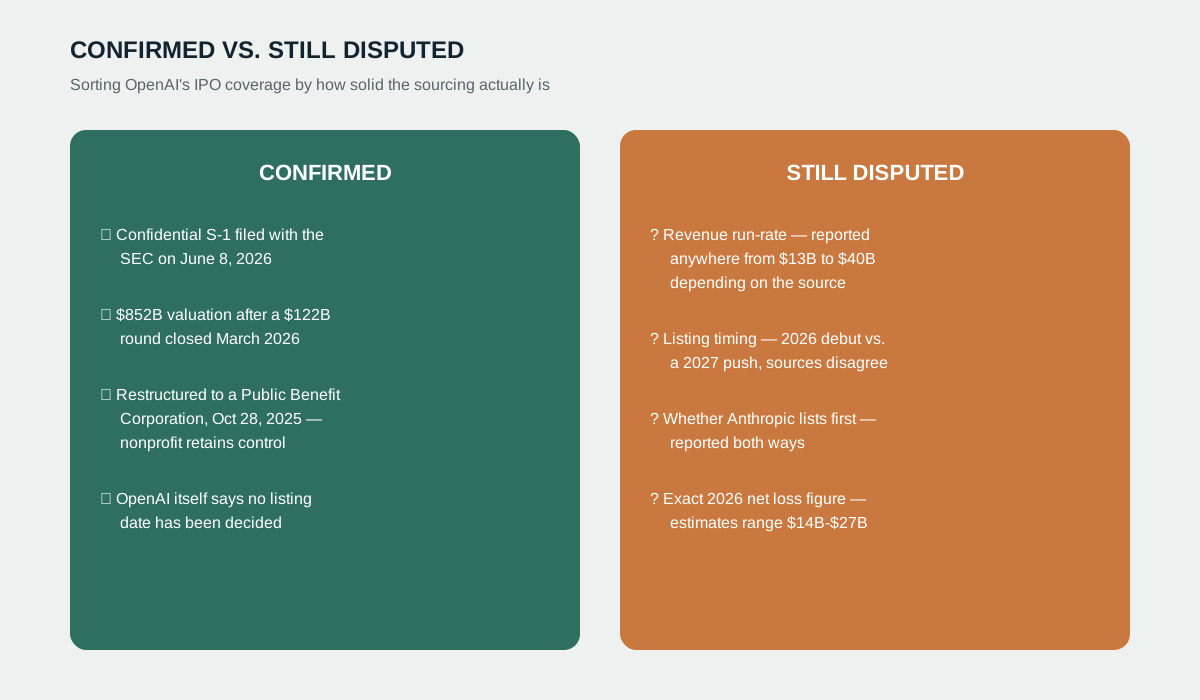
What's actually nailed down
Start with the part that isn't in dispute. OpenAI filed a confidential draft registration statement — an S-1 — with the US Securities and Exchange Commission on June 8, 2026. "Confidential" is the operative word: this isn't the public prospectus that eventually lands on SEC EDGAR before a real listing; it's a preparatory filing that lets a company get SEC feedback privately before committing to anything. No ticker symbol, no exchange, no date has been attached to it.
The valuation is solid too: $852 billion, set by a $122 billion equity round that closed in March 2026 — at the time, the largest private valuation of any AI company. And the corporate-structure question that a lot of "will OpenAI actually go public" confusion stems from was settled well before any of this: OpenAI completed its conversion to a Public Benefit Corporation on October 28, 2025. Under that structure, the original nonprofit — OpenAI Foundation — retains control of the newly formed for-profit entity, OpenAI Group PBC. A PBC is legally required to weigh its stated mission and broader stakeholder interests alongside shareholder returns, not just maximize profit. That's the actual answer to "does OpenAI going public mean it stops being a mission-driven company" — no, at least not by the letter of the structure it chose.
Where the coverage actually disagrees
This is the part most single-article coverage glosses over. Ask what OpenAI's revenue run-rate actually is right now, and you'll get meaningfully different answers depending which outlet you're reading: some report a run-rate approaching $40 billion, others put it closer to $25 billion, and a separately cited figure puts 2025's actual booked revenue at $13.07 billion against a $20.92 billion operating loss for that year. These aren't the same measurement described three ways — they look like run-rate projections, trailing booked revenue, and leaked internal forecasts all getting flattened into "OpenAI's revenue" without anyone specifying which one they mean.
Timing is just as unsettled. Earlier 2026 reporting had OpenAI targeting a Q4 2026 debut, with a public S-1 expected imminently. More recent reporting says the company has pushed its plans to 2027, and that Anthropic — OpenAI's closest rival — is now expected to list first, reportedly as early as October 2026, on the back of a $965 billion valuation and a $47 billion annualized revenue run-rate that would put it ahead of OpenAI on both counts if accurate. Whether that's really the order things will happen in is, again, not something anyone outside these companies can currently verify — it's sourced to unnamed people "familiar with the matter" on both sides.
Why the confusion, specifically
None of this is unusual for a company still in the confidential-filing stage — it's actually the normal state of pre-IPO coverage for any large private company, AI or not. A confidential S-1 exists precisely so a company can negotiate the terms of its eventual public debut without every number being locked to a public document yet. Until an actual public prospectus lands on EDGAR, every revenue figure, timeline and "beats rival to market" claim in circulation is sourced to leaks, projections and people close to the deal — useful directional signal, not verified fact. That's not a knock on any single outlet; it's the structural reality of covering a company that has explicitly declined to commit to a number or a date.
Claim versus evidence
- Confirmed fact: A confidential draft S-1 was filed with the SEC on June 8, 2026. No ticker, exchange or date has been announced.
- Confirmed fact: OpenAI is valued at $852B following a $122B round that closed in March 2026.
- Confirmed fact: OpenAI completed its restructuring into a Public Benefit Corporation on October 28, 2025, with the nonprofit retaining control.
- Official claim: OpenAI itself states it has not decided on a listing timeline.
- Disputed/unverified: Exact revenue run-rate (reported between $13B and $40B depending on source and metric used), exact listing year (2026 vs. 2027), and whether Anthropic will list first — all sourced to unnamed people familiar with the matter, not company disclosures.
Frequently asked questions
So when is OpenAI actually going public?
Nobody outside the company has confirmed this, and OpenAI itself says it hasn't decided. Treat any specific date or quarter you see reported as an estimate, not a fact, until a public S-1 actually appears on SEC EDGAR.
Does OpenAI's nonprofit background disappear once it lists?
No — as of its October 2025 restructuring, the OpenAI Foundation nonprofit retains control of the for-profit OpenAI Group PBC, and a Public Benefit Corporation is legally obligated to weigh its mission alongside shareholder interests. Going public wouldn't automatically change that structure.
Will Anthropic really go public before OpenAI?
That's currently reported, not confirmed — both companies have filed confidentially, and only an actual public listing will settle which one lists first.
Why do revenue figures for OpenAI vary so much between articles?
Different reports appear to mix run-rate projections, trailing booked revenue and leaked internal forecasts without always specifying which measurement they're citing — worth checking which one a headline is actually using before treating a number as comparable to another article's.
The bottom line
Strip out the speculation and OpenAI's actual, confirmed IPO story is fairly narrow: a confidential filing exists, the company is worth $852 billion on paper, and its nonprofit-controlled structure survives however this eventually plays out. Everything more specific than that — the exact revenue number, the exact quarter, who lists first — is currently a guess dressed up as reporting. That's worth knowing not because the guesses are necessarily wrong, but because treating them as settled fact is exactly how a "OpenAI IPO date" headline ends up needing a correction six weeks later.
Sources
- Evolving OpenAI's structure — OpenAI, official statement
- OpenAI IPO: S-1 Status, Valuation, Timeline, and Risks — TECHi
- OpenAI Vs Anthropic IPO: How They Compare And What We Know — Forbes
- OpenAI: $25B a Year, $14B Loss — Inside the Math (2026) — Value Add VC
Full forms
- SEC — Securities and Exchange Commission
- S-1 — the standard SEC registration form used to prepare for a US public listing
- PBC — Public Benefit Corporation
- ARR — Annual Recurring Revenue
HeadlineDecoded is committed to accuracy and transparency. Read our standards or submit a correction.