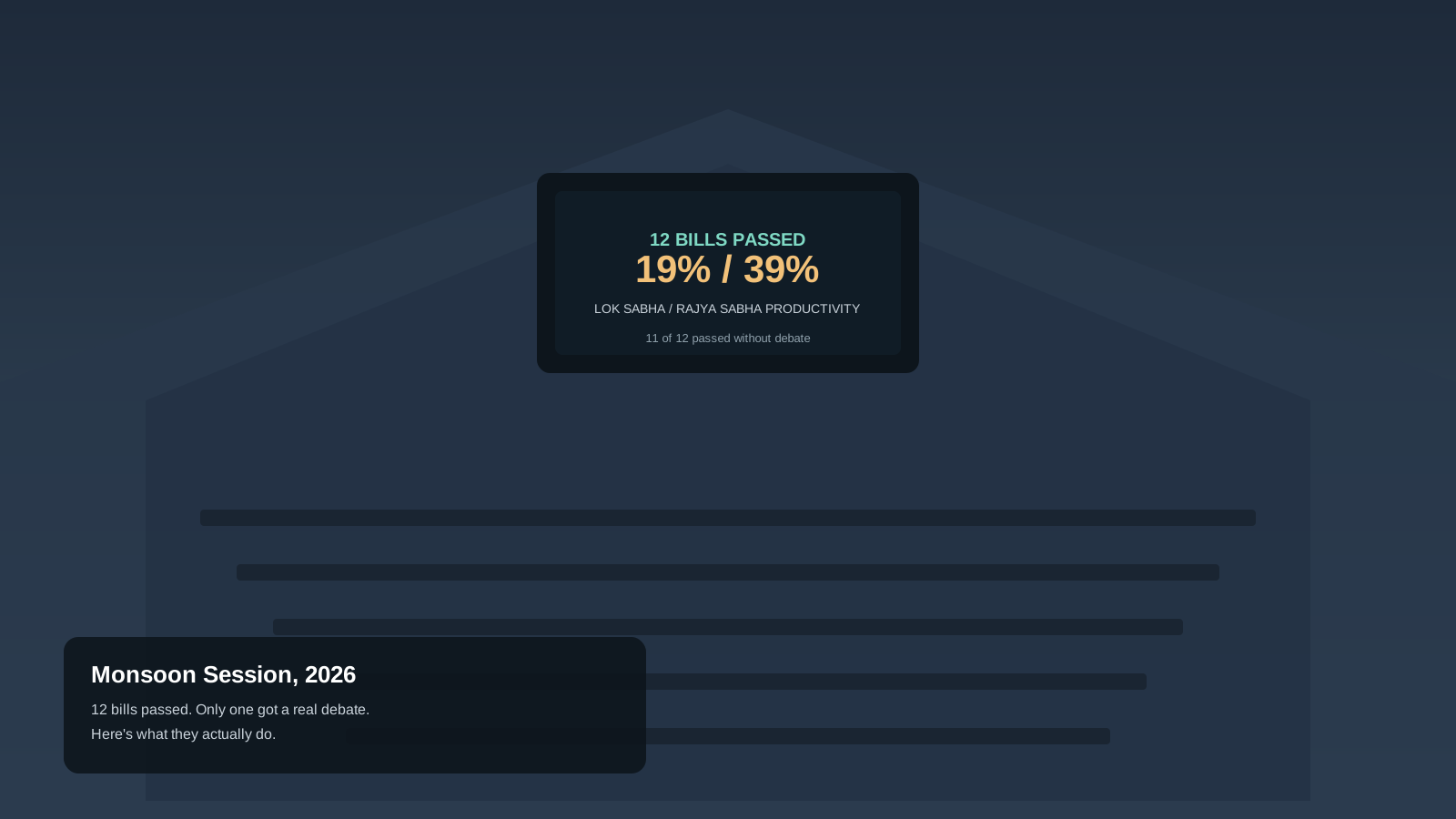
Parliament's Monsoon Session adjourned sine die on 13 August 2026, and the headline most outlets ran with was the productivity number: 19% in the Lok Sabha, the kind of figure that makes for an easy scandal-of-the-week story. That's a real problem, but it buries the more useful question — what did the 12 bills that did pass actually change? Eleven of them went through on a voice vote with no debate at all. Only one, on exam paper leaks, got a real hearing, and even that happened against a backdrop of the exact protests the bill was supposedly responding to. Here's what actually got written into law, stripped of the productivity-percentage headline.
The story in 60 seconds
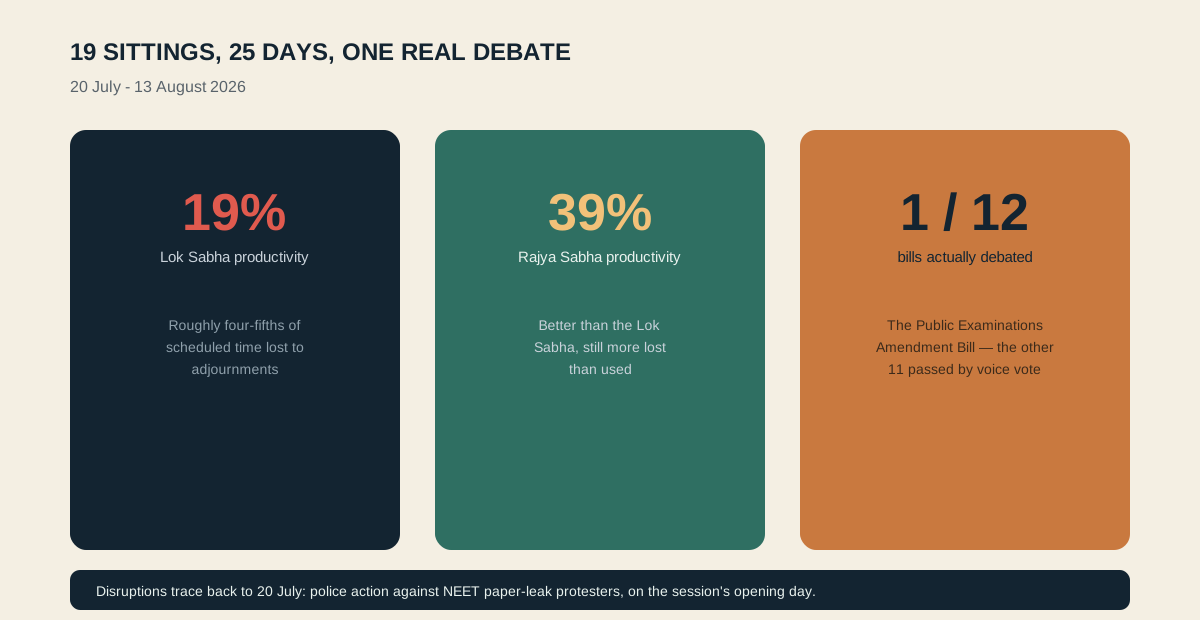
- The Monsoon Session ran from 20 July to 13 August 2026 — 19 sittings over 25 days — and adjourned with Lok Sabha productivity at 19% and Rajya Sabha at 39%, among the lowest in recent sessions.
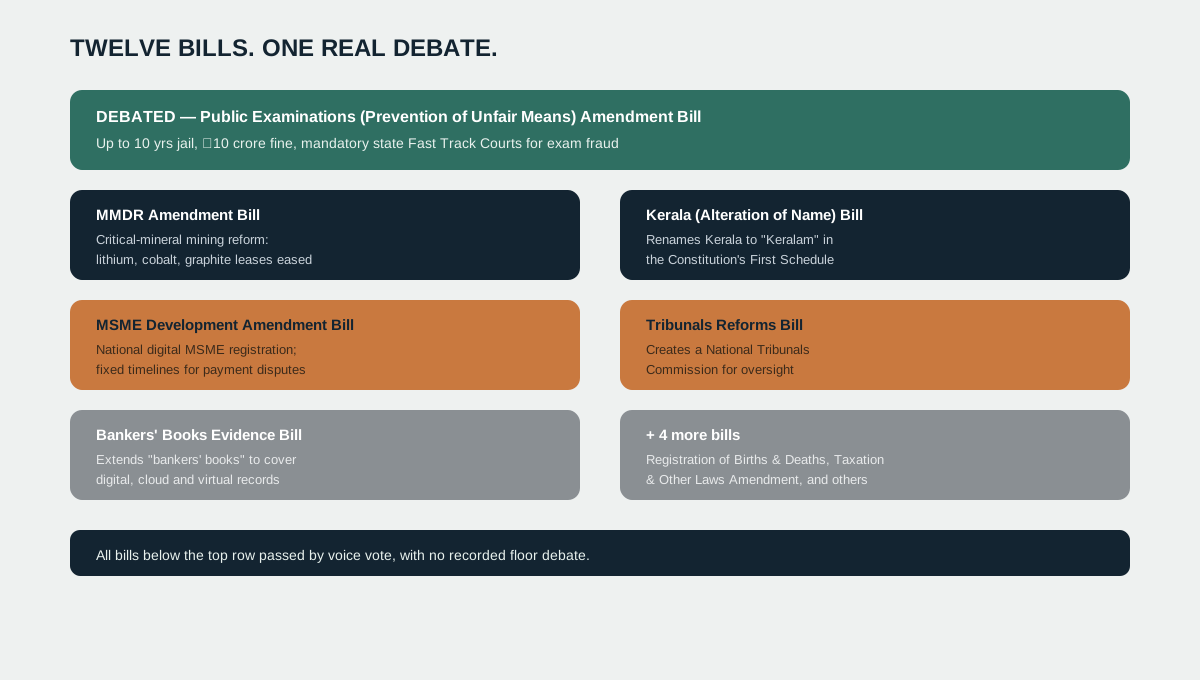
- 12 bills were passed by both Houses. 11 of them passed by voice vote with no debate; only the Public Examinations (Prevention of Unfair Means) Amendment Bill, 2026 received a substantive discussion.
- Disruptions traced back to the session's opening day, 20 July, when police action against students protesting the NEET paper-leak scandal triggered walkouts and repeated adjournments that persisted through much of the session.
- The Public Examinations Amendment Bill raises penalties for exam malpractice to up to 10 years' imprisonment and a ₹10 crore fine, and mandates Fast Track Courts in every state for exam-fraud cases.
- The MMDR Amendment Bill overhauls rules for critical mineral mining — including lithium, cobalt and graphite — letting existing mine leases add these minerals without extra payment beyond standard royalties.
- The Kerala (Alteration of Name) Bill, renaming the state "Keralam" in the Constitution, also cleared both Houses — a years-long request from the state finally getting through Parliament.
AI SummaryAI-generated summary, reviewed by editors
Parliament's Monsoon Session ended the way it began: in disruption. Nineteen percent productivity in the Lok Sabha, eleven of twelve bills passed without a single word of debate, and a new law tightening penalties for exam paper leaks that barely got discussed despite being the reason students were protesting outside i
Switch to ShortsThe number that says it all: 19%
Parliamentary "productivity" is measured as the share of scheduled sitting time actually spent on legislative business rather than lost to adjournments and disruption. A figure of 19% in the Lok Sabha means roughly four-fifths of the chamber's scheduled time this session produced nothing at all — no debate, no votes, no committee business, just adjournment after adjournment. The Rajya Sabha managed 39%, better but still a session where more time was lost than used. The proximate cause traces back to the very first sitting, 20 July, when police action against students protesting the NEET UG 2026 paper-leak scandal set off walkouts that recurred through much of the following 25 days.
That backdrop matters for what comes next, because it means the one bill that actually got debated — the exam-integrity law — passed in a chamber where the underlying anger that triggered the session's chaos was never really resolved, just legislated around.
The exam-integrity law: what actually changes
The Public Examinations (Prevention of Unfair Means) Amendment Bill, 2026 is the session's one substantively debated bill, and it's a direct legislative response to the year's NEET paper-leak fallout that HeadlineDecoded has tracked extensively. It amends the original 2024 Act with real teeth: penalties now go up to 10 years' imprisonment and a ₹10 crore fine, with convicted offenders' property subject to seizure. Debarment periods for service providers caught facilitating unfair means double, from four years to eight. The bill also creates a central special task force empowered to investigate exam-fraud cases, with a hard two-month deadline for completing investigations, and requires every state and Union Territory to set up dedicated Fast Track Courts to try these cases rather than letting them sit in the general court backlog. On paper, it's the most concrete legislative response yet to the pattern of leaks, scam PDFs and Telegram-sold papers this site has covered through the NEET 2026 cycle. Whether it's enforced with the same urgency it was written with is, as always with laws like this, a separate question.
The mining bill nobody's talking about
Buried under the exam-bill headlines, the MMDR (Mines and Minerals Development and Regulation) Amendment Bill, 2026 quietly reshapes how India mines the minerals its electronics and clean-energy manufacturing push actually needs. Existing mining leaseholders can now add critical and strategic minerals — lithium, graphite, nickel, cobalt, gold and silver among them — to their existing leases without paying anything extra beyond the standard royalty (and, for auctioned mines, the usual auction premium). The bill also scraps the previous cap on how much mineral output captive mines can sell on the open market, and for "deep-seated" minerals found more than 200 metres underground, it allows a one-time extension of the leased mining area — up to 30% more area under a composite licence, 10% more under a standard mining lease. It also sets up a formal authority to register and regulate mineral exchanges, effectively creating an electronic trading marketplace for minerals and metals that didn't exist before. For India's stated ambition to reduce dependence on imported critical minerals — the same ambition behind NITI Aayog's recent manufacturing-sector push — this is the unglamorous legislative plumbing that ambition actually runs on.
Quick hits: the other bills that passed without debate
- Kerala (Alteration of Name) Bill, 2026: Renames the state of Kerala to "Keralam" in the Constitution's First Schedule, honouring a Kerala Legislative Assembly resolution first passed back in June 2024. Central and state governments get up to a year to update existing laws and references to reflect the new name.
- MSME Development (Amendment) Bill, 2026: Creates a national digital platform for free MSME registration and sets firm timelines to resolve delayed-payment disputes — 90 days for mediation, 30 days to refer a failed mediation to arbitration, and 90 days for an arbitral award once pleadings close.
- Tribunals Reforms Bill: Establishes a National Tribunals Commission aimed at improving the independence, transparency and day-to-day efficiency of India's tribunal system.
- Bankers' Books Evidence Bill: Modernises what counts as admissible "bankers' books" evidence in court, explicitly extending the definition to electronic, digital, virtual and cloud-based banking records.
- Registration of Births and Deaths (Amendment) Bill and Taxation and Other Laws (Amendment) Bill: Both cleared the session alongside the rest, though — like nine of the twelve bills passed this session — without any recorded floor debate to draw specifics from beyond their passage itself.
Claim versus evidence
- Confirmed: The Monsoon Session ran 20 July-13 August 2026 (19 sittings, 25 days), closing at 19% Lok Sabha and 39% Rajya Sabha productivity, with 12 bills passed by both Houses.
- Confirmed: Only the Public Examinations (Prevention of Unfair Means) Amendment Bill, 2026 received substantive floor debate; the other 11 bills passed by voice vote without discussion.
- Confirmed: Disruptions began 20 July over police action against NEET paper-leak protesters and recurred through much of the session.
- Confirmed: The Public Examinations Amendment Bill's penalty and Fast Track Court provisions, and the MMDR Amendment Bill's critical-mineral and mineral-exchange provisions, are as described in official press releases and bill-tracking summaries (PIB, PRS India).
- Our analysis: Framing this session purely around its productivity percentage undersells what did pass. Several of these 12 bills carry real, specific consequences for exam-fraud enforcement, critical-mineral mining and MSME dispute resolution — consequences that got no public airing in the chamber where they were passed.
Frequently asked questions
Why was this session's productivity so low?
Lok Sabha productivity measures the share of scheduled sitting time actually used for legislative business. At 19%, roughly four-fifths of this session's scheduled time was lost to adjournments and disruption, largely stemming from protests over police action against NEET paper-leak protesters on the session's opening day.
Does the new exam-fraud law apply to the NEET UG 2026 leak case already under investigation?
The Public Examinations (Prevention of Unfair Means) Amendment Bill amends the framework going forward; whether and how its enhanced penalties apply to cases already under CBI investigation is a legal question this explainer does not resolve — check with the ongoing case's own proceedings for that specifics.
Does the MMDR Amendment Bill mean mining companies pay less overall?
It removes the extra payment previously required to add critical minerals to an existing lease, beyond the standard royalty (and auction premium, where applicable) — a reduction in that specific cost, not a blanket cut to mining costs generally.
When does Kerala officially become "Keralam"?
The bill has passed both Houses of Parliament; it still requires presidential assent to become law, after which central and state governments have up to a year to update existing legal references to the new name.
The bottom line
A 19% productivity score is a legitimate story about how Parliament functioned this session. But reducing the entire session to that one number misses that Delhi still legislated real, specific changes into law — tougher exam-fraud penalties born directly out of the protests disrupting the session, a quiet overhaul of how India mines the minerals its manufacturing ambitions depend on, and a state finally getting the name change it asked for two years ago. None of it got a real hearing on the floor. That doesn't mean it doesn't matter — it means nobody explained it to the public before it became law, which is exactly the gap this piece is trying to close.
Sources
- Parliament Monsoon Session ends with 12 Bills passed amid disruptions — Business Standard
- 19 Sittings, 12 Bills, Little Debate: Inside Parliament's Disrupted Monsoon Session — Outlook India
- Rajya Sabha Passes Public Examinations (Prevention of Unfair Means) Amendment Bill, 2026 — Press Information Bureau
- Lok Sabha passes MMDR Amendment bill to boost critical mineral exploration, mining flexibility — ANI
- The Kerala (Alteration of Name) Bill, 2026 — PRS Legislative Research
Full forms
- MMDR — Mines and Minerals (Development and Regulation)
- MSME — Micro, Small and Medium Enterprises
- NEET — National Eligibility cum Entrance Test
- PRS — PRS Legislative Research
HeadlineDecoded is committed to accuracy and transparency. Read our standards or submit a correction.