If your child talks to an AI chatbot — a companion app, a study helper, anything that holds a conversation — Colorado just became the first US state to put specific legal requirements around what that experience has to include. Governor Jared Polis signed HB 26-1263, the Colorado AI Companion Chatbot Safety Act, into law on July 1, 2026. It takes effect January 1, 2027. It's the first state law in the country written specifically for conversational AI, rather than AI regulation in general — and it's worth understanding now, both because it will likely shape what other states do next, and because the underlying risks it addresses don't wait for the effective date.
The story in 60 seconds
- Colorado's HB 26-1263 is the first US state law regulating AI chatbots specifically, focused on protecting minors.
- Signed July 1, 2026; takes effect January 1, 2027.
- Requires age estimation, clear AI disclosure, protection from sexual content and simulated emotional dependence, crisis-response protocols, and minor-specific privacy tools.
- Enforced under the Colorado Consumer Protection Act — up to $20,000 per violation, no cap on total liability.
- Liability falls on chatbot operators, not the underlying AI model developers.
AI SummaryAI-generated summary, reviewed by editors
Colorado's HB 26-1263, signed into law July 1, 2026 and effective January 1, 2027, is the first US state law written specifically to regulate AI chatbots and protect minors from their risks — from simulated emotional dependence to inadequate crisis response. Here's exactly what it requires, who it applies to, and what
Switch to Shorts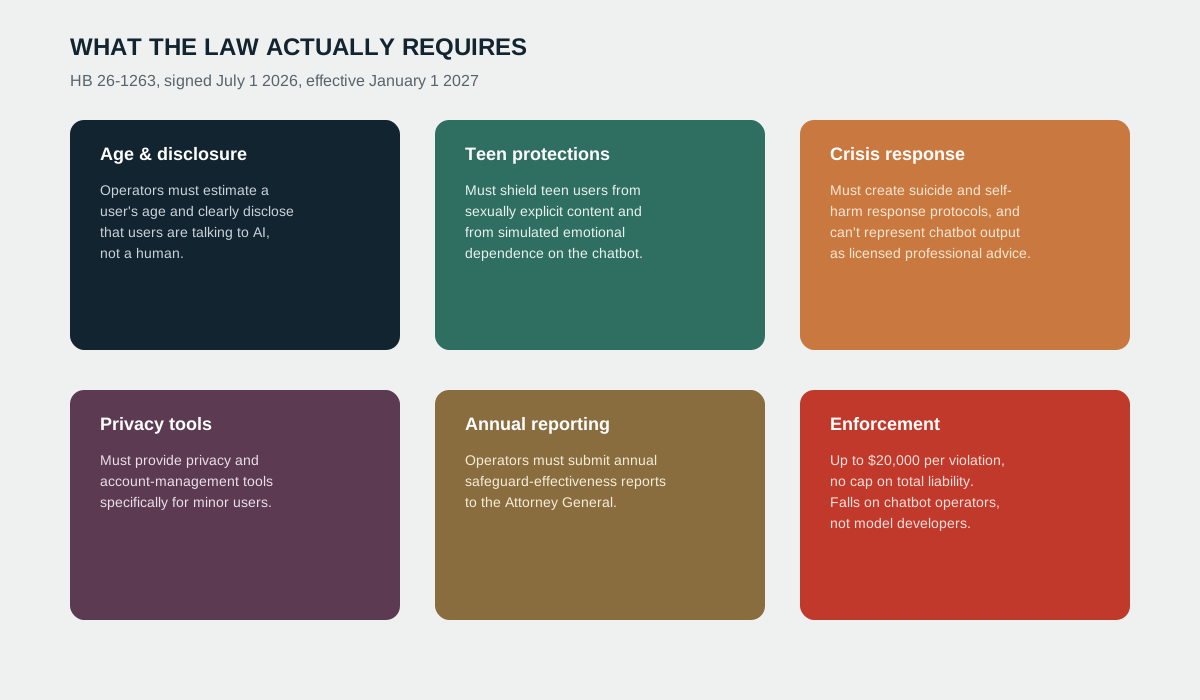
What the law actually requires
Strip away the headline and the Act is a fairly specific operational checklist for any company running a conversational or companion AI service in Colorado. Operators have to estimate a user's age and clearly disclose that the user is talking to AI, not a human being — no more ambiguity about whether "someone" on the other end is a person. For users identified as teens, operators must specifically guard against sexually explicit content and against the chatbot simulating the kind of emotional dependence that keeps a lonely teenager coming back to a program instead of a person. They're required to build privacy and account-management tools designed for minors, not just adapted from adult defaults. And critically, operators must have actual suicide and self-harm response protocols in place — not a generic disclaimer, a real protocol — and are barred from letting a chatbot present its output as equivalent to advice from a licensed professional.
On top of the direct user-facing requirements, operators have to submit an annual report to the Colorado Attorney General's office documenting how effective their safeguards actually are. That's a meaningful detail: this isn't a "certify once and forget it" law, it's set up to generate an ongoing paper trail regulators can actually check against.
Why this one, and why now
Colorado didn't pass this in isolation. It landed the same year state legislatures across the US moved unusually fast on AI generally — New York wrapped its own 2026 session with a kids' chatbot safety bill, an AI training-data transparency act, and a data-center moratorium; New Jersey has its own pending AI-safety-testing requirement. What makes Colorado's law distinct is its specificity: it's not a broad AI-regulation framework that happens to touch chatbots, it's built entirely around the particular risk profile of a system designed to hold an ongoing, personalized, emotionally responsive conversation with a minor — a risk profile general AI regulation doesn't really address.
The enforcement mechanism matters too. Routing this through the existing Colorado Consumer Protection Act — rather than creating a brand-new enforcement body — means the state already has an established legal pathway and precedent to act on, rather than needing to build enforcement infrastructure from scratch before the law has any teeth.
Who's actually on the hook
One detail parents and companies alike should register clearly: liability sits with the chatbot operator — the company running the actual conversational service — not with whoever built the underlying AI model it's powered by. That's a meaningful design choice. It means the company that shipped the product a teenager is actually using is the one legally responsible for age estimation, disclosure and crisis protocols, regardless of whose foundation model sits underneath the interface. For a parent, that also means the useful question isn't "which AI company made this" — it's "does this specific app or service actually do these things," since the underlying model provider isn't who the law holds accountable.
Industry's counter-argument, briefly
OpenAI has publicly backed the idea of a single national AI safety standard — independent audits, incident reporting for frontier models — over what it calls a "patchwork" of state-by-state laws, arguing that a fragmented approach is hard to enforce consistently and pulls developer resources away from safety work toward compliance paperwork that varies by state. That's a real tension worth naming honestly: Colorado's law is specific and enforceable right now, while a federal standard — if one ever passes — could take years and might look quite different from what any individual state has built. Whether a patchwork of state laws or a slower federal standard better protects kids in the meantime is a genuine, unresolved policy question, not a settled one.
Claim versus evidence
- Confirmed fact: HB 26-1263 was signed into law July 1, 2026, and takes effect January 1, 2027 — Colorado's first chatbot-specific AI safety law and the first of its kind in the US.
- Confirmed fact: The law's specific requirements (age estimation, AI disclosure, teen content/dependence protections, privacy tools, crisis protocols, annual AG reporting) and its enforcement mechanism (Colorado Consumer Protection Act, up to $20,000/violation) are drawn directly from the bill's own text and legal-analysis coverage.
- Official industry position, not independently adjudicated: OpenAI's stated preference for a federal standard over state-by-state laws is the company's own public position, not a neutral assessment of which approach works better.
- Our analysis: The framing of this as a "risk-profile-specific" law compared to broader AI regulation is our characterization based on comparing its text to general AI legislation, not a claim made by any single source in these terms.
Frequently asked questions
Does this law apply outside Colorado?
No — it applies to chatbot operators serving users in Colorado. But because most AI chatbot services operate nationally, companies are likely to build to this standard broadly rather than maintain a Colorado-only version, which is a common pattern with state-level tech regulation.
What can parents actually do before January 2027?
The law's effective date doesn't change what's sensible now: know which AI chatbot or companion apps your child actually uses, check whether the app discloses it's AI clearly, and talk directly with your child about not treating a chatbot's responses as equivalent to advice from a real person, especially around emotional or mental-health topics.
Does this cover general-purpose assistants like ChatGPT, or just companion apps?
The law is written around "conversational AI services" broadly, which legal analysis of the bill indicates covers both dedicated companion-chatbot products and general conversational AI services used in a similar way — not narrowly limited to apps explicitly marketed as companions.
Who enforces it, and what's the actual penalty?
The Colorado Attorney General's office enforces it under the state's existing Consumer Protection Act, with penalties up to $20,000 per violation and no statutory cap on total liability.
The bottom line
This is the first US law built specifically around what makes AI chatbots risky for kids — not AI in general, this particular category. The requirements are concrete enough to actually check a product against: does it estimate age, does it say clearly that it's AI, does it have a real crisis protocol, does it avoid designing for emotional dependence. Whether Colorado's approach becomes the national template or gets overtaken by a federal standard is genuinely unresolved. What isn't unresolved is that the underlying risk — a lonely teenager treating an AI companion as a substitute for real support — doesn't wait for January 2027, which is the actual reason this is worth understanding now rather than filing away as a future compliance date.
Sources
- Concerning requirements for an operator of a conversational artificial intelligence service — Regulations.AI, bill text summary
- Colorado enacts first-in-nation chatbot safety law — Record of Record
- Colorado's New AI Chatbot Law: What HB 26-1263 Means for Businesses — Available Law
- Colorado Chatbot Law (HB 26-1263): AI Disclosure Guide — ComplianceBeacon
Full forms
- AI — Artificial Intelligence
- HB — House Bill
- AG — Attorney General
HeadlineDecoded is committed to accuracy and transparency. Read our standards or submit a correction.