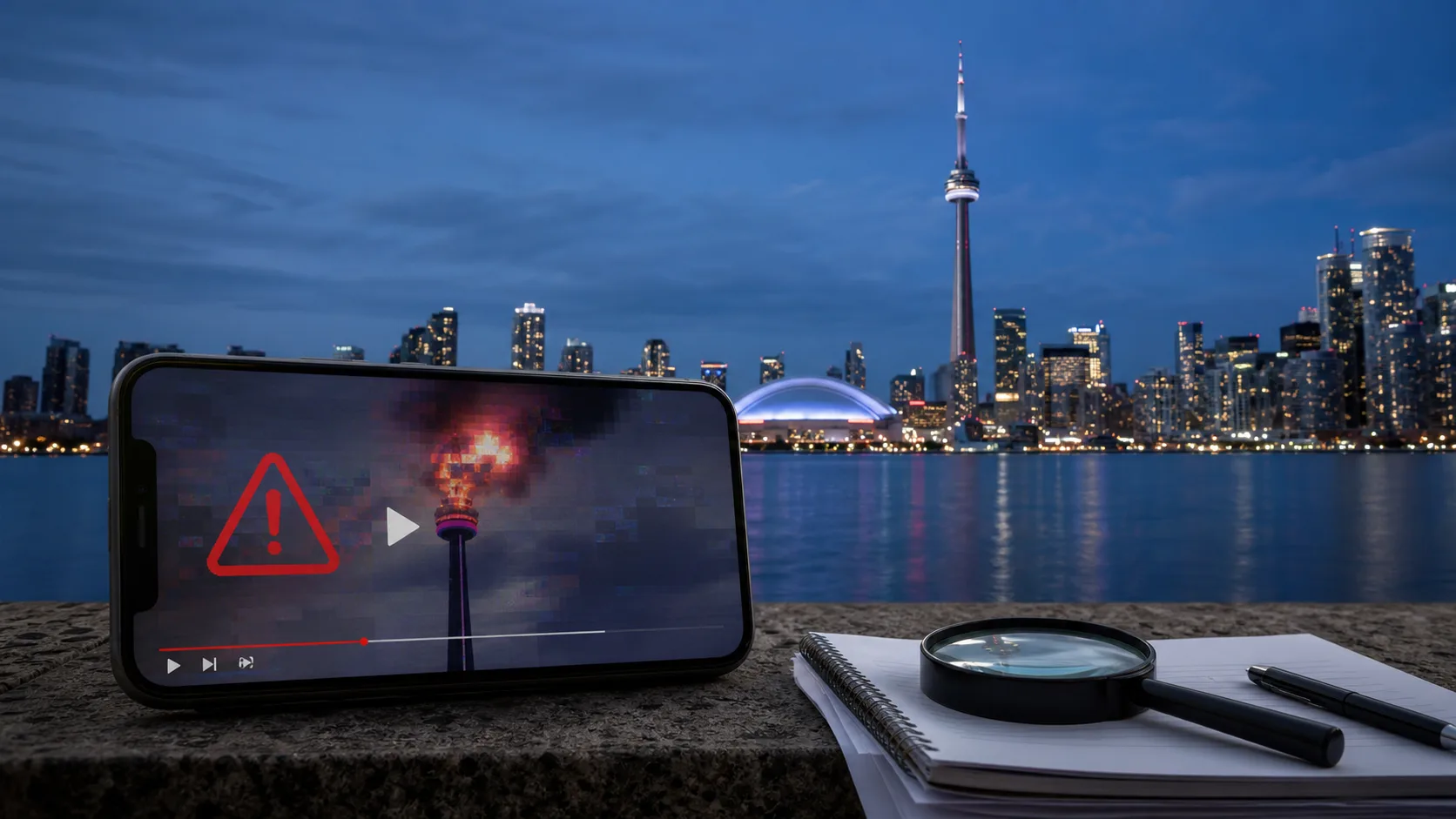
The claim: a video circulating on Facebook shows Toronto's CN Tower engulfed in flames. The verdict: false. The CN Tower said the clip was “a deepfake and entirely fictional”, and its official live-views page shows the landmark's normal camera feeds. The video was not evidence of a real emergency.
The story in 60 seconds
- The Canadian Press reported that the Facebook video had reached about 12 million views and had been shared more than 8,000 times when it was checked.
- The CN Tower's spokesperson said there was no fire and the tower remained safe, secure and fully operational.
- The creator's public page carried a history of similar landmark-fire videos, including the Golden Gate Bridge and Hollywood sign.
- The clip shows common synthetic-media clues: smoke moving against normal physics, missing fine detail such as licence plates and an over-polished visual texture.
- The safest conclusion is not “AI detection is perfect”; it is that the official denial, live camera and independent source tracing all contradict the fire claim.
AI SummaryAI-generated summary, reviewed by editors
The CN Tower called the viral Facebook clip fictional. Its official live views, an archived source and independent reporting show why the fire claim is false.
Switch to ShortsWhat the original source shows
The earliest accessible copy linked by the Canadian Press is an archived Facebook Reel. We do not download or republish the video. We preserve the source link for verification and describe only what the reporting documents: a distant waterfront view, a street-level burning-tower sequence and an aerial shot presented as a disaster scene.
The post's reach is also time-sensitive. The Canadian Press recorded roughly 12 million views at publication, while later reposts can display different counts. A view total is therefore a snapshot, not a permanent measurement of the rumour's audience.
Open the archived source video (external archive; availability may change).
How the claim was checked
- Check the institution: the CN Tower's own statement directly rejects the fire claim.
- Check a live view: the tower's official live-views page provides East and West views and identifies the camera service.
- Check independent reporting: The Canadian Press documented the statement, the source page's pattern and the video's distribution.
- Inspect the frames: downward-drifting smoke, unstable textures and missing small details are useful warning signs, but visual clues alone should not be treated as laboratory proof.
Why the AI clues matter — and their limits
Smoke normally follows heat and wind; in the clip it appears to move in ways that do not match the surrounding scene. Cars and street details lack the crisp, consistent plates and signage expected in a real, close-up recording. The fire has a smooth, glossy appearance that resembles synthetic rendering. These clues support the AI assessment reported by The Canadian Press, but they are not a substitute for primary confirmation.
AI-video detection tools can produce false positives and false negatives. The stronger method is triangulation: compare the claim with the institution responsible for the landmark, a live or time-stamped view, reputable reporting and the original account's history.
This fits a wider landmark-hoax pattern
The creator's page had posted similar “landmark on fire” scenes. That pattern matters because a recognisable building supplies instant context while the clip is short enough to outrun verification. Similar fake Hollywood-sign fire visuals have also been documented by fact-checkers. A familiar landmark is not proof that a dramatic video is authentic.
Claim versus evidence
- False: The CN Tower was burning. The tower's spokesperson said there was no fire, and the official live views contradict the claim.
- Documented: The video spread widely on Facebook; the last independently reported count we use is about 12 million views and 8,000 shares at the time of The Canadian Press report.
- Supported: The source page had a history of similar AI-assisted landmark-fire videos.
- Not claimed: We do not identify the creator's software or infer a precise model from visual appearance alone.
What readers should do before sharing an emergency video
Pause before reposting. Search the landmark's official account or website, look for a live camera or emergency notice, compare the upload time with local reporting, and open the original post instead of relying on a screenshot. If the claim could trigger panic, travel changes or donations, wait for corroboration.
For related guidance, read our fact check on a deepfake investment video, our analysis of a disaster-misinformation wave and our AI science explainer.
Bottom line
The CN Tower fire video is fake. The conclusion rests on the tower's direct denial, its official live views, the archived source and the clip's documented synthetic-media clues. The broader lesson is practical: treat dramatic video as a claim to check, not as proof that an emergency happened.
Sources
- The Canadian Press: Fact File — AI video sparks false rumour of CN Tower fire
- CN Tower official live views
- Archived Facebook Reel source
- Snopes: fake Hollywood-sign fire visuals
Full forms
- AI — Artificial Intelligence
- CBC — Canadian Broadcasting Corporation
HeadlineDecoded is committed to accuracy and transparency. Read our standards or submit a correction.