AI SummaryAI-generated summary, reviewed by editors
Genome language models produced viable bacteriophages that replicate in bacteria—not human-infecting viruses. The milestone is real, but so are important scientific and biosecurity caveats.
Switch to ShortsScientists have used artificial intelligence to design complete viral genomes that produced viable, self-replicating bacteriophages in laboratory tests. The result is a genuine milestone in synthetic biology—but the phrase “AI-designed viruses” needs careful context. These viruses were designed to infect bacteria, not people, and the underlying study was released as a preprint rather than a peer-reviewed paper.
What the researchers actually did
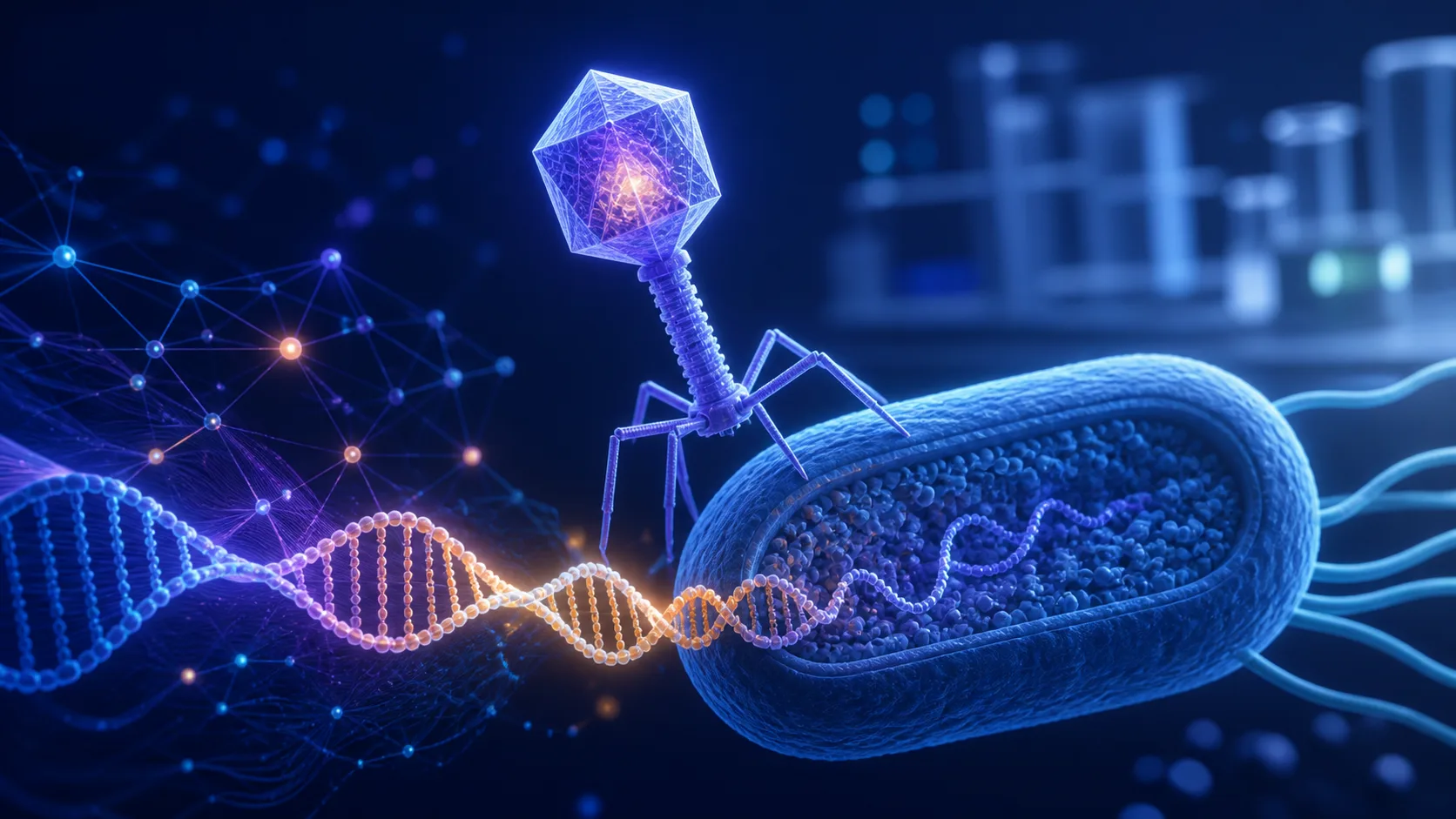
A US research team used the Evo 1 and Evo 2 genome language models to generate complete DNA sequences modelled on ΦX174, a small and extensively studied bacteriophage. Bacteriophages, often shortened to phages, are viruses whose hosts are bacteria.
The models were asked to produce genomes with plausible biological organization and a desired bacterial host range. Researchers then synthesized selected candidate genomes and tested whether they could form viable phages. According to the study, 16 generated designs were able to reproduce through bacterial hosts.
That makes the experiment different from using AI to redesign one protein or suggest a mutation. The models generated genome-scale sequences whose interacting components had to work together well enough to produce viable viral particles.
Were the viruses created “from scratch”?
Not in the everyday sense of beginning with no biological reference. The work used ΦX174 as a design template and drew on models trained to recognize patterns across genomic data. The resulting genomes contained substantial sequence differences and new combinations, but they remained within the biological neighborhood of a well-characterized phage.
A more accurate description is that AI generated novel, complete phage-genome designs under constraints established by researchers. Human scientists chose the organism, objectives, candidates, synthesis process and laboratory tests.
What “fully functional” means here
In this experiment, functionality meant that a generated genome could give rise to a viable phage and replicate using susceptible bacterial cells. It does not mean the system independently designed an organism for any environment or that every proposed sequence worked.
The 16 successful phages were the experimentally viable subset of a larger design-and-screening process. That distinction matters: generative models propose candidates, while laboratory testing determines which designs actually function.
Do they pose a threat to people?
The phages studied were designed around ΦX174 and tested against bacteria, including strains of Escherichia coli. There is no evidence in the reported work that they can infect human cells or cause human disease. Calling them “viruses” is scientifically correct, but it can misleadingly evoke human pathogens unless their bacterial host is stated immediately.
The researchers’ choice of a small, non-human-infecting phage reduced the immediate risk and made laboratory validation more practical. That does not make every possible use of genome-design AI harmless.
Why the finding matters
Phages are being investigated as tools against antibiotic-resistant bacteria, for precision microbiome engineering and for biotechnology. Models capable of proposing diverse phage genomes could eventually help researchers target bacterial strains that evade naturally occurring phages.
The work also suggests that biological language models are moving from designing isolated molecules toward coordinating many interacting genetic elements at genome scale. Stanford’s Human-Centered AI institute subsequently described the 16 phages as previously unknown viruses that kill bacteria and highlighted human verification as central to AI-assisted science.
The safety concern is about capability, not this phage experiment alone
A system that can generate viable viral genomes creates a dual-use question. The same general advances that may support phage therapy or vaccine research could, as models improve, lower barriers to designing organisms with undesirable properties.
That does not mean current models can simply produce a dangerous human pathogen on command. Designing a sequence is only one part of a complex chain involving synthesis, laboratory expertise, host compatibility, replication, transmission and disease. But the experiment strengthens the case for screening synthetic-DNA orders, evaluating biological design models before release, controlling access to higher-risk capabilities and coordinating standards internationally.
The urgent policy issue is therefore prospective: safety systems need to develop before genome-generation tools become more capable and easier to use, rather than after a harmful application appears.
What remains uncertain
- The research was posted on bioRxiv in September 2025 and had not undergone journal peer review in the version examined for this article.
- The authors describe it as the first generative design of viable bacteriophage genomes; broad “first whole genome” claims should remain attributed to the researchers.
- Success with a compact, well-studied phage does not demonstrate equivalent performance with larger or human-infecting viruses.
- Further independent replication is needed to establish how reliably the approach generalizes across different phages and bacterial hosts.
Bottom line
The central claim is supported: AI-generated complete genome designs produced 16 viable bacteriophages in laboratory testing. But the result is not evidence that AI created a human-infecting virus, nor was it an unconstrained act of autonomous biological invention. It is a significant proof of concept whose medical promise and biosecurity implications now need to be evaluated together.
Sources
- King and colleagues: Generative design of novel bacteriophages with genome language models, bioRxiv
- Nature: World’s first AI-designed viruses a step towards AI-generated life
- Stanford HAI: How AI is transforming scientific discovery
HeadlineDecoded is committed to accuracy and transparency. Read our standards or submit a correction.