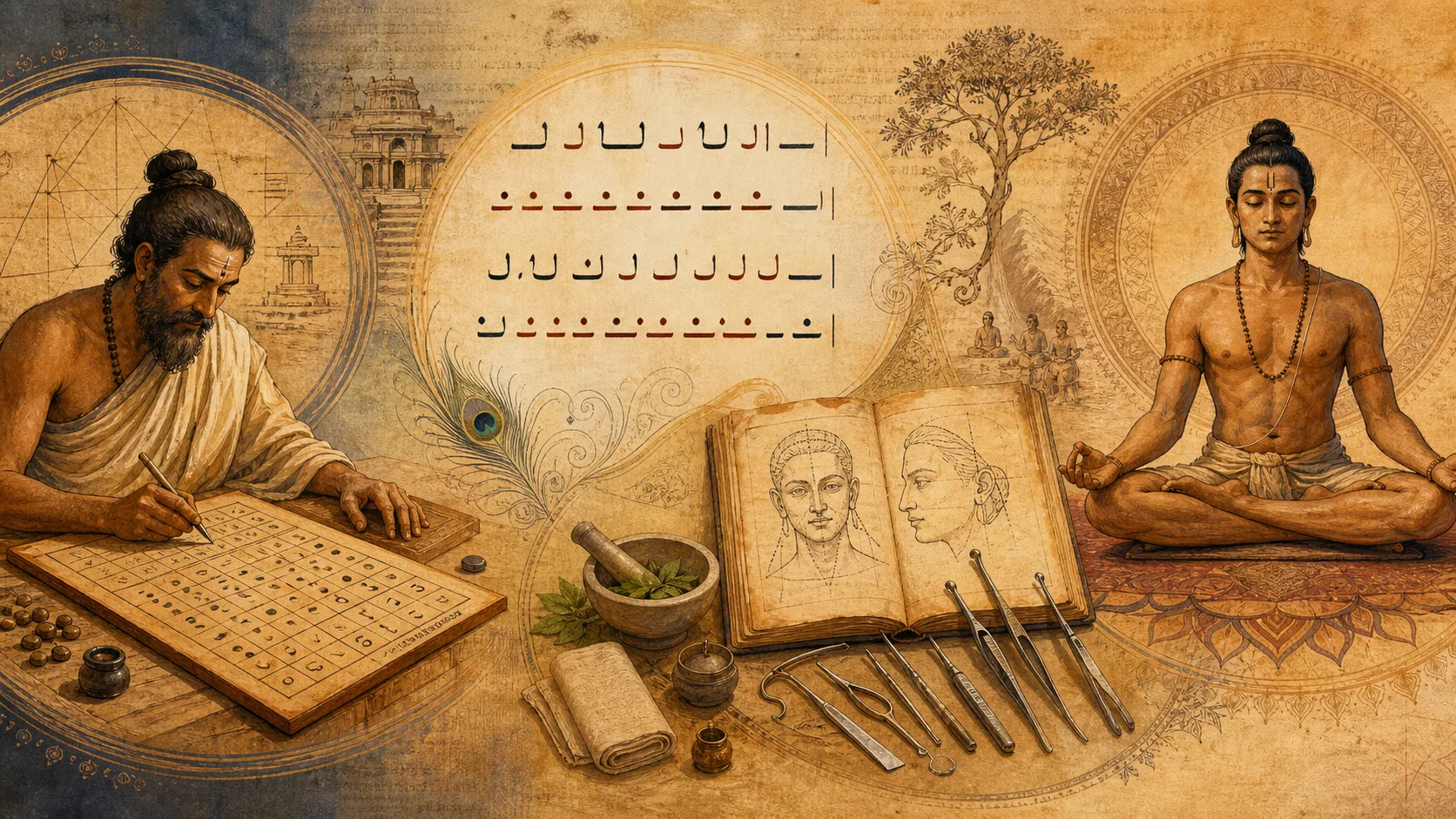
One-sentence decode: Ancient Indian scholars made enduring contributions to mathematics, combinatorics, medicine and yoga—but their achievements become more meaningful, not less, when separated from exaggerated modern claims.
The story in 60 seconds
- The modern Hindu–Arabic numeral system developed over centuries, with important roots in India.
- Aryabhata used a sophisticated decimal place-value approach, although his system did not employ the modern zero symbol.
- Brahmagupta formulated influential arithmetic rules involving zero and negative numbers in the seventh century.
- Pingala’s study of Sanskrit metre used two contrasting syllable types and combinatorial procedures that resemble binary enumeration.
- There is no established direct path from Pingala’s work to modern digital computing.
- The Sushruta Samhita describes early surgical procedures, including forms of nasal reconstruction.
- The United Nations declared June 21 the International Day of Yoga in 2014.
- Commercial estimates of yoga’s market value vary widely because researchers count different products and services.
AI SummaryAI-generated summary, reviewed by editors
Ancient Indian scholars made enduring contributions to mathematics, combinatorics, medicine and yoga—but their achievements become more meaningful when separated from exaggerated modern claims.
Switch to ShortsA foundation built over centuries
Long before electronic calculators and computers, scholars in the Indian subcontinent were working on difficult questions involving numbers, astronomy, language, medicine and human well-being.
Their achievements did not appear in one place or at one moment. They developed through different intellectual traditions over many centuries. Some ideas later travelled through the Islamic world and eventually became part of mathematical knowledge used across Europe and beyond.
That history is more complicated than the claim that a single ancient scholar “invented mathematics” or “created computer code.” It is also more interesting.
Aryabhata, place value and decimal notation
Aryabhata, born in 476 CE, was one of ancient India’s most influential mathematicians and astronomers. His work used a sophisticated positional approach in which the value assigned to a number depended on its place.
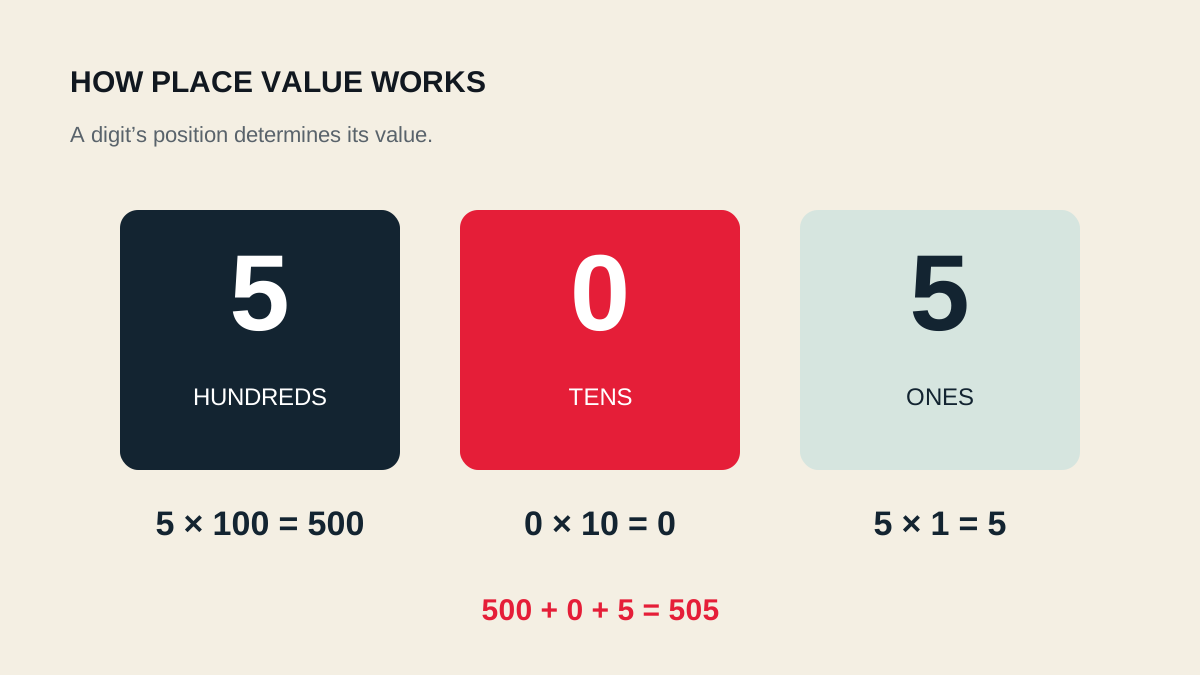
Place value is the principle that makes the same digit mean different things depending on its position. In the number 505, for example, the first 5 represents five hundreds while the final 5 represents five units.
Aryabhata’s system did not use the modern written zero symbol. Nevertheless, it demonstrated an advanced understanding of positional calculation and powers of ten.
The numeral system used today was not the creation of one person. Its defining features—decimal base, place value, nine digits and zero—emerged gradually within Indian mathematical traditions. The system was transmitted and developed through Arabic and Islamic scholarship before reaching Europe. This is why it is commonly called the Hindu–Arabic numeral system.
What Brahmagupta did with zero
Brahmagupta, who lived during the seventh century, made another major advance. In his Brahmasphutasiddhanta, completed around 628 CE, he presented arithmetic rules involving zero, positive numbers and negative numbers. He described how adding zero leaves a number unchanged and how subtracting a number from itself produces zero.
Not every rule was correct by modern standards. His treatment of division by zero remained unresolved. But his effort to treat zero as something that could participate in arithmetic was historically significant.
Brahmagupta did not single-handedly invent zero, but he produced one of the earliest known systematic mathematical treatments of it.
MacTutor’s history of zero describes Aryabhata’s positional method and Brahmagupta’s later treatment of zero.
Did Sanskrit poetry produce binary code?
Pingala’s work presents the most fascinating—and most frequently exaggerated—part of the story.
Pingala is associated with the Chandahshastra, an ancient study of Sanskrit poetic metre. Sanskrit metre can classify syllables as either laghu, meaning light or short, or guru, meaning heavy or long.
Because every position can take one of two states, combinations of syllables form two-part patterns. Pingala’s tradition developed methods for listing, counting and reconstructing those patterns. Modern writers can illustrate the structure with zeroes and ones, but Pingala used categories of syllables, not electronic digits.
The work can legitimately be described as an early form of binary-like combinatorial reasoning. It should not be described as the invention of modern binary computer code.
Modern computing depends on many later developments, including formal binary arithmetic, Boolean logic, electronic circuits, information theory and programmable machines. No established evidence shows that Pingala’s work was directly transmitted into the engineering history that produced digital computers.
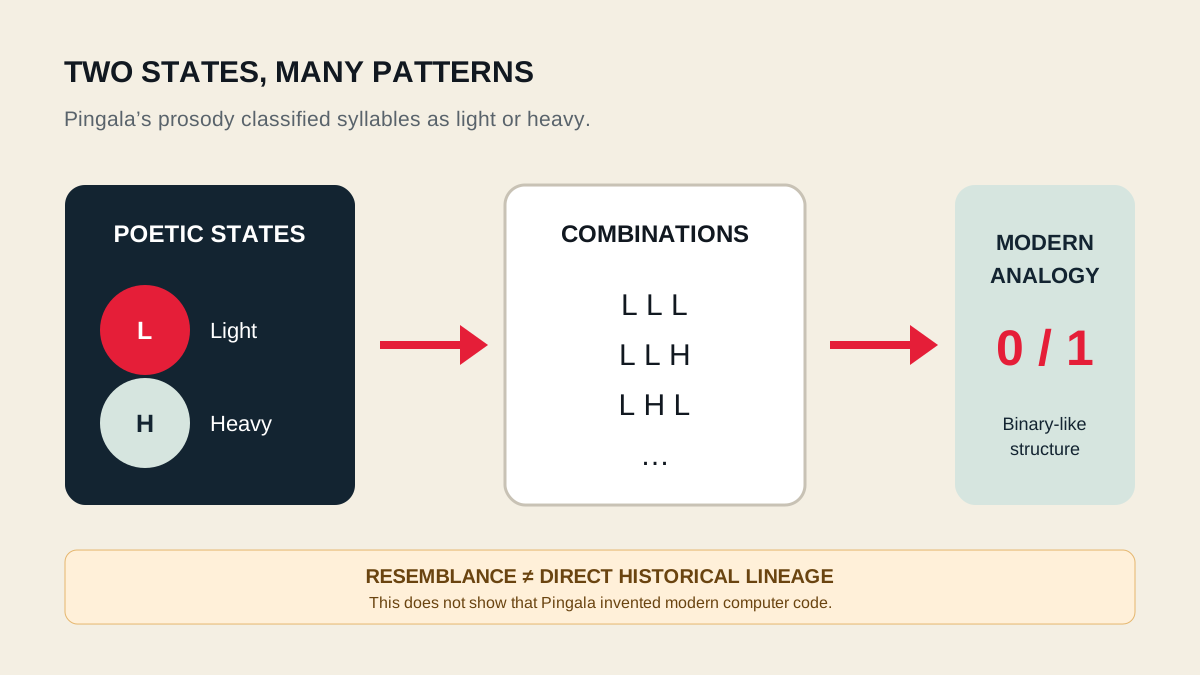
Visual decode: resemblance is not a direct lineage
- Sanskrit metre classifies a syllable as light or heavy.
- That produces two possible states at each position.
- Algorithms can enumerate the possible combinations.
- The resulting structure resembles binary enumeration.
- The resemblance does not prove a direct historical path to modern computers.
Sushruta and reconstructive surgery
Ancient Indian medical literature contains detailed discussions of surgical practice. The Sushruta Samhita, attributed to Sushruta, describes anatomy, instruments, wound management and numerous procedures. It is particularly well known for accounts of reconstructing a damaged nose using tissue from the cheek.
Nasal reconstruction had practical importance in societies where injury or deliberate mutilation could result in the loss of a nose.
Modern historical reviews regard Sushruta as an important early figure in reconstructive and plastic surgery. However, descriptions such as “the father of all surgery” are honorary titles, not precise historical measurements. Scholars also debate the dates and textual layers of the surviving work.
The defensible conclusion is that the Sushruta tradition preserved some of the world’s earliest detailed descriptions of reconstructive surgical techniques. A PubMed-indexed historical review discusses the account of nasal reconstruction and its later association with the “Indian method.”
Yoga’s journey from India to the world
Yoga developed through diverse religious, philosophical and physical traditions in India. It cannot be reduced to the exercise classes commonly marketed under the name today.
Different schools developed practices involving ethics, meditation, breath, concentration, bodily postures and spiritual discipline. Modern global yoga emerged through further adaptation, including interactions among Indian teachers, international students, physical culture and commercial wellness industries.
In December 2014, the United Nations General Assembly proclaimed June 21 the International Day of Yoga. The resolution was adopted without a vote, and the first observance took place in 2015. The UN Digital Library provides the resolution record.
Is yoga a $127 billion industry?
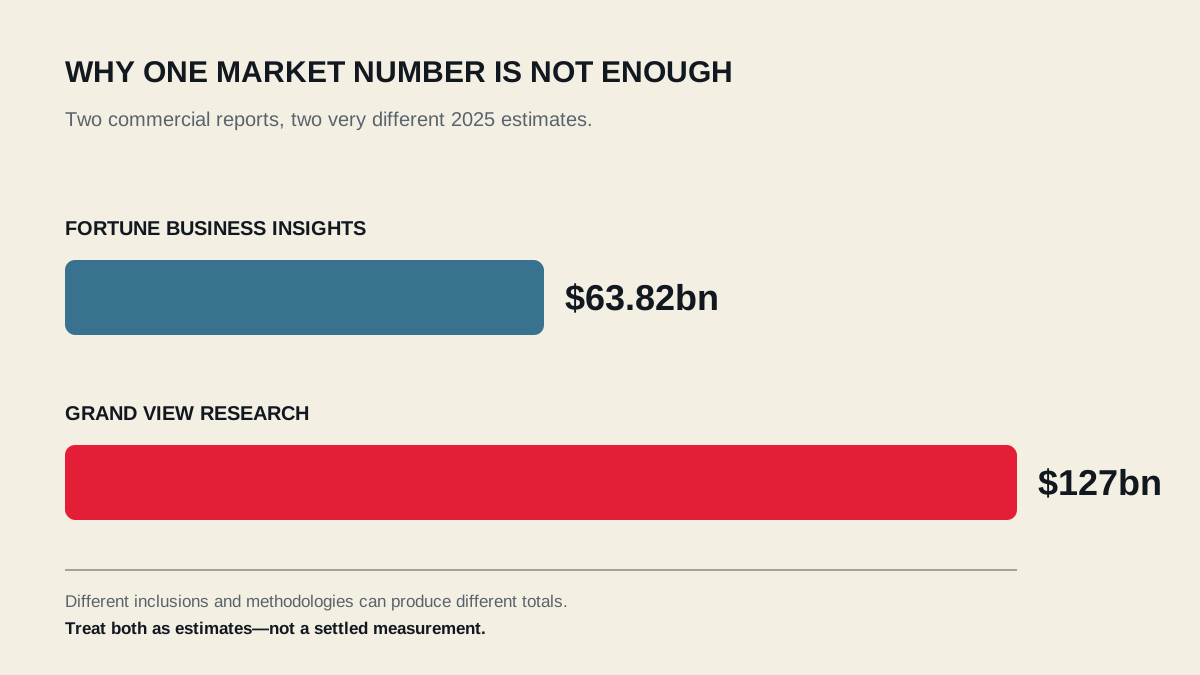
One commercial market report estimates that the global yoga market was worth approximately $127 billion in 2025. Another current market-research company estimates the same year at $63.82 billion. The difference is too large to ignore.
Estimates may include different combinations of studio memberships, instructor training, retreats, tourism, clothing, equipment, online classes, wellness services and yoga therapy.
Yoga supports a global commercial market worth tens of billions of dollars, but published estimates vary substantially depending on what is counted.
The $127 billion estimate should be attributed specifically to Grand View Research, rather than presented as an undisputed measurement.
Claim versus evidence
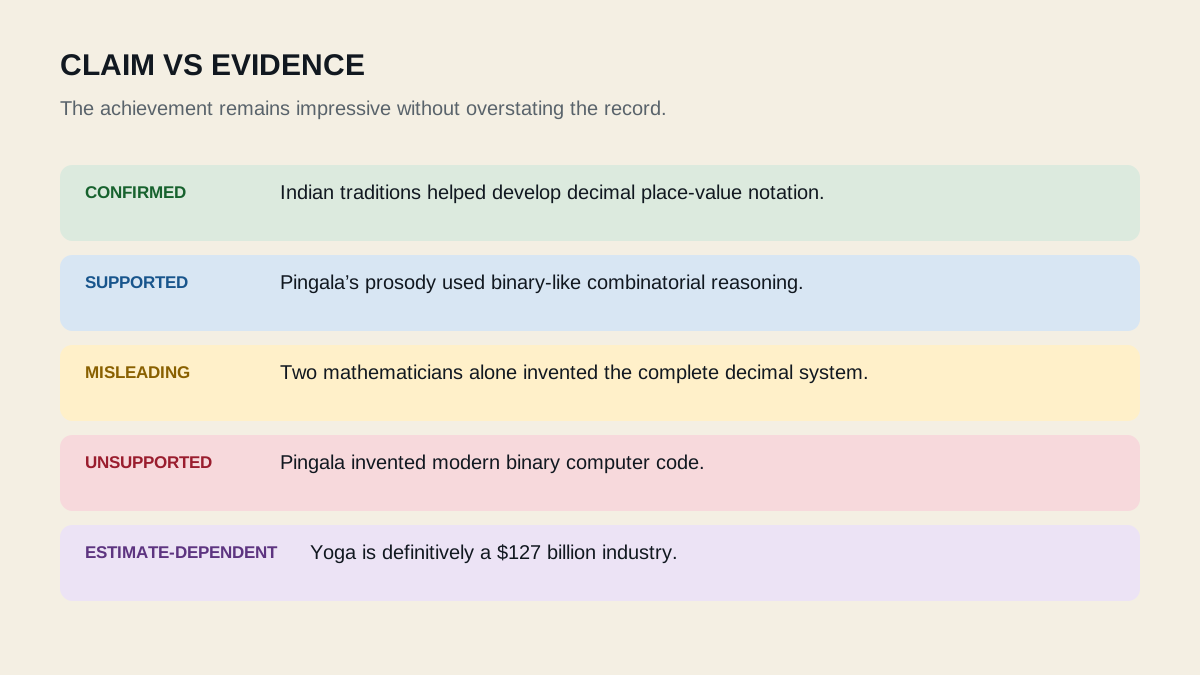
- Confirmed: Indian traditions played a foundational role in decimal place-value notation.
- Confirmed: Brahmagupta formulated arithmetic rules involving zero.
- Misleading: Aryabhata and Brahmagupta alone invented the complete decimal system.
- Supported: Pingala’s prosody used binary-like combinatorial reasoning.
- Unsupported: Pingala invented modern binary computer code.
- Confirmed: The Sushruta tradition described nasal reconstruction.
- Disputed: A single precise date for Sushruta and every layer of the text.
- Confirmed: Yoga developed from Indian traditions.
- Confirmed: The UN recognizes June 21 as International Day of Yoga.
- Estimate-dependent: Yoga is definitively a $127 billion industry.
Why this history matters
The importance of these contributions does not depend on claiming that ancient scholars secretly invented every modern technology.
Their real achievement was developing powerful ways to represent numbers, classify patterns, perform calculations, document medical techniques and investigate the relationship between body and mind.
Those ideas emerged in contexts very different from modern science and computing. But they demonstrate that knowledge has always developed through many cultures—and that today’s world rests on intellectual foundations built across centuries and continents.
Three things to remember
- India’s decimal and mathematical traditions helped shape the number system used around the world.
- Pingala’s poetic patterns resemble binary logic, but calling them the direct basis of computing goes beyond the evidence.
- Sushruta and yoga have genuine global legacies that should be explained with historical context rather than exaggerated claims.
HeadlineDecoded is committed to accuracy and transparency. Read our standards or submit a correction.