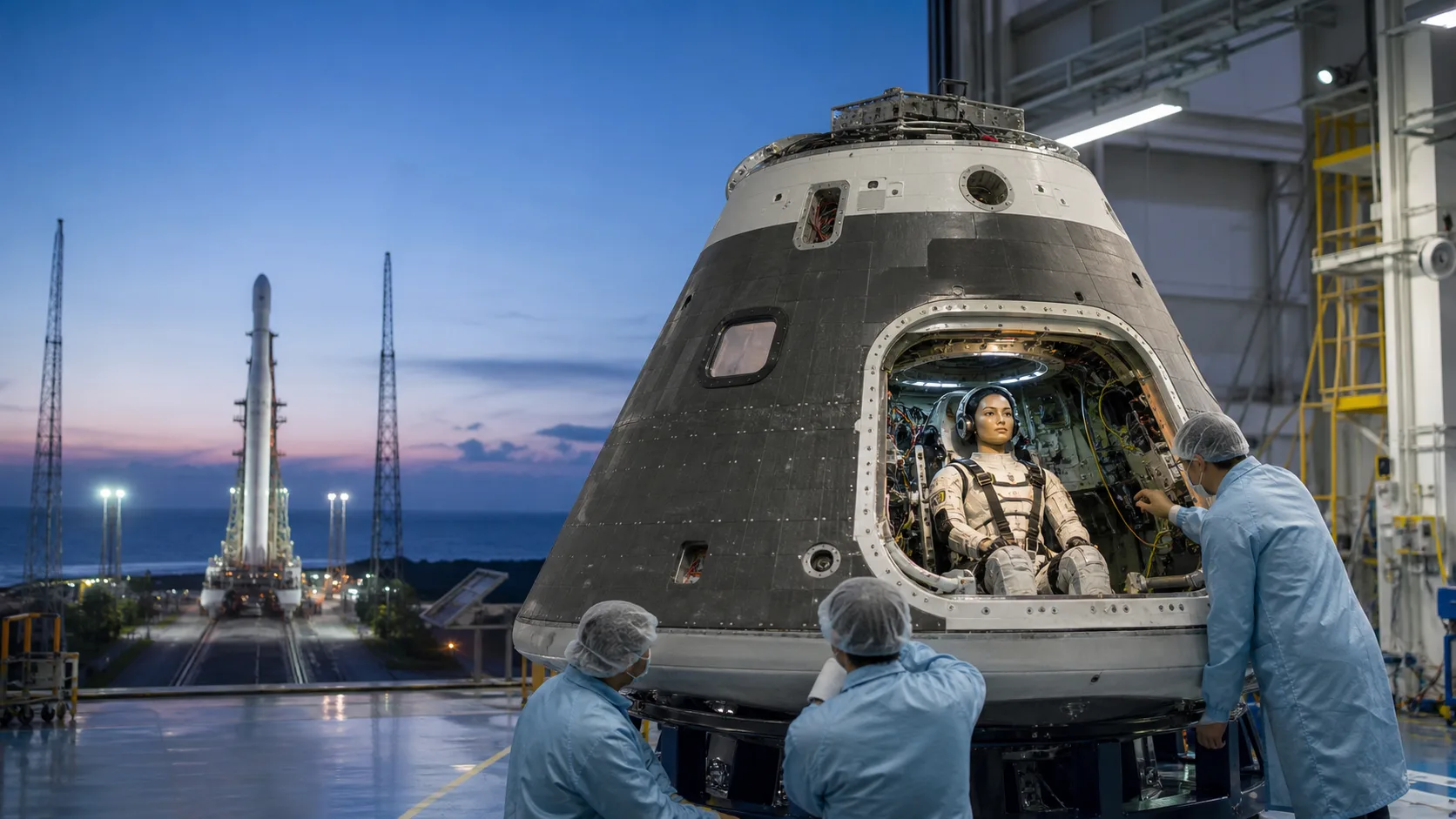
Gaganyaan G1 is not a rehearsal with astronauts missing; it is the first end-to-end orbital test of the systems that must work before astronauts can fly. The uncrewed mission is meant to demonstrate the human-rated launch vehicle, orbital-module operations, communication and mission management, re-entry and crew-module recovery. Vyommitra—the female-presenting humanoid developed by ISRO—adds a human-like instrumented payload, but the mission's safety case rests on the complete vehicle and ground system, not on the robot alone.
The story in 60 seconds
- G1 is the first uncrewed orbital mission in India's Gaganyaan human-spaceflight programme.
- Its job is to validate an end-to-end sequence: launch on the human-rated LVM3 (HLVM3), orbital-module operations, re-entry, parachute descent, splashdown and recovery.
- Vyommitra can monitor module parameters, perform microgravity experiments and simulate selected human functions. It is not an astronaut substitute or the sole life-support test.
- ISRO's programme FAQ describes two government-approved uncrewed missions before the crewed mission—not three G1/G2/G3 flights as the previous version of this article stated.
- April and July 2026 tests validated important parachute and crew-module systems. These are readiness milestones, not proof that the full flight will succeed.
- The latest government timing reviewed places G1 in the second half of 2026 and human spaceflight in 2027. No official launch day should be inferred from that window.
AI SummaryAI-generated summary, reviewed by editors
Gaganyaan G1 is designed to test India’s human-rated launcher, orbital module, re-entry, parachutes and recovery without risking a crew. Recent qualification tests show progress, but the second half of 2026 remains a target—not a confirmed launch date.
Switch to Shorts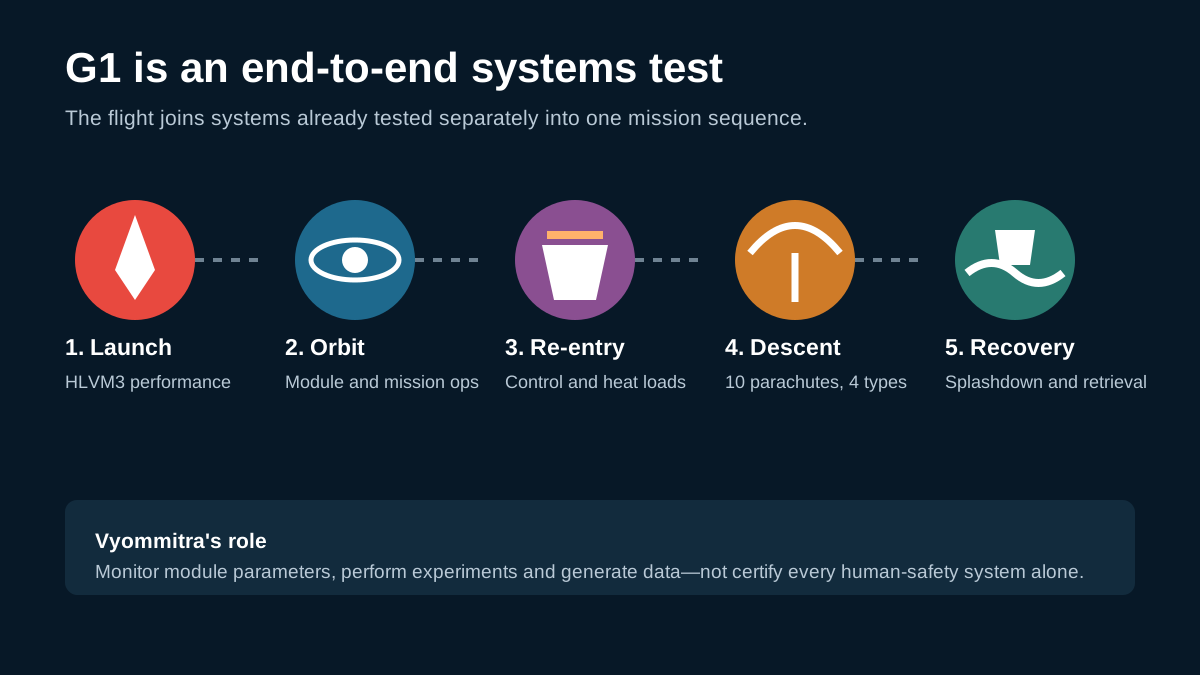
What G1 actually has to prove
A 2025 parliamentary answer described HLVM3 G1/OM1 as an end-to-end demonstration covering aerodynamic characterisation of the human-rated launcher, orbital-module mission operations, re-entry and crew-module recovery. Earlier government material also lists orbital-module propulsion, communications and mission management among G1's objectives.
That makes G1 different from a component test. A parachute may perform correctly in an air-drop trial and a propulsion system may pass on the ground, but the mission must connect launch, orbit, de-boost, atmospheric entry, deceleration, sea landing and retrieval in the correct order under real flight conditions.
Vyommitra's role—without the mythology
ISRO says Vyommitra—its name combines the Sanskrit words for space and friend—was developed to function aboard Gaganyaan. In uncrewed experimental missions, it is intended to perform microgravity experiments, monitor module parameters and simulate selected functions similar to those of a human.
Calling Vyommitra a “robot astronaut” is useful shorthand but can mislead. It cannot reproduce the full physiology, judgement or workload of a human crew. The mission therefore uses extensive instrumentation, software simulations, environmental testing and ground telemetry alongside the humanoid. G1 tests the spacecraft as a system; Vyommitra is one part of that evidence.
What recent tests established
On April 10, 2026, ISRO's second Integrated Air Drop Test released a roughly 5.7-tonne simulated crew module from a Chinook helicopter about three kilometres above the sea near Sriharikota. Ten parachutes of four types deployed in sequence, followed by Indian Navy recovery.
On July 7, the fifth Integrated Main Parachute Air Drop Test placed a main parachute under the maximum expected G1 load condition. Five days later, ISRO reported qualification tests of the crew-module uprighting system, the crew/service-module umbilical separation system and the crew-module structure under apex-cover separation loads. Together, these results build confidence in descent and post-splashdown safety; none substitutes for the orbital mission.
The launch date is still a target
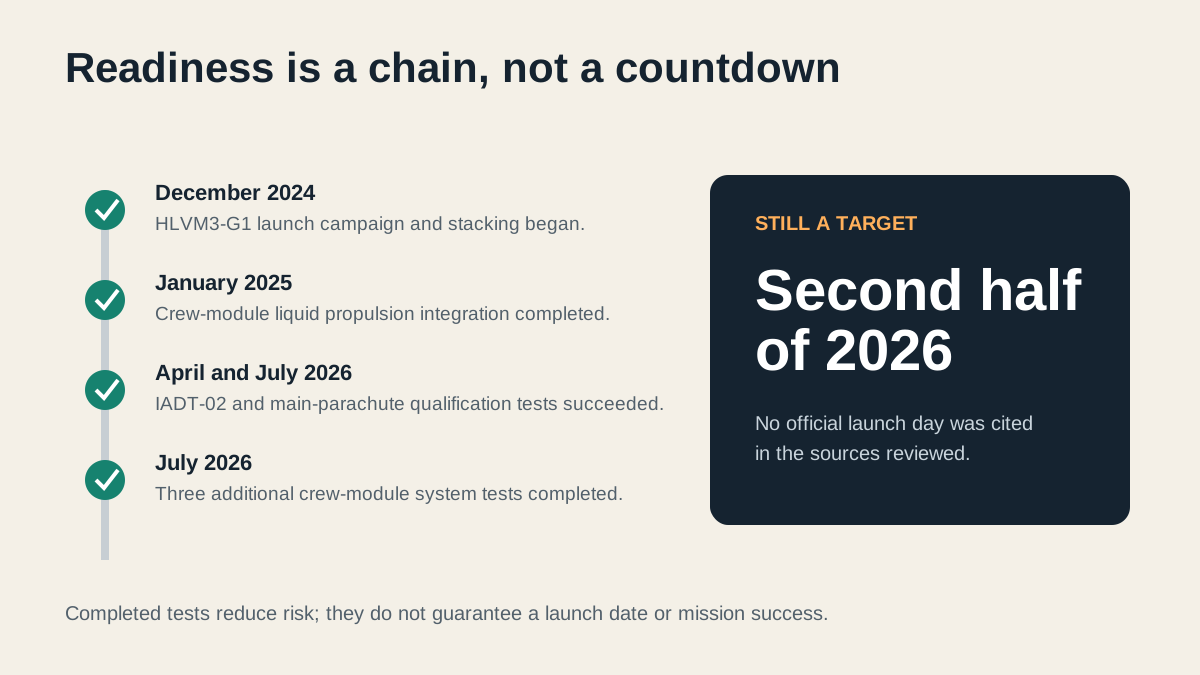
G1 has passed several earlier public targets. The launch campaign began with HLVM3 stacking in December 2024, and the crew-module liquid propulsion system was integrated in January 2025. In January 2026, the government said G1 was likely in the second half of 2026, followed by human spaceflight planned for 2027.
As of the official updates reviewed for this article, readiness work was still being reported in July 2026 and no exact G1 launch date had been announced. “Second half of 2026” is therefore a planning window, not a booked appointment. Human-rating programmes deliberately keep schedules subordinate to qualification evidence.
What happens after G1
ISRO's current public FAQ says the approved programme includes two uncrewed missions and one crewed mission. The crewed objective is to launch up to three people to a roughly 400-kilometre low-Earth orbit for up to three days and recover them in Indian sea waters. Whether dates move depends on what the uncrewed flights and remaining abort tests reveal.
G1 should therefore be judged by engineering questions, not spectacle: Did the launcher and orbital module perform within limits? Did communications and mission management stay continuous? Did re-entry guidance work? Did all recovery systems deliver a retrievable module? An anomaly would delay the crewed flight, but finding a weakness before people fly is precisely why G1 exists.
Related science coverage
For a broader view of India's scientific legacy and the difference between evidence and mythology, read our explainer on ancient Indian mathematics, medicine and ideas. Also see our guide to what an experimental breakthrough proves—and what it does not.
For a physics-first misinformation example, read why the August 12 eclipse cannot switch off Earth’s gravity.
Safety evidence also develops in stages after an occurrence. Our Air India AI2379 evidence review separates an operator statement, attributed reporting and pending investigation findings.
Frequently asked questions
Will astronauts fly on Gaganyaan G1?
No. G1 is an uncrewed test mission.
Is Vyommitra controlling the spacecraft?
Official descriptions emphasise monitoring, experiments and simulation of selected human functions. Vehicle avionics and mission systems conduct the flight.
When will G1 launch?
The latest government window reviewed is the second half of 2026. An exact launch date has not been confirmed in the cited official updates.
How many uncrewed Gaganyaan missions are approved?
ISRO's public FAQ says two uncrewed missions and one crewed mission are approved.
How long is the planned crewed mission?
ISRO describes up to three crew members in roughly 400-kilometre low-Earth orbit for up to three days.
Primary sources
- Gaganyaan programme FAQ — ISRO
- HLVM3-G1 launch campaign begins — ISRO
- G1 crew-module propulsion integration — ISRO
- Second Integrated Air Drop Test — ISRO
- July 2026 main-parachute qualification test — ISRO
- Crew-module qualification tests — ISRO
- Second-half 2026 G1 timing — Press Information Bureau
HeadlineDecoded is committed to accuracy and transparency. Read our standards or submit a correction.