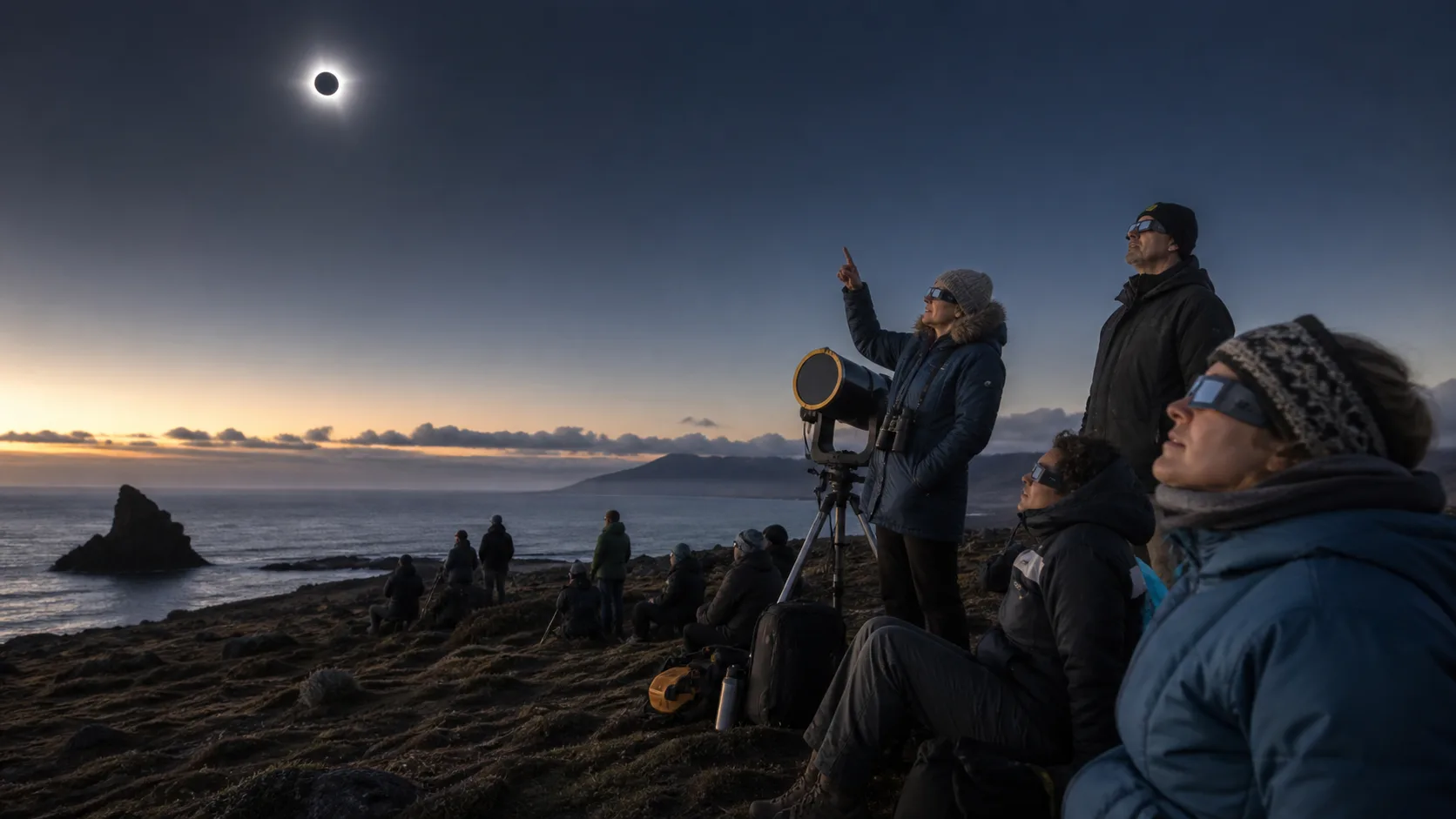
A viral post claims Earth will lose gravity for seven seconds on August 12, 2026, supposedly because NASA predicted an unusual Sun-Moon-Earth alignment under a secret programme called “Project Anchor.” The date borrows credibility from a real total solar eclipse. But an eclipse is the Moon's shadow crossing Earth; it does not remove Earth's mass or switch off gravitational attraction. NASA documents the eclipse and the underlying gravity physics, but no official NASA source reviewed supports the alleged programme, timestamp or danger warning.
Verdict
False. Earth will not lose gravity for seven seconds. The August 12 total solar eclipse is real, but it has no mechanism capable of turning off gravity.
The story in 60 seconds
- NASA confirms a total solar eclipse on August 12, 2026, visible along a path crossing Greenland, Iceland, northern Russia, Spain and a small corner of Portugal.
- A solar eclipse occurs when the Moon passes between the Sun and Earth and casts a shadow. It changes the sunlight reaching observers, not Earth's mass.
- Near Earth's surface, gravitational acceleration depends primarily on Earth's mass and radius. Neither disappears during an eclipse.
- NASA's gravity guide says gravitation is the mutual attraction of mass and never completely disappears.
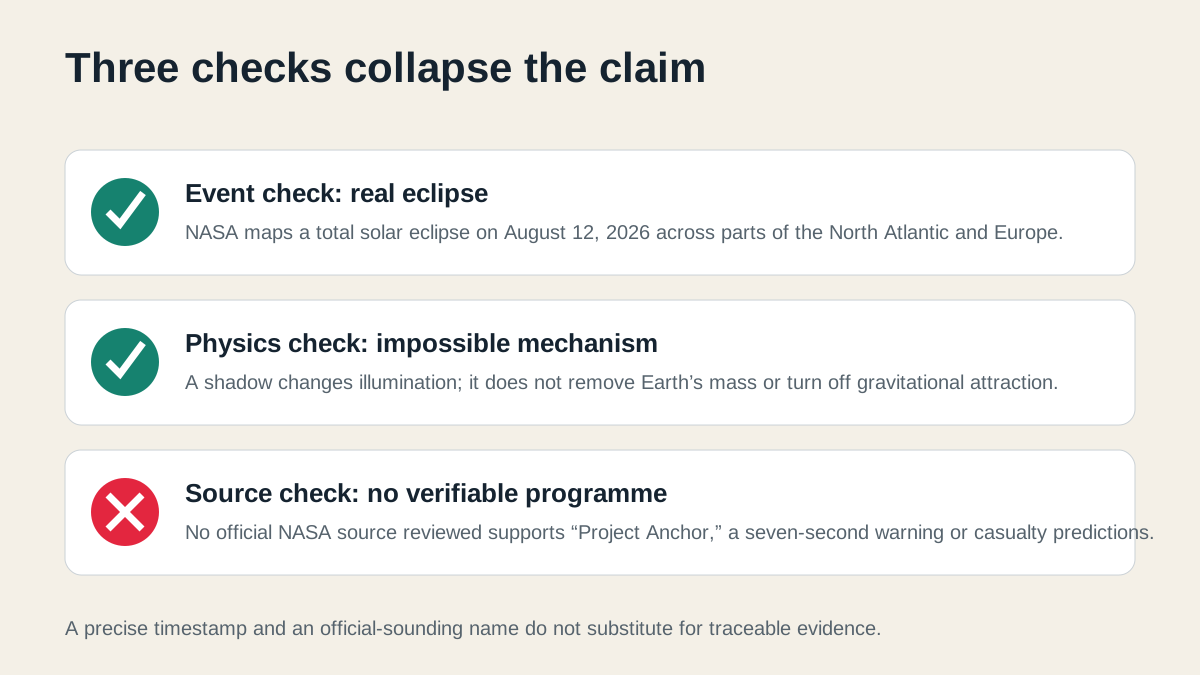
- No official NASA page, programme record or scientific publication reviewed supports “Project Anchor” or a seven-second zero-gravity event.
- “Gravity waves” sometimes discussed around eclipses are atmospheric waves—not the disappearance of gravitational force.
AI SummaryAI-generated summary, reviewed by editors
A viral “Project Anchor” post says Earth will lose gravity for seven seconds during the August 12, 2026 eclipse. The eclipse is real; the gravity claim is physically impossible and unsupported by any official NASA source reviewed.
Switch to Shorts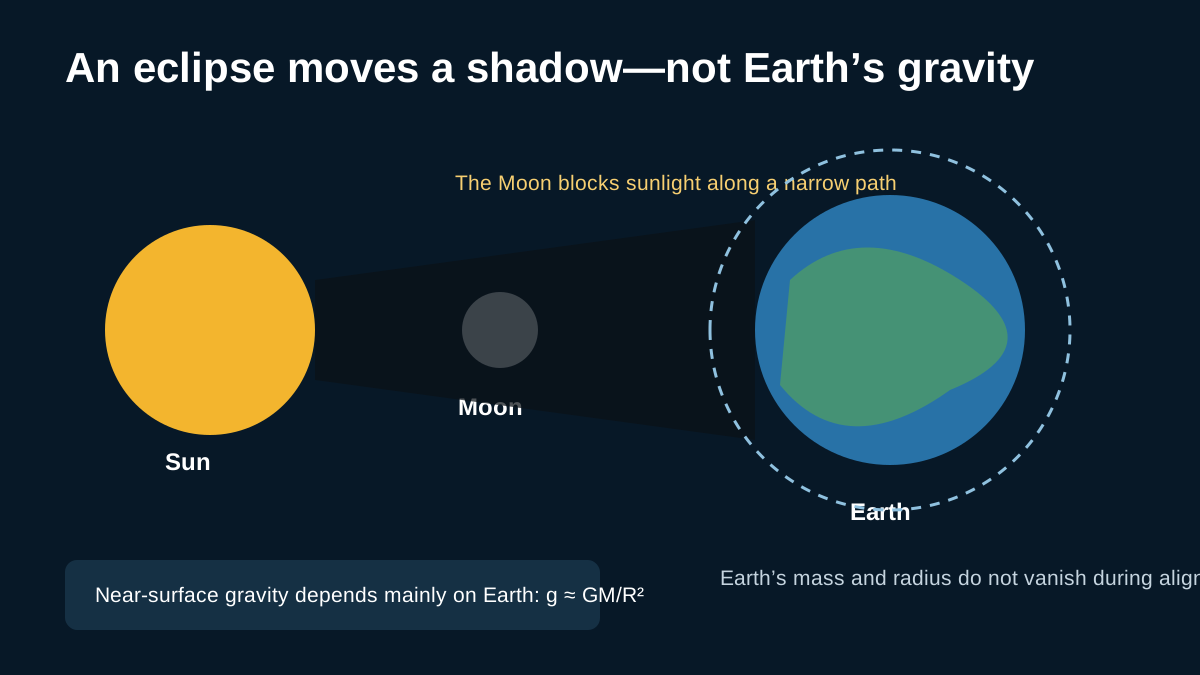
What the viral claim gets wrong
The post combines a real date with invented-looking precision: a named secret project, an exact time and predictions of mass casualties. Those details create authority without supplying a traceable document. A genuine scientific warning of this scale would be independently observable, published across space agencies and scientific institutions, and supported by a mechanism that survives basic physics.
We found the real NASA eclipse page and NASA's public gravity material. We did not find an official source supporting the central claim. Absence from one webpage alone would not disprove a secret event; the decisive evidence is that the proposed mechanism contradicts well-tested gravitational physics.
Why gravity cannot “switch off”
Gravity is the attraction between masses. Close to Earth's surface, the familiar approximation is g ≈ GM/R², where M is Earth's mass and R its radius. For surface gravity to vanish globally, Earth would have to lose essentially all of its gravitational mass or spacetime would have to change catastrophically. A Moon-Sun alignment does neither.
The Sun and Moon do exert gravity on Earth, producing tides. Their alignment at new moon contributes to spring tides—a normal, predictable variation in tidal range. That is not cancellation of Earth's pull. People and objects do not become weightless during new moons or eclipses.
What actually happens on August 12
NASA says the Moon's umbral shadow will cross a narrow path that includes parts of Greenland, Iceland, northern Russia, Spain and a small part of Portugal. Many surrounding regions will see a partial eclipse. Most observers in the path of totality will experience total darkness for less than two minutes; the maximum is still under two and a half minutes.
India is not listed in NASA's visibility regions for this eclipse. The genuine safety issue is eye protection where the eclipse is visible: outside the brief total phase, observers must use proper solar viewers or indirect projection. Regular sunglasses are not sufficient.
Do eclipses affect gravity at all?
The relative positions of Earth, Moon and Sun continuously affect tides, and precise instruments can measure tiny geophysical changes. But these ordinary effects are many orders of magnitude away from “zero gravity.” The word “gravity” also appears in atmospheric gravity waves: ripples in air where buoyancy acts as the restoring force. NASA-supported teams have measured such waves around eclipses. They do not mean gravitational attraction vanished.
How to check spectacular science claims
- Find the primary event: NASA's eclipse page confirms what is actually scheduled.
- Check the mechanism: ask what physical quantity would need to change. Here, Earth's mass and radius remain effectively unchanged.
- Look for independent institutions: a global hazard would not rest on one screenshot or unnamed leak.
- Separate similar terms: microgravity, gravitational waves and atmospheric gravity waves do not mean gravity has been turned off.
- Do not amplify the frightening details: share the correction without repeating invented casualty predictions as if they were estimates.
Related explainers and fact checks
For another precise-date social-media rumour, see our Instagram ban hoax fact-check. Our Gaganyaan G1 explainer shows how real space missions distinguish tests from confirmed outcomes, while our ancient India science review separates documented achievements from exaggeration.
The same source discipline matters in breaking aviation news. See our AI2379 confirmed-versus-reported evidence map.
Frequently asked questions
Will Earth lose gravity on August 12, 2026?
No. There is no physical mechanism or credible evidence for the claim.
Is there really an eclipse that day?
Yes. NASA documents a total solar eclipse across parts of the North Atlantic and Europe, with a wider partial-eclipse region.
Will the eclipse be visible from India?
NASA's official visibility description does not include India.
Is “Project Anchor” a verified NASA programme?
No official NASA source reviewed supports a programme by that name connected to a gravity-loss prediction.
Can astronauts experience zero gravity?
What is commonly called zero gravity in orbit is microgravity: astronauts and their spacecraft are continuously falling around Earth while gravity still acts on them.
Primary sources
- Total Solar Eclipse on August 12, 2026 — NASA Science
- Why eclipses happen — NASA Science
- Gravity and mechanics — NASA Science
- The Moon, Sun and Earth's tides — NASA Science
- What is microgravity? — NASA Glenn Research Center
HeadlineDecoded is committed to accuracy and transparency. Read our standards or submit a correction.