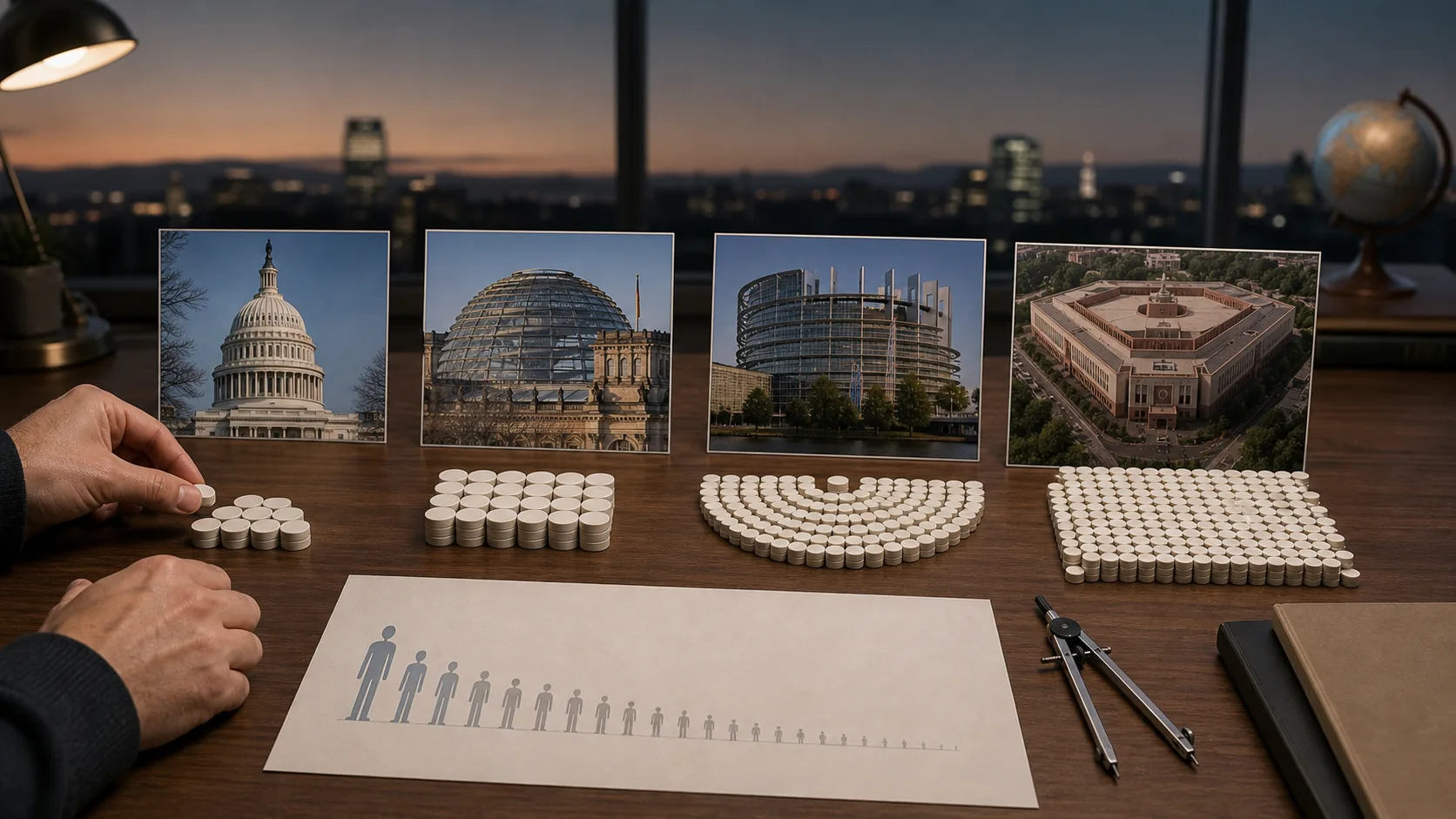
International comparisons can clarify India’s representation debate only if the institutions are compared carefully. The United States reallocates a statutory 435 voting House seats among states after every census. Germany combines constituency and party-list voting within a fixed 630-seat Bundestag from 2025. The European Parliament allocates 720 seats among sovereign member states through degressive proportionality. India’s withdrawn 2026 package proposed an 850-seat constitutional ceiling and an illustrated 816-seat Lok Sabha. These are useful contrasts, not interchangeable templates.
The story in 60 seconds
- The US House has 435 voting representatives under federal statute. Congress can amend that law; “frozen forever” is an overstatement.
- After each decennial census, the 435 seats are reapportioned among states using the Method of Equal Proportions. States can gain or lose seats.
- Germany’s Bundestag had 735 members after the 2021 election in the Federal Returning Officer’s official comparison. Electoral reform produced a fixed 630-member chamber at the 2025 election.
- The European Parliament has 720 members for 2024–29. Treaty rules require degressive proportionality, with 6 to 96 seats per member state.
- The EU is not a direct federal analogue: its seats represent citizens of sovereign member states, and each election-period allocation is adopted through an EU decision.
- India’s 2026 proposal did not become law. Its amendment was defeated and its linked delimitation bill withdrawn.
AI SummaryAI-generated summary, reviewed by editors
The US reapportions 435 House seats, Germany now elects a fixed 630-member Bundestag, and the EU uses treaty-based degressive proportionality. Each solves a different problem. Here is the accurate comparison with India’s withdrawn 2026 delimitation package.
Switch to Shorts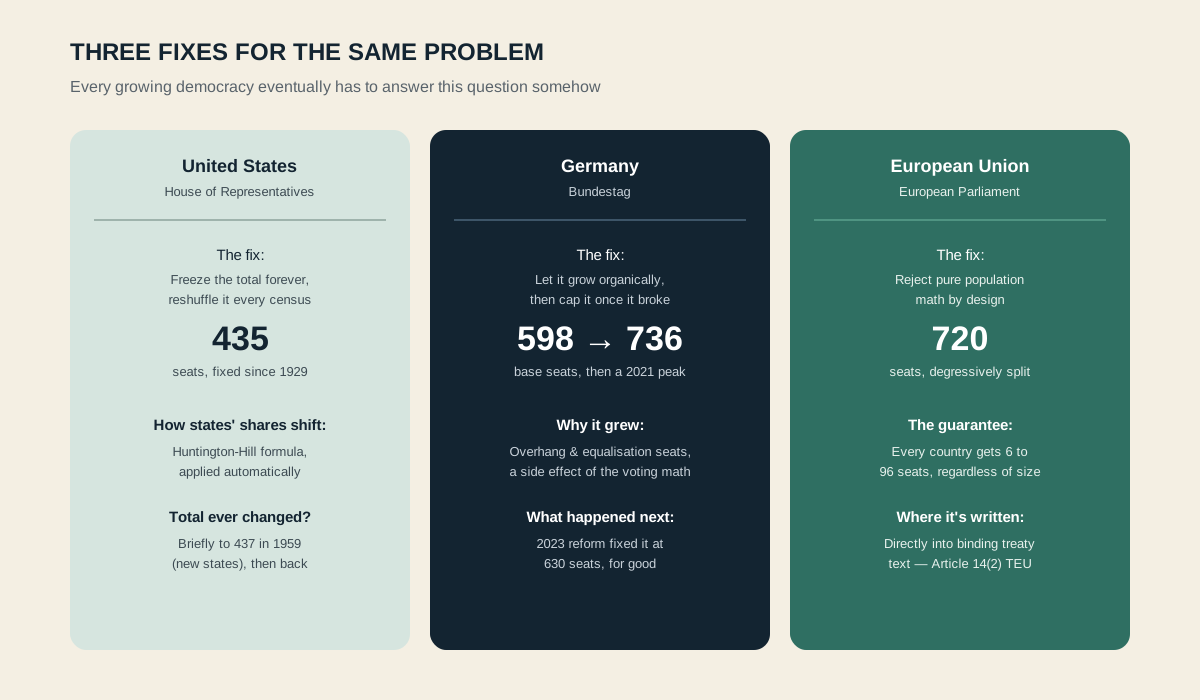
United States: fixed statutory total, automatic reapportionment
The Permanent Apportionment Act of 1929 fixed the House at 435 voting members and established an automatic reapportionment process after each census. Congress permanently adopted the Method of Equal Proportions in 1941. Every state receives one seat; priority values allocate the remaining seats.
The key trade-off is visible after every census: because the total stays fixed, growth in one state can shift a seat away from another. The 2020 apportionment moved seven seats among 13 states. Congress retains legal power to change the House size, so the design is durable rather than constitutionally permanent.
Germany: proportional party strength inside a fixed 630-seat chamber
Germany’s mixed system gives voters a constituency vote and a party-list vote. Through 2021, overhang and compensatory seats could expand the Bundestag above its 598-seat baseline. The official 2025 comparison records 735 members for 2021 and 630 for the newly elected chamber.
From 2025, the second vote determines party seat totals within 630 seats. A constituency winner receives a seat only when that mandate is backed by sufficient second votes. The reform controlled chamber size by changing how direct mandates interact with proportional allocation—not by redrawing population shares among German states in the Indian sense.
European Union: degressive proportionality among member states
Article 14(2) of the Treaty on European Union sets the governing principles: no more than 750 members plus the President, degressive proportionality, at least six seats and no more than 96 per member state. For 2024–29, a European Council decision set the chamber at 720.
Degressive proportionality means larger states receive more seats, but each member from a larger state represents more people than a member from a smaller state. This deliberately protects minimum representation for smaller member states. It is stronger textual protection than a ministerial assurance, but it belongs to a union of states with a different constitutional structure.
India’s withdrawn 2026 proposal
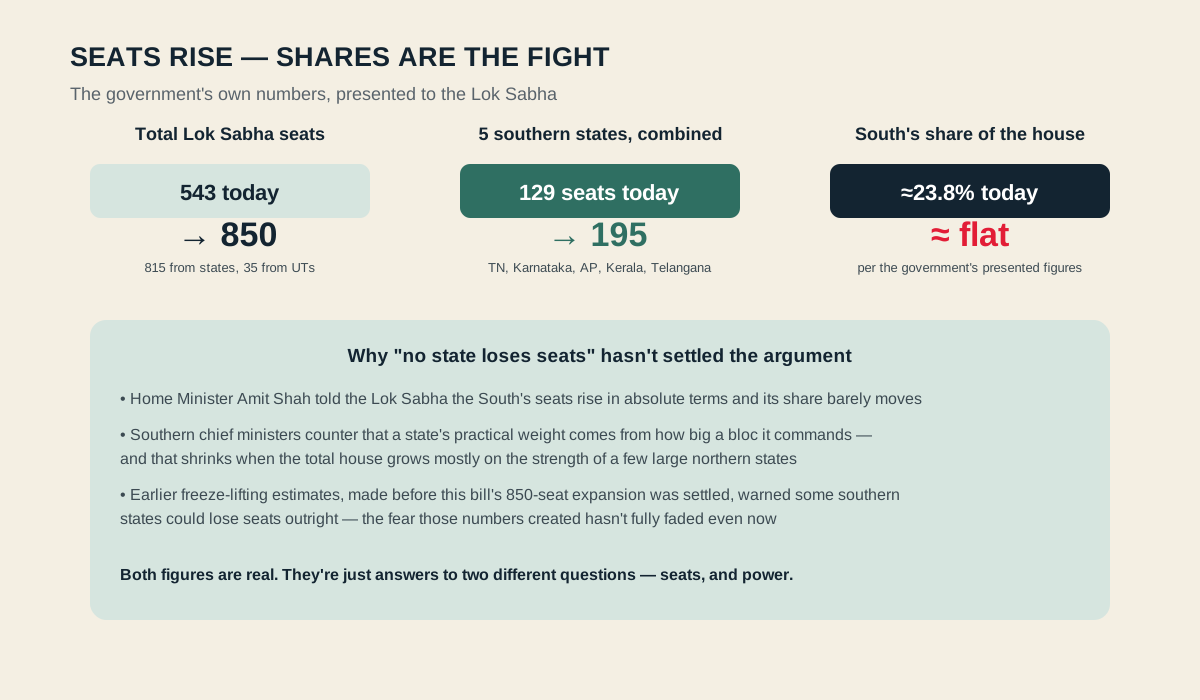
The Constitution (131st Amendment) Bill proposed a maximum of 850 Lok Sabha members—up to 815 from states and 35 from Union Territories. The government illustrated an 816-seat outcome and said the five southern states would rise from 129 to 195 seats while retaining a near-24% combined share.
The draft returned to population-proportionate allocation and did not contain an EU-style 6-to-96 floor or the government’s full state table. On April 17, 2026, the constitutional amendment was negatived; the linked delimitation proposal was withdrawn. India has therefore not adopted this “fourth model.”
What India can—and cannot—learn
- From the US: an automatic formula can reduce repeated legislative deadlock, but a fixed total makes interstate gains and losses unavoidable.
- From Germany: chamber-size problems can arise from electoral-system compensation, not only population growth; reform changes representation trade-offs.
- From the EU: minimum and maximum state representation can be written into higher law, but the union’s member-state structure differs from India’s federation.
- For India: the decisive questions remain domestic—census basis, House size, state allocation rule, federal safeguards and public process.
Comparison at a glance
- US: 435 voting seats; census reapportionment among states; statutory size.
- Germany: 630 seats from 2025; party proportionality plus constituency contests.
- EU: 720 seats for 2024–29; treaty-based degressive proportionality; 6–96 per state.
- India: 543 elected seats today; 850 ceiling and 816 illustration were proposed in 2026 but not enacted.
Related coverage
See our India delimitation explainer, fact-check of the government’s seat illustration and Commission process guide.
Frequently asked questions
Is the US House constitutionally fixed at 435?
No. Federal law fixes 435 voting seats, and Congress can change the statute.
Did Germany’s Bundestag have 736 members in 2021?
The Federal Returning Officer’s official 2025 comparison lists 735 members for the 2021 Bundestag. The new Bundestag elected in 2025 has 630.
Does the EU allocate seats strictly by population?
No. Degressive proportionality gives smaller member states more seats per resident, within a six-seat floor and 96-seat ceiling.
Did India adopt an 850-seat Lok Sabha?
No. 850 was a proposed constitutional ceiling. The amendment was defeated and the linked proposal withdrawn.
Sources
- Permanent Apportionment Act of 1929 — US House Historian
- 2020 congressional apportionment and equal-proportions method — US Census Bureau
- Germany’s electoral system from 2025 — Federal Returning Officer
- 2025 final result: 630 members, 2021 comparison — Federal Returning Officer
- 2024–29 European Parliament composition — European Parliament
- India’s 2026 proposal and status — PRS
HeadlineDecoded is committed to accuracy and transparency. Read our standards or submit a correction.