Union Home Minister Amit Shah used precise figures to argue that the 2026 delimitation package would not reduce southern representation: 129 seats would become 195, and the five states’ combined share would edge from 23.76% to 23.87% in an 816-seat Lok Sabha. The official arithmetic is internally consistent and the government supplied state-by-state figures. The important limitation is legal: the draft did not expressly guarantee a uniform 50% increase for every state. The enabling constitutional amendment was then defeated on April 17 and the linked delimitation proposal was withdrawn.
The story in 60 seconds
- The current total is correct: Karnataka, Andhra Pradesh, Telangana, Tamil Nadu and Kerala together hold 129 of 543 elected Lok Sabha seats, or 23.76%.
- The government’s illustration was not merely “roughly 129×1.5”. PIB listed 42, 38, 26, 59 and 30 seats respectively—195 in total.
- In an 816-seat house, 195 seats equal 23.90% when calculated directly; the government described the share as 23.87%, apparently using its underlying allocation or an approximately 815-seat denominator in another official explainer.
- The 850 figure was the proposed constitutional ceiling. The government said 816 would be the exact working strength under its illustration.
- The bill required population-proportionate allocation but did not write a state-by-state 50% increase or no-loss floor into the statute.
- The constitutional amendment was negatived on April 17, 2026; the linked delimitation proposal was withdrawn. None of these illustrated seat totals became law.
AI SummaryAI-generated summary, reviewed by editors
Amit Shah's April 2026 seat illustration was internally consistent: five southern states would rise from 129 to 195 seats in an 816-seat Lok Sabha. But the draft did not guarantee a uniform 50% increase—and the package was defeated and withdrawn.
Switch to Shorts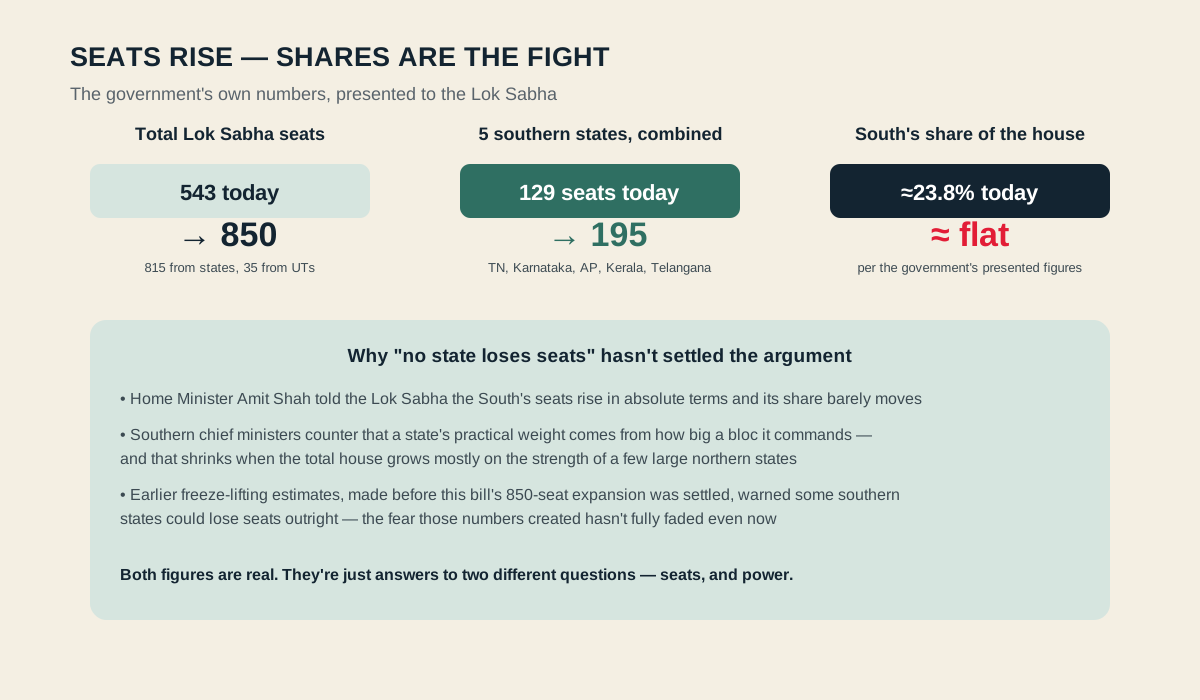
Claim 1: the South currently has 129 seats, or 23.76%
Verdict: accurate. Tamil Nadu has 39 seats, Karnataka 28, Andhra Pradesh 25, Kerala 20 and Telangana 17. The total is 129. Dividing 129 by 543 gives 23.7569%, which rounds to 23.76%.
Claim 2: the South would rise to 195 seats
Verdict: accurate as the government’s stated illustration. The April 16 PIB record listed Karnataka at 42, Andhra Pradesh 38, Telangana 26, Tamil Nadu 59 and Kerala 30. Those figures total 195. Each is close to a 50% rise from the current allocation, with whole-seat rounding.
The earlier version of this fact-check described 195 mainly as a rounded result of multiplying 129 by 1.5. That was incomplete: the government published the individual state figures, so the claim can be checked directly.
Claim 3: the combined share would remain near 24%
Verdict: broadly accurate within the government’s model, but the published percentages require care. PIB said the five-state share would move from 23.76% to 23.87%. Using the stated totals directly, 195 divided by 816 is about 23.90%. A government explainer elsewhere referred to an approximately 815-seat house, under which 195 is about 23.93%. These are small rounding or denominator differences, not evidence that the broad near-24% claim is false.
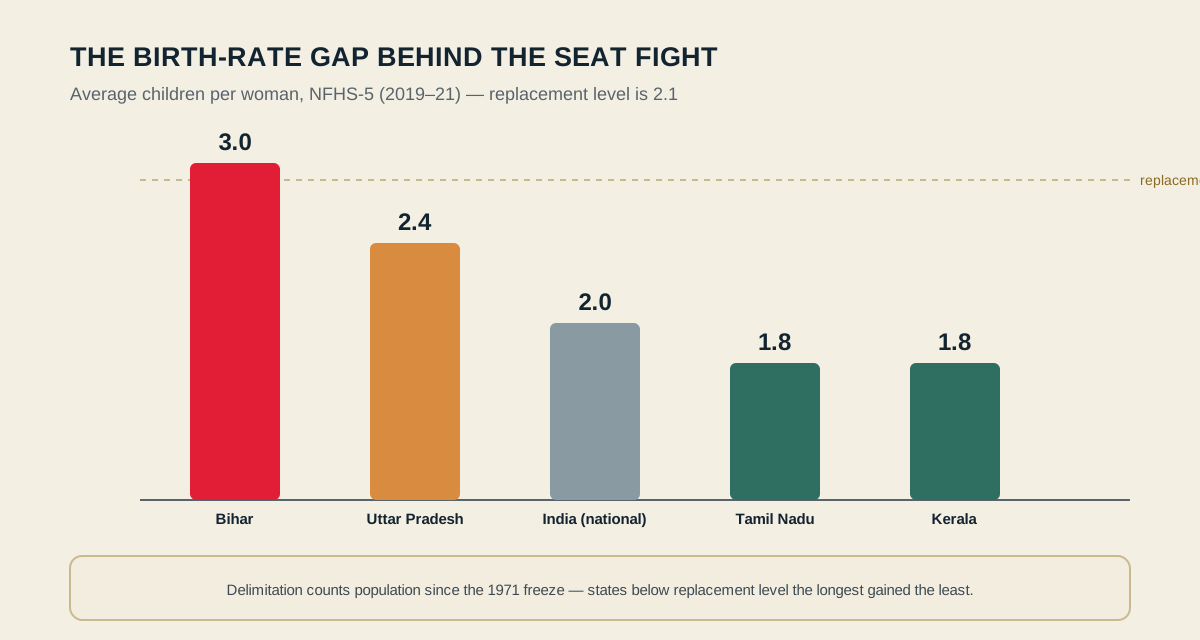
The larger issue is what the calculation proves. A broadly uniform increase naturally preserves relative shares. It demonstrates the government’s chosen illustration; it does not by itself prove that every legally permissible population-based allocation would reproduce that outcome.
Claim 4: no southern state would lose seats
Verdict: true in the stated illustration, not guaranteed in the draft text. Every southern state gained in the official table. But the Constitution (131st Amendment) Bill restored the principle of allocating seats in proportion to population, while the Delimitation Bill left the detailed allocation to a future Commission using the latest published census available when constituted.
The proposed statutes did not reproduce the five-state table or include a simple clause saying every state must receive exactly 50% more seats. A parliamentary assurance is relevant evidence of government intent, but it is not identical to an enacted allocation rule.
Claim 5: expansion would help implement women’s reservation
Verdict: substantially accurate, with a disputed policy design. The 106th Constitutional Amendment links women’s reservation to a post-2023 census and subsequent delimitation. The 2026 amendment proposed removing that census condition, allowing implementation through the new exercise. Expanding the House would also create more seats overall.
Opposition members supported women’s representation while objecting to tying its faster implementation to a contested delimitation framework. That disagreement concerns legislative design and political leverage, not whether the two issues were legally connected.
The missing fact: what happened after the speech
The speech and figures described a live government proposal on April 16. On April 17, the Constitution (131st Amendment) Bill failed to secure the special majority required and was negatived in the Lok Sabha. The government then withdrew the linked Delimitation Bill and Union Territories Laws amendment proposal.
That status changes how the figures should be reported today. They are an authenticated illustration of what the government proposed—not Kerala’s new 30 seats, Karnataka’s new 42 seats or an enacted 195-seat southern bloc.
Claim versus evidence
- Accurate: 129 current seats and a 23.76% current share.
- Accurate illustration: 195 proposed seats, supported by five state-specific figures.
- Broadly accurate: the illustrated combined share remains near 24%; official material contains minor denominator/rounding differences.
- Not guaranteed by the bill: an identical 50% rise for every state or a permanent no-loss rule.
- No longer pending: the enabling amendment was defeated and the linked proposal withdrawn.
- Not law: none of the state-specific numbers in the illustration.
The verdict
Mostly accurate but missing decisive context. Amit Shah’s baseline and state-by-state illustration were genuine and internally coherent. The speech accurately described the government’s proposed 50% model, but the draft did not expressly lock that table or a uniform state increase into law. Most importantly, the legislative package was defeated and withdrawn the next day, so its numbers are proposals—not current allocations.
Related coverage
For the full legal status and North–South debate, read our Delimitation Bill 2026 explainer. Our Kerala seat-number fact-check separates the current 20 seats from the proposed 30, while the Commission explainer shows how a legally constituted body would apply the rules.
Frequently asked questions
Did Amit Shah fabricate the 129-to-195 figure?
No. The government published a state-by-state table that totals 195. The limitation is that it was an illustration, not an enacted allocation.
Why do 23.87% and a direct 195÷816 calculation differ?
Direct division gives about 23.90%. Government publications used “approximately” and referenced totals of 815 or 816 in different places. The small difference does not change the broad claim that the illustrated share stayed near 24%.
Did Kerala officially gain 10 Lok Sabha seats?
No. Kerala moving from 20 to 30 was part of the government’s failed 2026 illustration. Its legal allocation remains 20.
Was the Delimitation Bill 2026 passed?
No. The enabling constitutional amendment was negatived on April 17, and the linked delimitation proposal was withdrawn.
Sources
- April 16 intervention with state-by-state seat illustration — Press Information Bureau
- April 17 reply and combined southern share — Press Information Bureau
- Constitution (131st Amendment) Bill provisions and status — PRS Legislative Research
- Delimitation Bill 2026 summary — PRS Legislative Research
- Government explainer on the proposed 50% model — New India Samachar / PIB
HeadlineDecoded is committed to accuracy and transparency. Read our standards or submit a correction.