On 14 August 2026, the Registrar General of India notified a 40-question Household Schedule for Census 2027 — and for the first time since 1931, it asks every respondent's caste, not only those who identify as Scheduled Caste or Scheduled Tribe. The same schedule adds questions India's census has never asked before: Aadhaar number, voter ID, passport status, driving licence, mobile number and how many bank accounts a person holds. It is a genuinely new census, not a bigger version of the old one, and it lands with a rollout that is easy to misread if you only catch the headline.
The story in 60 seconds
- On 14 August 2026, Registrar General and Census Commissioner Mritunjay Kumar Narayan notified the 40-question Household Schedule for Census 2027, under Section 8 of the Census Act, 1948.
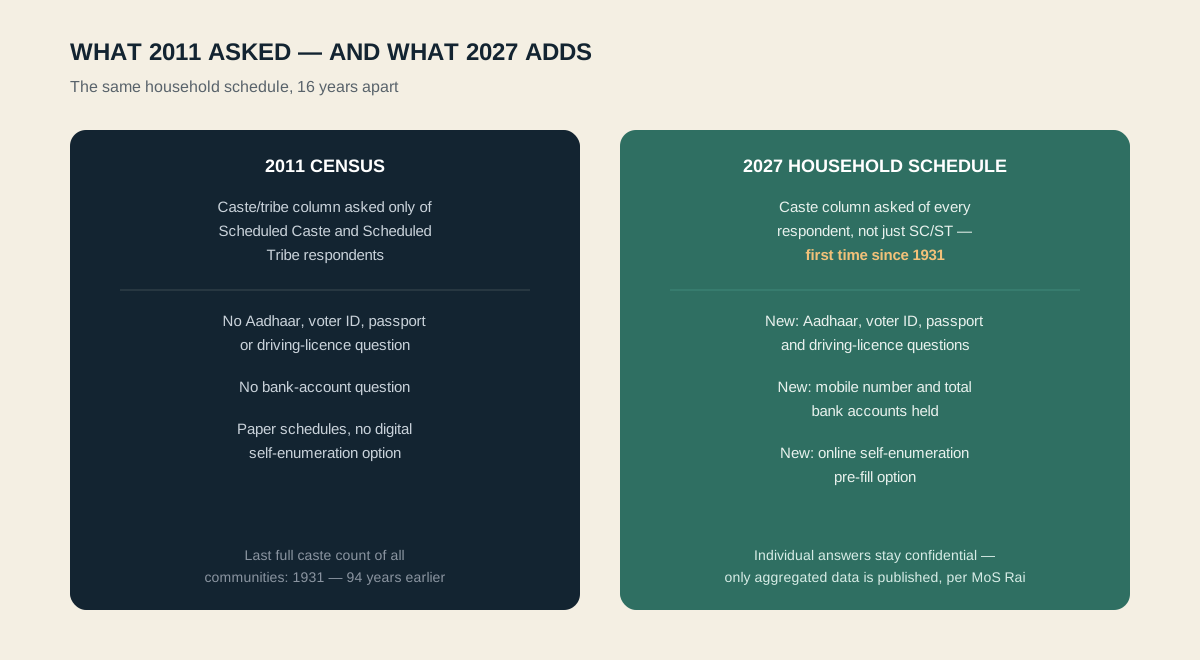
- For the first time since 1931 — a 94-year gap — caste will be recorded for every respondent, not only Scheduled Castes and Scheduled Tribes.
- The same schedule adds personal-identity questions never asked before: Aadhaar number, voter ID number, passport status, driving licence status, mobile number and total bank accounts held.
- Snow-bound Himalayan districts count first — Population Enumeration runs there from September 2026, with online self-enumeration pre-fill open 17–31 August 2026. The rest of India follows nationwide from 9–28 February 2027.
- The government says individual answers stay confidential and only aggregated figures get published — though at least one opposition MP has publicly asked whether disclosing caste will be optional.
- The eventual population count also feeds the next delimitation exercise — the Lok Sabha seat-redrawing fight HeadlineDecoded has tracked since April.
AI SummaryAI-generated summary, reviewed by editors
The Registrar General has notified the 40 questions for Census 2027's Household Schedule. For the first time since 1931, caste will be asked of every respondent, not just Scheduled Castes and Tribes — alongside new Aadhaar, bank-account and voter-ID questions. Here is what's confirmed, what's still unresolved, and why
Switch to ShortsWhat the notification actually says
The Household Schedule is the form an enumerator fills in — on paper for decades, on a smartphone app this time — for every person in every household. The 14 August notification lists all 40 items it will collect: name, relationship to head of household, sex, date of birth, marital status, religion, mother tongue, disability status, migration history, education, employment, and — new to this round — caste, Aadhaar number, voter ID number, passport status, driving licence status, mobile number, number of bank accounts, and even where a person received their Covid-19 vaccination.
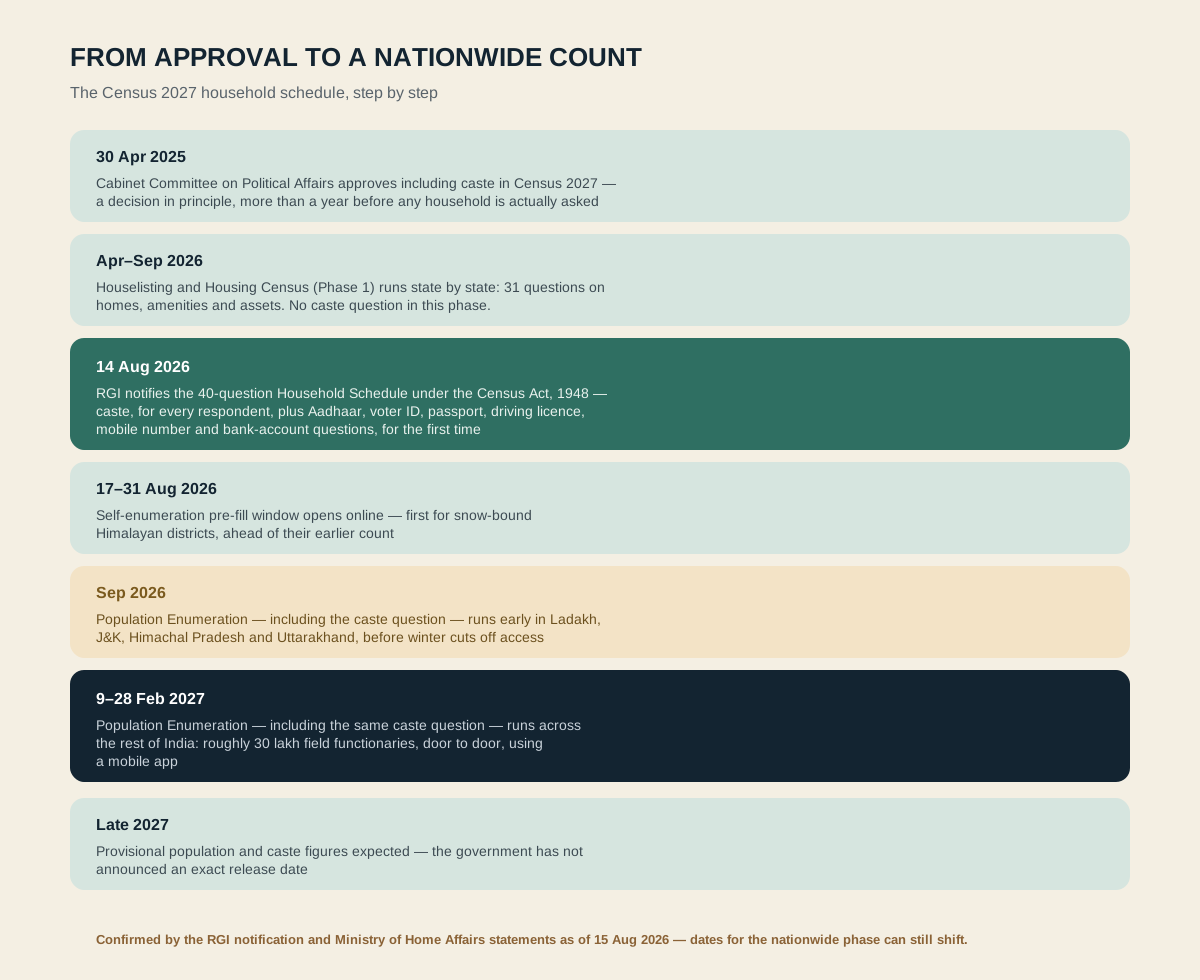
This is a separate step from the Houselisting and Housing Census that already ran state by state between April and September 2026, which asked about the home itself — drinking water, electricity, assets — and did not touch caste. The Household Schedule notified this month is what feeds Population Enumeration, the count of people rather than houses.
Why caste is back after 94 years
India's last census to record caste across every community was in 1931, under colonial administration. Every census since Independence has asked about caste only to identify Scheduled Caste and Scheduled Tribe status — categories tied to constitutional protections and reservation — not to count every jati in the country. The Cabinet Committee on Political Affairs, chaired by the Prime Minister, approved bringing a full caste count back into the census on 30 April 2025, more than a year before any household was actually asked. Friday's notification is the operational step that turns that decision into an actual question on the form.
The politics here are not subtle. Caste data feeds directly into arguments over reservation quotas, welfare targeting and representation — several opposition parties have demanded a caste census for years, and the government's own framing leans on it as a transparency measure. Whatever the motive, the immediate fact is narrower than the debate around it: this notification sets out what will be asked, not what will be done with the answers once they exist.
The new personal-ID questions — and the confidentiality promise
Every previous Indian census asked about people, not their paperwork. This one asks for Aadhaar, voter ID, passport and driving-licence status, plus a mobile number and how many bank accounts a person holds — details no census here has collected before. Minister of State for Home Affairs Nityanand Rai has stated on the record that individual data collected in the census stays confidential, and that only aggregated figures at various administrative levels are published — a standing legal protection under the Census Act, not a new promise invented for this round.
That has not closed the question for everyone. West Bengal TMC MP Shatrughan Prasad Sinha has publicly asked whether disclosing caste will be optional — a fair question, given that the Census Act actually cuts the other way: Section 8 makes it a legal duty to answer a census officer truthfully, and Section 11 sets a fine of up to ₹1,000 for refusing or knowingly giving a false answer. In other words, under the law as it stands, answering is not optional in the way a survey is — though the Act separately protects a few specific categories of answer, such as not requiring a woman to name her husband.
Not everyone is being asked right now — the phased rollout, explained
It is easy to read "notification issued" as "enumerators are at your door this week." They are not, for most of the country. Snow-bound Himalayan districts — Ladakh, Jammu and Kashmir, Himachal Pradesh and Uttarakhand — go first, because winter cuts off physical access later in the year: their Population Enumeration, caste question included, runs in September 2026, with an online self-enumeration window open 17–31 August 2026 for households that want to pre-fill their answers before an enumerator visits. Everywhere else in India, Population Enumeration is scheduled for 9–28 February 2027, using broadly the same field workforce — roughly 30 lakh functionaries — that carried out the Houselisting phase on a mobile app instead of paper. The government has not announced an exact date for when provisional figures, including the caste breakdown, will actually be released; expect that some time in late 2027, not immediately after enumeration ends.
Why this connects to India's delimitation fight
Every count taken in this census will eventually be the population figure used for whatever comes after the current Lok Sabha seat freeze — the fight HeadlineDecoded has covered since the Delimitation Bill 2026 failed to clear the Lok Sabha in April. A Delimitation Commission works from Census population data to redraw constituency boundaries and seat counts, and any future recalculation of SC/ST reserved seats depends on exactly the kind of caste and population data this census will produce. That is also why competing seat-count projections circulating today are still just projections — the real numbers this census generates are years away, and the next delimitation exercise cannot proceed without them. For the full run of that story, see HeadlineDecoded's ongoing Delimitation Bill coverage.
Questions readers are asking
Do I have to answer the caste question?
Under Section 8 of the Census Act, 1948, yes — census questions are a legal obligation, not an optional survey, and Section 11 sets a fine of up to ₹1,000 for refusing to answer or knowingly answering falsely. Whether that legal position will actually hold up against public pressure to make caste disclosure optional, as some MPs have asked, is an open political question, not a settled one.
Will my individual caste or Aadhaar answer be made public?
The government's stated position, given on record by MoS Nityanand Rai, is that individual-level data stays confidential and only aggregated figures at administrative levels are published. That protection has applied to Indian census data for decades; this notification does not change it.
Does this change reservation quotas right now?
No. This notification sets out what questions will be asked, starting in September 2026 for snow-bound districts and February 2027 nationwide. Any policy use of the resulting caste data — including reservation debates — would come after the data exists, likely not before late 2027 at the earliest.
Why does a population census need my bank account count?
The government has framed the new identity and financial-access questions as measuring financial inclusion and digital-service reach rather than collecting financial details themselves — the schedule asks how many bank accounts a person holds, not balances or transaction data. That framing has not stopped the questions from drawing scrutiny, given how much personal-identity data is being gathered in one place for the first time.
If I already used the self-enumeration portal for my house, do I need to do it again?
The self-enumeration option that ran during Houselisting covered housing and amenities, a separate form from the Household Schedule with caste and personal-ID questions. The 17–31 August 2026 self-enumeration window is for that Household Schedule, currently open to snow-bound districts ahead of their September count; households elsewhere will get their own pre-fill window closer to February 2027.
Abbreviations and full forms
RGI — Registrar General of India. SC/ST — Scheduled Castes/Scheduled Tribes. MoS — Minister of State. MHA — Ministry of Home Affairs.
Sources and provenance
- Centre issues notification for first phase of Census 2027 — News on Air (Prasar Bharati), on the Houselisting notification, workforce and mobile-app rollout.
- Census 2027 to collect mobile, Aadhaar, bank accounts, ID details alongside caste — ThePrint, on the 40-question Household Schedule, the Nityanand Rai confidentiality statement, budget and Cabinet-approval date.
- Census 2027: Aadhaar, bank accounts, mobile numbers & caste among 40 questions — Onmanorama, on the notification date and timeline.
- Census 2027: Centre notifies 40 questions, caste and Covid vaccination details included — India TV News, on the RGI Commissioner's name and the notified question list.
- Census 2027 India: Phase 1 Schedule, Self-Enumeration & How to Register Online — PIB Points, on the Houselisting-versus-Population-Enumeration phase dates.
- The Census Act, 1948 — Indian Kanoon, Sections 8 and 11 on the legal duty to answer and penalties for refusal.
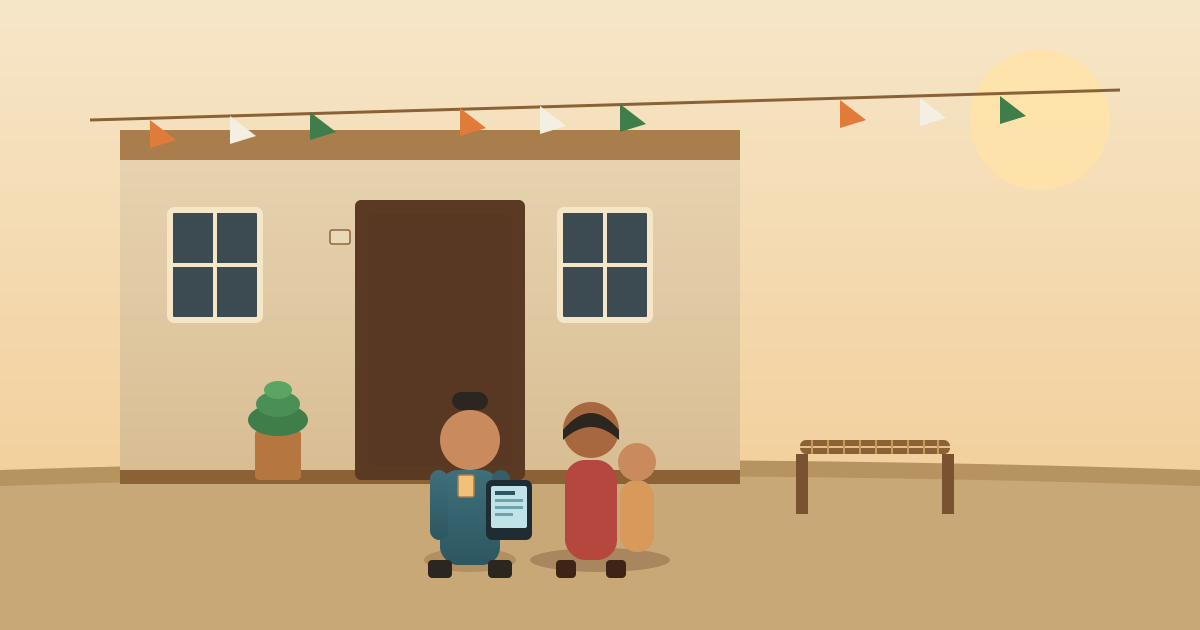
Image disclosure: the header is a newsroom-created editorial illustration of a generic enumerator-at-doorstep scene. It does not depict any real official, household or location.
HeadlineDecoded is committed to accuracy and transparency. Read our standards or submit a correction.