Before the 2025–26 campus-placement season began, students and placement-team members at several Indian Institutes of Technology (IITs) told Careers360 that more students were rejecting pre-placement offers (PPOs). At IIT Roorkee, the report put PPOs at 250, up from 200, and rejections at 24, up from 18. The original story was a pre-season snapshot published in November 2025—not a result from 2026. Official placement rules and IIT Delhi’s later results add the context needed to understand both the opportunity and the risk.
Update and correction: The previous version said final placements would begin on 1 December 2026. The cited report was published on 17 November 2025 and referred to placements beginning on 1 December 2025 for the graduating class of 2026. This version corrects the year, adds official IIT policies and includes the later IIT Delhi Phase I outcome. It also removes unsupported certainty about whether individual students who rejected PPOs secured better jobs.The story in 60 seconds
- Careers360 reported that PPOs rose 10–20% across selected IIT campuses before the 2025–26 placement season, while rejections also increased.
- At IIT Roorkee, the reported count was 250 PPOs and 24 rejections, compared with 200 and 18 in the previous cycle; IIT Madras rejections were reported up 10–15%.
- IIT rules differ: accepting a closed PPO at IIT Madras ends regular placement participation, while IIT Hyderabad permits limited attempts at a declared “dream” company under defined conditions.
- By December 2025, IIT Delhi officially reported 1,275 offers, more than 1,140 students placed and over 300 PPOs—33% more PPOs than the previous year.
- No verified source reviewed by HeadlineDecoded tracks the eventual result for every student who rejected a PPO. Campus-wide totals cannot prove that their individual bets succeeded.
AI SummaryAI-generated summary, reviewed by editors
Students at several IITs reportedly rejected more pre-placement offers before the 2025–26 placement season. Official rules show why that was a consequential choice; later campus totals show a strong market, but not whether each gamble paid off.
Switch to ShortsWhat a PPO is—and why “guaranteed job” needs qualification
A pre-placement offer is normally made after an internship or another evaluation route, before the main campus interviews. It is more certain than entering placements without an offer, but it still operates under institute and company conditions. At IIT Madras, the official 2025–26 guide distinguishes a closed PPO, which must be accepted or rejected within 72 hours, from an open PPO, which can remain available until the company’s placement slot.
Once an IIT Madras student accepts a PPO, the guide says the student is removed from the placement process. IIT Hyderabad uses a different framework: its published policy permits a limited “dream option” after an accepted PPO, with eligibility depending on the package and other conditions. So “reject the PPO or lose every chance to improve” is not a universal IIT rule; students must read their own institute’s current policy.
What was reported before placements
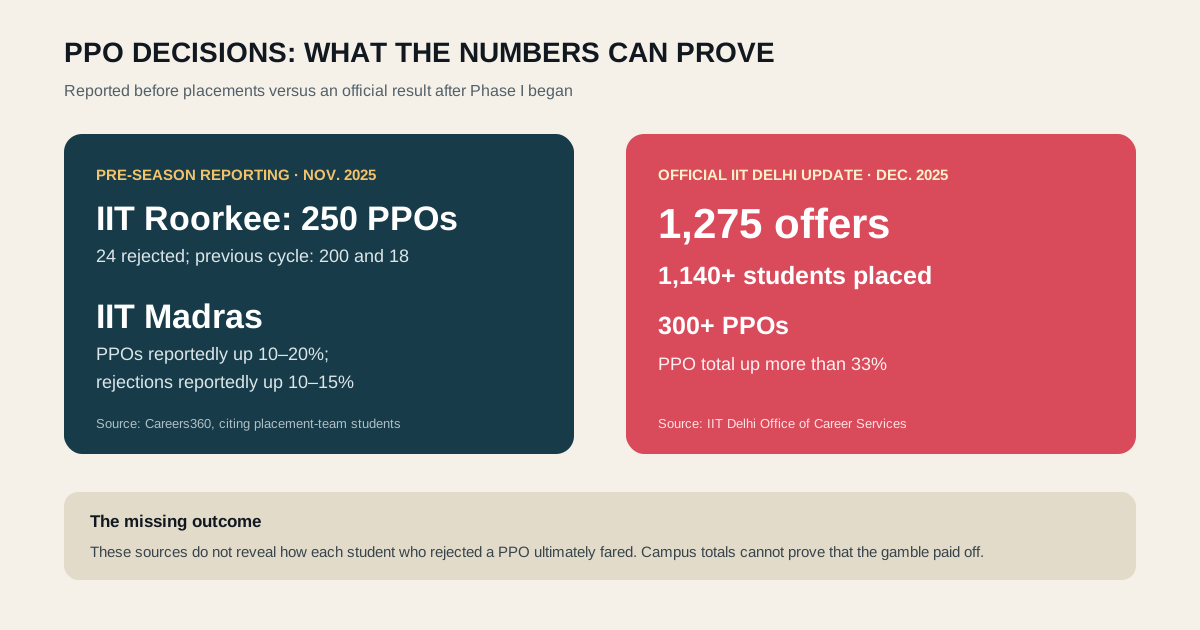
The November 2025 Careers360 report relied mainly on students or placement-team members, some unnamed. It reported a 10–20% rise in PPOs across the IIT campuses discussed, 250 PPOs at IIT Roorkee with 24 rejected, and a 10–15% year-on-year rise in rejections at IIT Madras. Respondents linked the decisions to confidence after internships, hopes of better roles and pay, work-life balance and the desire to enter the main placement round.
Those figures are credible as attributed reporting, but they are not a centrally audited dataset for all IITs. They should not be rewritten as a universal IIT trend or as proof that rejecting an offer produced a better outcome.
What placements later showed
IIT Delhi’s Office of Career Services reported on 29 December 2025 that students had secured 1,275 offers, including PPOs, and more than 1,140 individual students had been placed. It said the institute received more than 300 PPOs, up over 33% from the previous year, along with more than 35 international offers.
The recruiter list in IIT Delhi’s official release included technology, finance, consulting, manufacturing and other employers. That complicates the earlier claim that the “big three” consulting firms were simply absent from IIT campuses: the pre-season source reflected respondents’ campus experience at that point, while IIT Delhi later reported substantial consulting participation, including Accenture Strategy and Consulting, EY GDS and EY-Parthenon. The official release did not list McKinsey, BCG or Bain, but absence from one published recruiter list is not proof that all three were absent from every IIT for the entire season.
The unanswered question: did rejection pay off?
None of the sources reviewed provides a matched outcome table showing the PPO rejected by each student and the final offer that student later accepted. Without that, it is not possible to calculate a “success rate” for rejecting PPOs. Aggregate placement strength can explain why students felt confident; it cannot establish that a particular decision was wise.
The decision also depends on more than headline cost to company (CTC). Students should compare fixed pay, variable pay, stock conditions, location, role, joining date, bond or clawback clauses, probation, work hours, learning and the risk that an offer is delayed or withdrawn. Our career and degree decision checklist explains how to compare long-term value instead of one headline number.
A decision checklist before accepting or rejecting
- Read the institute rule first. Confirm whether acceptance removes you from placements and whether an open or dream option exists.
- Separate fixed pay from CTC. Ask for the fixed component, variable conditions, stock vesting and relocation costs.
- Compare roles, not only brands. Day-to-day work, manager, location and skill growth may matter more than a modest salary difference.
- Price the downside. Decide whether you can tolerate graduating without an alternative offer if the main round underperforms.
- Verify everything in writing. Use the placement office and official offer documents; do not rely on screenshots, anonymous salary spreadsheets or social-media claims.
Why this is not the average engineering graduate’s market
The reported choices came from highly selective institutions with concentrated recruiter access. They do not show that most Indian engineering students can safely reject a solid offer. Our reporting on India’s youth skills-to-jobs gap and degree ROI and AI exposure provides the broader labour-market context. For students outside major placement campuses, verifying whether an offer is real, paid and aligned with the role promised may be the more important question.
Questions readers are asking
Do all IITs follow the same PPO rule?
No. IIT Madras and IIT Hyderabad publish materially different routes. Students must check the current policy at their own institute.
Did 24 IIT Roorkee students all get better offers?
There is no verified matched-outcome evidence in the reviewed sources. The 24 figure was attributed to a placement-team student before the main round.
Does a higher CTC always mean a better offer?
No. CTC may include variable pay, joining or retention bonuses and stock values that are not equivalent to monthly fixed salary.
Was the placement round in December 2026?
No. The cited pre-season report concerned the 2025–26 cycle and said the main round began on 1 December 2025 for students graduating in 2026.
Sources and method
- IIT Delhi Office of Career Services: 2025–26 placement update.
- IIT Madras official 2025–26 placement and PPO policy.
- IIT Hyderabad official placement and PPO policy.
- Careers360’s 17 November 2025 pre-season report.
Image disclosure: the header is an AI-generated editorial illustration of a generic engineering student considering an offer. It is not a photograph of a real student, IIT campus, company or placement decision. No original official social post containing the cross-campus rejection figures was found; the article therefore links the institutes’ official pages and the attributed report rather than embedding unverified posts.
Related: What Oracle’s AI restructuring shows about entry-level hiring.
Related: What Oracle’s AI restructuring shows about entry-level hiring.
Related: What Oracle’s AI restructuring shows about entry-level hiring.
Related: What Oracle’s AI restructuring shows about entry-level hiring.
Related: What Oracle’s AI restructuring shows about entry-level hiring.
Related: What Oracle’s AI restructuring shows about entry-level hiring.
Related: What Oracle’s AI restructuring shows about entry-level hiring.
Related: What Oracle’s AI restructuring shows about entry-level hiring.
HeadlineDecoded is committed to accuracy and transparency. Read our standards or submit a correction.