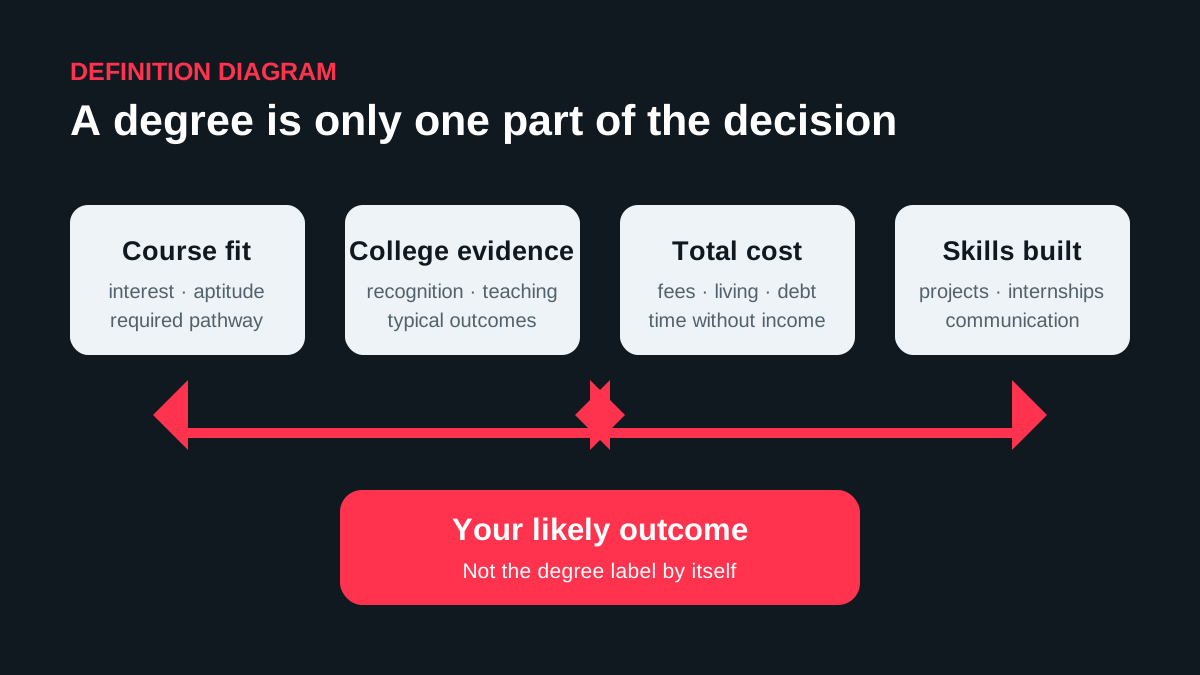
The most useful question is not “Which degree is best?” It is “Which affordable course, at which credible college, gives me the strongest route into work I can realistically do?”
The story in 60 seconds
- Do not rank a degree in isolation: compare the course, college, complete cost and skills you will build together.
- Calculate tuition, living costs, equipment, loan interest and income forgone—not only the advertised annual fee.
- Verify the institution and programme, then inspect typical placement and higher-study outcomes instead of the highest package.
- Test a field through a small real task and conversations with recent graduates before committing years and money.
- Prepare for artificial intelligence by building strong subject foundations, judgement, communication and verifiable practical work.
AI SummaryAI-generated summary, reviewed by editors
Before comparing BTech, BCom, BA, BSc, BCA, medicine, law or management, compare the college, total cost, real outcomes and skills you will graduate with.
Switch to ShortsDegree rankings often compress very different students and colleges into one misleading list. A low-fee BSc with strong teaching, internships and a clear postgraduate route may be a better decision than an expensive engineering seat with weak placements. A BCom can be valuable for one student and unsuitable for another. Medicine, nursing, law and accountancy can offer durable professional routes, but they also involve very different entrance barriers, training periods, licensing rules and costs.
India’s own education data shows why broad labels are not enough. The latest available All India Survey on Higher Education records more than 1.13 crore students in Arts, 49.18 lakh in Science, 44.08 lakh in Commerce and 39.04 lakh in Engineering and Technology. These are enormous and internally diverse groups—not single career outcomes.
Start with the job, not the degree name
Write down three roles you might want at age 23 or 24. They do not need to be permanent life decisions. For each role, answer:
- Is a specific degree or professional registration legally required?
- What do entry-level job advertisements repeatedly ask for?
- Can I test the work now through a small project, course, volunteer assignment or job shadow?
- What is the realistic backup route if I change my mind?
This immediately separates regulated careers from open-entry careers. A doctor, nurse, pharmacist or advocate follows prescribed education and registration routes. Software, sales, design, media, analytics and many business roles are more open, but employers may demand evidence of practical ability.
Calculate the real cost before discussing ROI
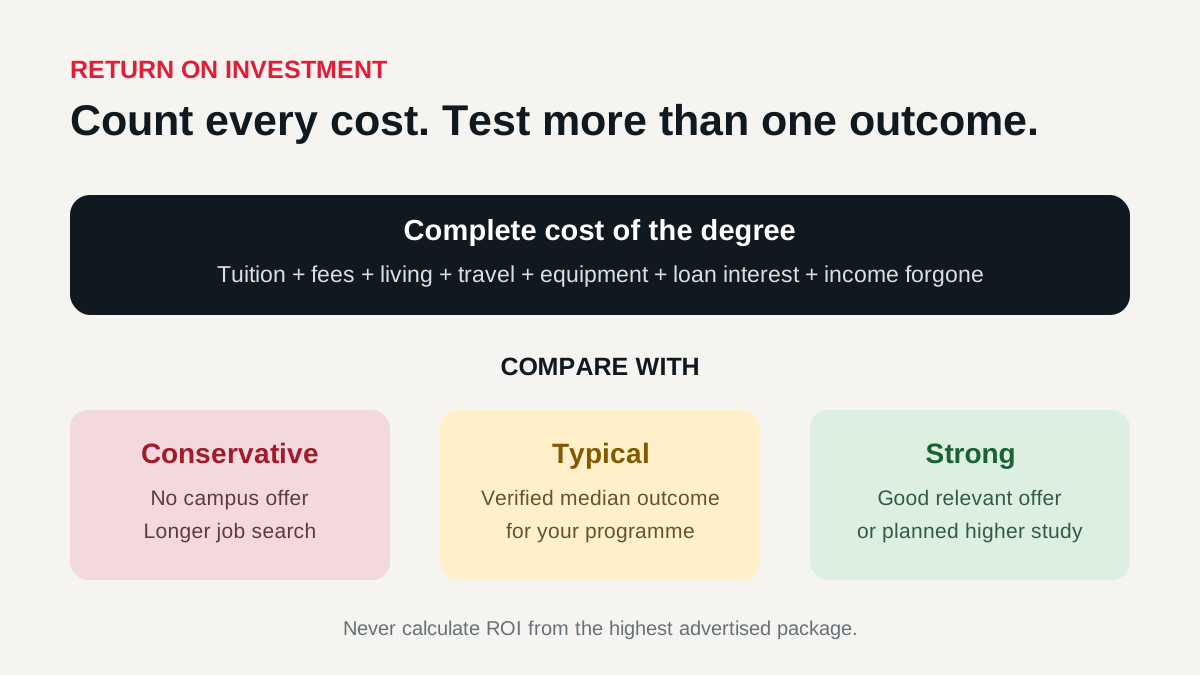
Do not compare only annual tuition. Calculate the full cost of completing the course:
Total course cost = tuition + mandatory fees + accommodation + travel + equipment + interest on education loans + income you give up while studying.
Then make three outcome cases—not one optimistic placement claim:
- Conservative: no campus placement and six to twelve months to find relevant work.
- Typical: the institution’s median outcome for the programme, not its highest package.
- Strong: a good placement or admission into the next qualification you genuinely plan to complete.
A lower-fee government or aided seat can improve this calculation substantially, but low fees alone do not make a course suitable. Teaching quality, laboratories, clinical exposure, internships, location, safety and completion rates still matter.
Check the college’s evidence, not its advertisement
Before paying a deposit, verify the institution and the exact programme. The University Grants Commission advises students and parents to check whether a higher-education institution is recognised, and it maintains warnings about fake or non-compliant institutions. Online and distance programmes require recognition for the relevant academic session; last year’s approval is not automatically enough.
For institutions participating in the National Institutional Ranking Framework, open the institution’s submitted-data PDF rather than relying only on its rank. Look for:
- the number of students who graduated;
- the number placed;
- the median salary of placed graduates;
- the number entering higher studies; and
- whether the figures cover your programme and graduating year.
Ask the college for a programme-level placement report with employer names and role types. “Up to ₹30 lakh” tells you almost nothing about the typical student. Ask how many students were eligible, how many sought placements and how many received relevant offers. Speak privately to at least two recent graduates found independently, not only ambassadors selected by the college.
How to think about the major degree families
Technology: BTech, BCA and computing-oriented BSc routes
These routes can lead to software, data, cybersecurity, product and IT operations, but the degree title does not substitute for fundamentals. Compare the curriculum’s mathematics and computing depth, faculty continuity, laboratories, internship access and the quality of student projects. A BCA followed by an MCA is a longer route than a three- or four-year technical degree, so include the extra time and fees in the comparison. Test your interest by completing a small programming project before admission.
Commerce and business: BCom and BBA
These degrees keep several routes open—accounting, operations, sales, banking, analytics, management studies and professional qualifications—but a vague plan to “do an MBA later” is not enough. Check whether the programme teaches spreadsheets, financial statements, statistics, business writing, presentations and data tools. Chartered Accountancy can be a strong professional path for students who actually want audit, tax, reporting or finance, but its examinations and training commitment should be evaluated separately from the BCom degree.
Science: BSc and related programmes
A BSc can support research, laboratories, teaching, analytics, technology and postgraduate specialisation. Its value depends heavily on the subject, laboratory access and the next step. Ask whether a bachelor’s degree is enough for the roles you want or whether an MSc, professional programme or competitive examination is normally required. Build one visible proof of ability: a data project, lab portfolio, field study, technical report or research internship.
Humanities and social sciences: BA and liberal disciplines
These are not automatically “low-value” degrees. They can build research, language, writing, policy, teaching and analytical capabilities. The risk is graduating without a clear body of work or occupational route. Pair the subject with evidence: published writing, survey analysis, a language credential, archival or field research, teaching experience, public-policy work, statistics or a portfolio relevant to the intended role.
Regulated professions: medicine, nursing, pharmacy and law
These paths should be evaluated through recognition, licensing, supervised training, total duration and working conditions—not only first salary. For medicine, include internship and possible postgraduate preparation. For nursing, check clinical exposure, registration and the actual requirements of any country where you may later work; learning a language does not by itself guarantee migration or employment. For pharmacy, distinguish community, hospital, industry, regulatory and research roles. For law, compare litigation, corporate, compliance, public service and judiciary routes, because their early-career economics differ greatly.
Do not ask whether AI will “replace the degree”
AI affects tasks, not every worker in a field equally. Routine drafting, basic coding, standard research and repetitive analysis may change faster than work requiring responsibility, judgement, physical presence, trusted relationships, regulation or deep domain knowledge. But no degree is permanently AI-proof.
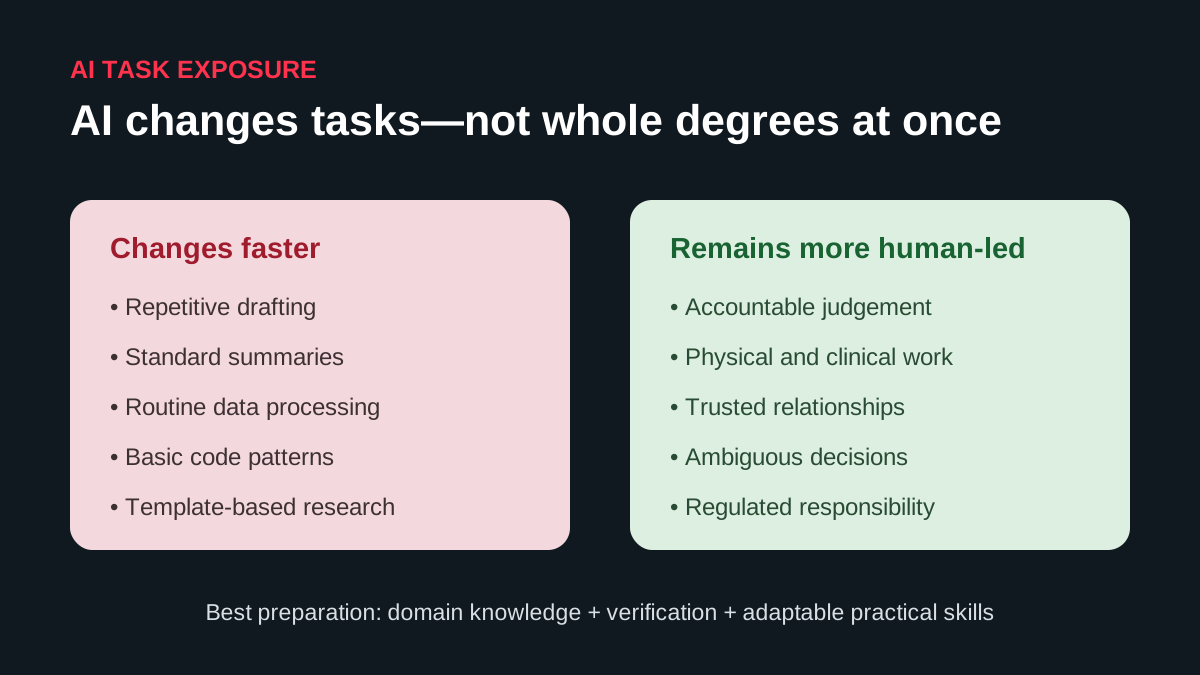
The Economic Survey 2025–26 emphasises foundational skills, adaptability, problem-solving, working with others and structured links between education and work. That suggests a better strategy than adding “AI” to a résumé:
- learn the foundations of your discipline well enough to detect an AI tool’s mistakes;
- use AI for low-risk practice, comparison and first drafts—not as an unverified authority;
- learn spreadsheets, data handling, research and clear communication;
- complete projects with real constraints and explain your decisions; and
- understand privacy, copyright, bias and professional accountability.
A 30-day test before committing years and lakhs
- Week 1: read the first-year syllabus from three colleges and note the subjects that genuinely interest or concern you.
- Week 2: complete one beginner task from the field—write a small program, analyse a company’s accounts, read a legal judgement, complete a lab simulation, interview a professional or produce a researched essay.
- Week 3: speak to one current student and two graduates. Ask what surprised them, what the college did not provide and what they had to learn independently.
- Week 4: compare three affordable college-course combinations using total cost, verified outcomes, curriculum, location, internships and backup options.
The decision sheet
Score each college-course combination from 1 to 5 on the factors below. Do not score a degree in the abstract.
- Interest and aptitude: Can I tolerate the actual coursework and daily work?
- Recognition: Are the institution and programme valid for this admission year?
- Affordability: Can my family manage the conservative outcome without dangerous debt?
- Typical outcomes: Are placement and higher-study figures transparent and relevant?
- Practical exposure: Are laboratories, clinics, internships or projects genuinely available?
- Optionality: If my first plan changes, what credible routes remain?
- Skill-building time: Will the workload and location allow projects, internships and communication skills?
Final rule: never borrow heavily because of one exceptional salary shown in an advertisement. Choose using a conservative financial case, verify the programme, and know what you will build beyond the syllabus. A degree can open a door; the college, cost, experience and evidence of skill determine how useful that door becomes.
Official sources and tools
- Ministry of Education: All India Survey on Higher Education 2021–22
- Economic Survey 2025–26: Employment and Skill Development
- Economic Survey 2025–26: Evolution of the AI Ecosystem in India
- UGC: verify higher-education institutions and advisories
- UGC recognition and distance-learning FAQs
- NIRF India Rankings 2025: college data and institution submissions
Abbreviations and full forms
- AI: Artificial Intelligence
- AISHE: All India Survey on Higher Education
- BA: Bachelor of Arts
- BBA: Bachelor of Business Administration
- BCA: Bachelor of Computer Applications
- BCom: Bachelor of Commerce
- BSc: Bachelor of Science
- BTech: Bachelor of Technology
- CA: Chartered Accountancy
- MCA: Master of Computer Applications
- NIRF: National Institutional Ranking Framework
- ROI: Return on Investment
- UGC: University Grants Commission
HeadlineDecoded is committed to accuracy and transparency. Read our standards or submit a correction.