One-sentence decode: Most students still pick a degree by prestige or family expectation rather than by what it actually returns years later — this is our own comparison of India's most common undergraduate degrees on employability, ROI, AI resistance and optionality, with the specific exams, seats and skills that move each one up or down.
The story in 60 seconds
- We compare 13 common undergraduate paths on four measures: employability, return on investment, resistance to AI disruption, and optionality (how many career paths stay open).
- Typical, middle-of-the-pack outcomes matter more for planning than the best-case topper any college advertises — so that's what this ranking is built around.
- B.Tech in Computer Science/IT and MBBS come out strongest overall; B.Com and BA alone are the weakest without an add-on qualification or extra skills.
- The two levers that move almost every degree up a tier: a government-college seat (for cost, not prestige) and deliberately layering AI-adjacent skills on top of the syllabus.
AI SummaryAI-generated summary, reviewed by editors
Prestige and family expectation are how most students still pick a degree — rarely what it actually returns years later. Here's our own analysis of India's most common undergraduate degrees on four honest measures: employability, return on investment, AI resistance and optionality.
Switch to ShortsHow we're weighing this
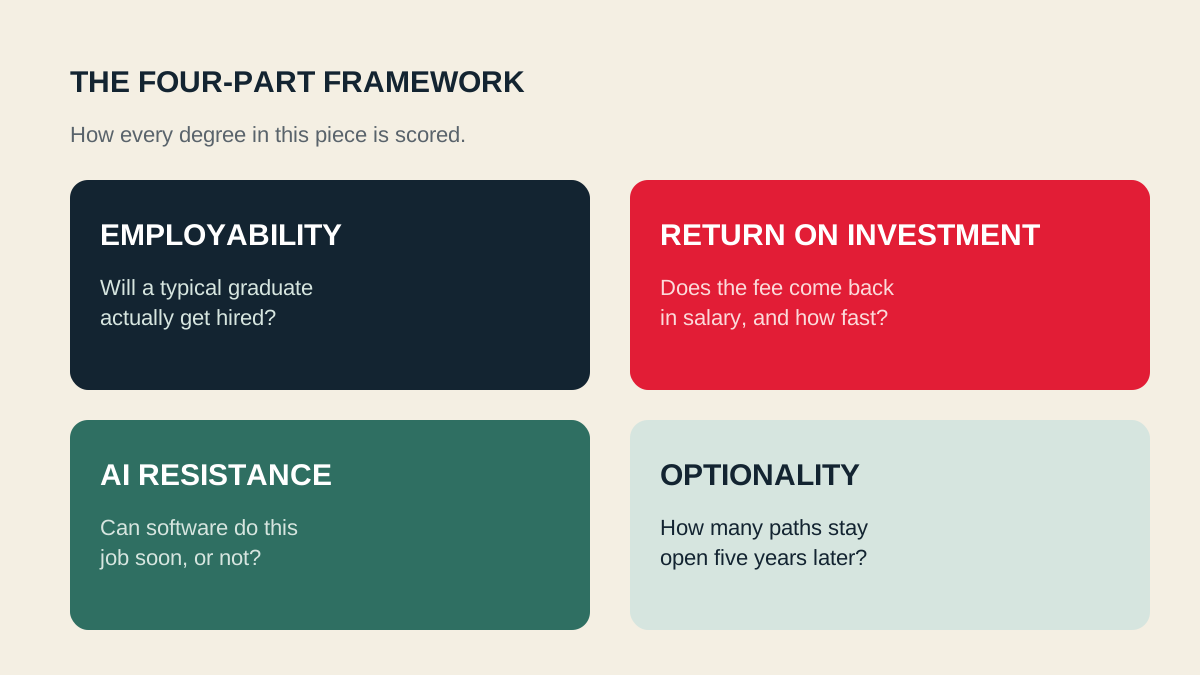
"Which degree is prestigious" is the wrong first question. The more useful ones are narrower: Will you get hired? Does the fee you pay come back in salary within a reasonable time? Can software do this job soon? And if you change direction mid-career, how many doors are still open?
We score each degree qualitatively on those four measures using typical outcomes — the middle of the distribution, not the IIT topper or the AIIMS rank-one who skews every average upward. Planning around the median graduate is a more honest way to choose a degree than planning around the best-case one.
1. B.Tech in Computer Science / IT — the strongest overall bet
Employability: High. ROI: Strong, especially from government institutes. AI resistance: Moderate — routine coding is being automated, but building and shipping software isn't. Optionality: High.
Entry is via JEE Main/Advanced for IITs and NITs, or state engineering entrance exams (MHT-CET, KCET, and others) for state government colleges — both dramatically cheaper than private engineering colleges for a comparable, sometimes better, outcome. The degree alone gets you in the door; what actually moves starting pay is what you build alongside it — real projects, internships, and applied AI skills (below) rather than just clearing exams.
2. MBBS — a slow-burn but very strong career
Employability: High (licensed profession). ROI: Strong long-term, slow to arrive. AI resistance: High. Optionality: Moderate — but with deep specialisation options.
Entry is exclusively via NEET-UG. This is the one degree on this list where the government-vs-private gap in fees is largest — a government medical college can cost a small fraction of a private one for the identical licence to practise. AI is transforming diagnostics and imaging, but it isn't replacing the legal authority to treat patients, which is why medicine stays near the top despite the long runway to real earnings (internship, then possibly a postgraduate specialisation via NEET-PG).
3. B.Com + CA — the combination beats the base degree
Employability: Moderate for B.Com alone, high for B.Com + CA. ROI: Strong. AI resistance: High for the certified role. Optionality: Moderate.
A plain B.Com is a weak signal on its own in most hiring today. Chartered Accountancy changes that — you can start the CA Foundation route right after Class 12 through ICAI, or take the direct entry route after a commerce degree. AI tools can already draft filings and flag anomalies, but they can't sign off with legal liability, which is exactly why the certified role, not the software, stays in demand. Pairing CA with comfort in AI-assisted auditing and analytics tools is what separates a fast promotion from a slow one.
4. MBA — the institution decides almost everything
Employability: Highly institution-dependent. ROI: Excellent from a top-tier school, weak-to-negative from a low-ranked private one. AI resistance: Moderate. Optionality: High.
This is the degree where the ranking question matters most: an MBA is only worth the fee at a genuinely strong institute. CAT is the entry exam for the IIMs and most top B-schools; XAT, GMAT and CMAT open others. If you can't realistically clear a top-80-ish B-school, a two-year MBA fee is usually better spent on a specific, in-demand skill certification plus work experience — an MBA from a weak college rarely pays for itself.
5. B.Pharm — modest now, better positioned for later
Employability: Moderate. ROI: Modest early, improving with specialisation. AI resistance: Improving. Optionality: Moderate.
Starting pay in retail/manufacturing pharma roles is typically modest. The upside is India's large pharmaceutical and generics industry, and a genuine, growing intersection between pharma knowledge and AI in drug discovery, clinical trial design and regulatory data analysis — a B.Pharm graduate who can also handle data tools has a meaningfully different career trajectory than one who only does the licensing coursework. State-level pharmacy entrance exams or merit-based admission are the usual entry route; GPAT opens the door to M.Pharm and research roles later.
6. Nursing — the opportunity is often abroad
Employability: High globally, moderate in India on domestic pay alone. ROI: Strong if you go overseas. AI resistance: High (hands-on care). Optionality: Moderate.
Domestic nursing salaries in India are often modest relative to the workload, but ageing populations in Germany, Japan, the Gulf and parts of Europe have structural, long-term demand for trained nurses. B.Sc Nursing is the standard route (admission is merit-based or via state-level tests); the highest-leverage add-on isn't a technical skill at all — it's a language (German, Japanese) plus the relevant international licensing exam for your target country.
7. B.Sc — modest pay, unusually good optionality
Employability: Moderate on the degree alone. ROI: Modest immediately, depends on what comes next. AI resistance: Varies by specialisation. Optionality: High.
B.Sc rarely leads to a strong starting salary by itself, and that's the wrong way to judge it. Its real value is as a base for what follows — MSc, an MBA, teaching, research, a lateral move into tech via a coding bootcamp, finance, or journalism. Admission is largely merit-based, with CUET covering many central universities. If you take this route, treat the three years as a runway to pick a specific specialisation (data, life sciences, or a professional add-on) rather than an end state.
8. BCA — a cheaper on-ramp into tech
Employability: Moderate, rising sharply with skills. ROI: Good — low fees relative to engineering. AI resistance: Moderate. Optionality: Moderate-high.
BCA is a genuinely underrated route into software roles for students who don't clear a top engineering entrance exam or can't afford private engineering fees. Admission is mostly merit-based. Followed by an MCA, or by self-taught, project-backed skills in web/app development and applied AI tooling, BCA graduates can land outcomes comparable to mid-tier engineering graduates — but only if the self-directed learning actually happens, since the BCA curriculum alone is usually lighter than a B.Tech's.
9. BBA — a flexible springboard
Employability: Moderate. ROI: Depends heavily on what follows. AI resistance: Moderate. Optionality: High.
BBA's honest pitch isn't a strong first salary — it's flexibility. It sets up reasonably well for an MBA later, or for direct routes into data analytics, financial analysis, CFA or CMA. IPMAT is worth knowing about if you want an integrated five-year BBA+MBA at an IIM; otherwise admission is largely merit-based or via university-level tests. Treat the three years as a chance to pick a specific lane (finance, analytics, marketing) rather than staying generalist all the way through.
10. Law / LLB — strong, but the college matters
Employability: High from a strong law school, weak from an average one. ROI: Strong for corporate law and litigation from top colleges. AI resistance: Moderate-high (advisory and courtroom work stay human). Optionality: Moderate.
CLAT is the entry exam for the National Law Universities' five-year integrated programme; AILET separately for NLU Delhi. As with an MBA, the college tier matters enormously — corporate law placements are concentrated in a small number of NLUs. AI-assisted contract review and legal research tools are already in use at most firms, which makes comfort with legal-tech tools (not just casebooks) an increasingly real differentiator for new graduates.
Where we'd be more cautious
BA on its own has the weakest employability signal on this list — not because the subject matter lacks value, but because the degree alone rarely demonstrates a specific, hireable skill. It works far better paired with something concrete: a language, a digital skill, a professional exam, or a specific specialisation (economics, psychology, political science) pursued seriously rather than passively.
Architecture, Dentistry, Hotel Management and Mass Communication also rank lower on this framework, for different reasons in each case: Architecture and Dentistry both have long, expensive training pipelines relative to typical early-career pay; Hotel Management has a large graduate supply against a limited number of well-paid roles; and Mass Communication faces a double squeeze — AI tools increasingly handle first-draft writing, transcription and basic research, while entry-level roles at established media organisations are already scarce. None of these are reasons to avoid the field if it's a genuine calling — they're reasons to go in with a specific specialisation and a portfolio, not just the degree certificate.
The biggest single shift: hiring is moving from degree-based to skill-based. The certificate gets you shortlisted; what you can actually do gets you hired.
Add AI skills to your degree — concretely
"Add AI skills" is common advice and rarely specific enough to act on. Here's what it actually looks like by field:
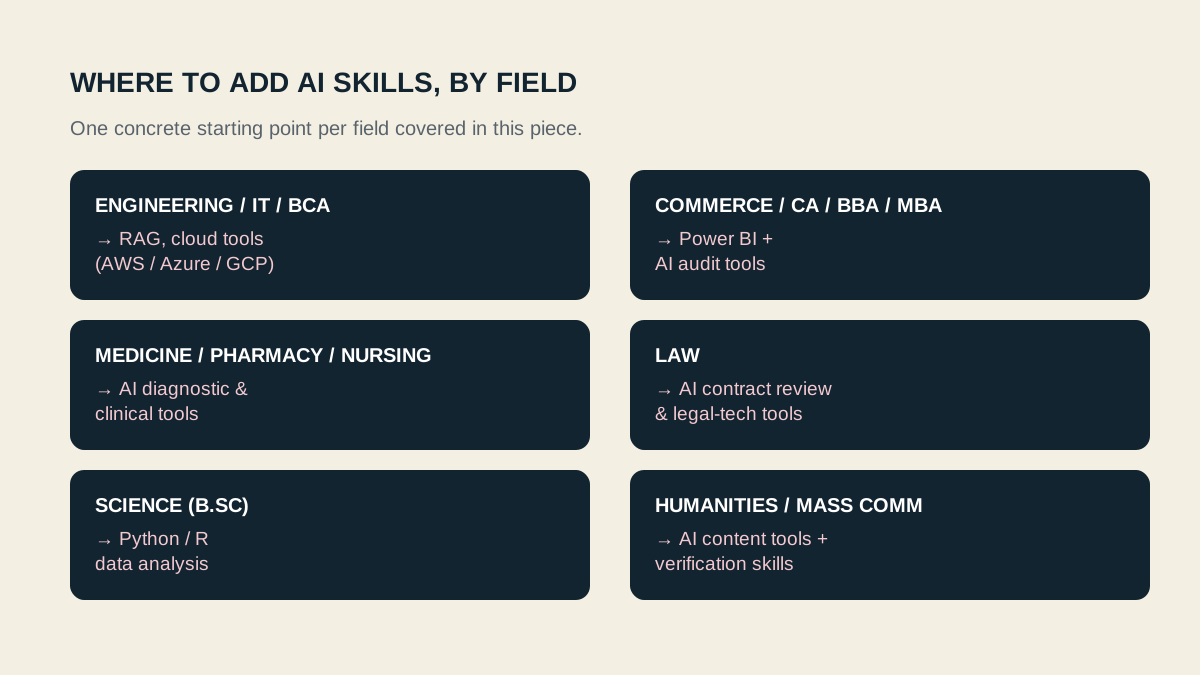
- Engineering/IT/BCA: Python, working with LLM APIs and retrieval-augmented generation (RAG), basic MLOps, and comfort with at least one cloud platform (AWS, Azure or GCP).
- Commerce/CA/BBA/MBA: Excel/Power BI for data analysis, AI-assisted audit and bookkeeping tools, and enough prompt literacy to use AI research and drafting tools critically rather than blindly.
- Medicine/Pharmacy/Nursing: Familiarity with AI-assisted diagnostic and imaging tools, clinical decision-support systems, and — for pharmacy specifically — data analysis relevant to drug discovery and clinical trials.
- Law: AI-assisted contract review, legal research and e-discovery tools, alongside the judgment to know when a tool's output needs human correction.
- Science (B.Sc): Data analysis in Python or R, and basic statistics — the single most transferable skill out of a B.Sc into tech, finance or research.
- Humanities/Mass Communication: AI content and editing tools, paired deliberately with verification, fact-checking and original-reporting skills — the parts of the job AI is worst at and audiences increasingly value.
The government-seat math
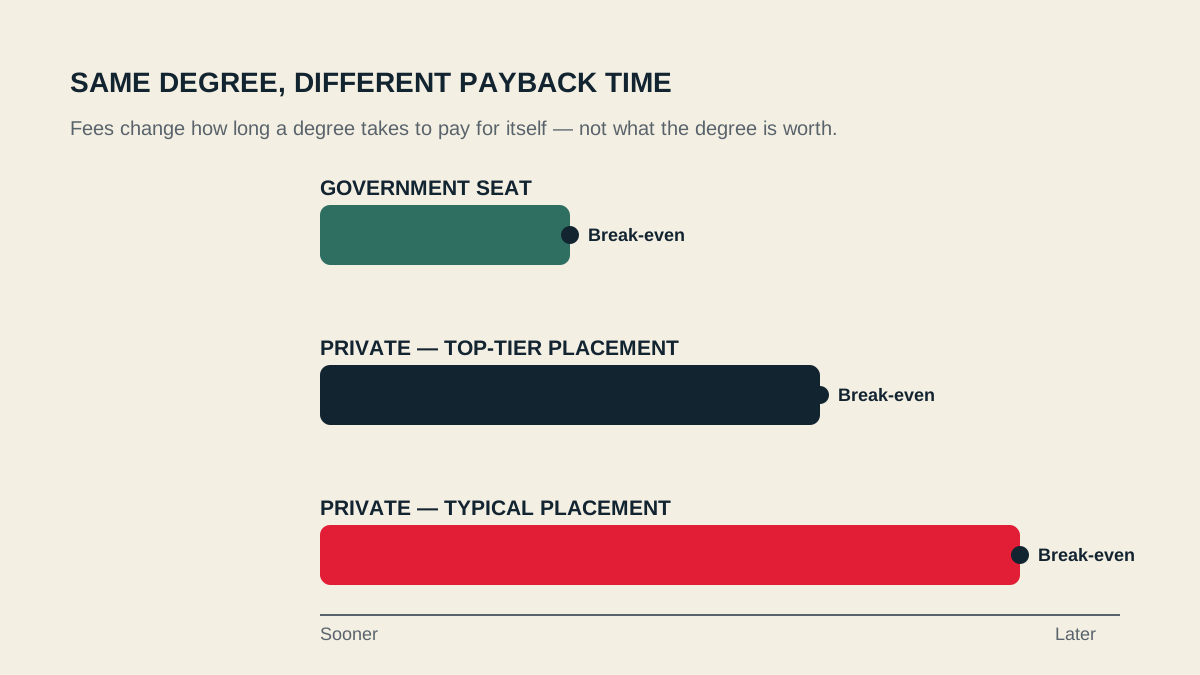
Across almost every field above, a government college seat changes the ROI calculation more than the degree choice itself. Government engineering, medical and law colleges typically charge a fraction of what comparable private institutions do, for a degree that carries the same or greater weight with employers. Where a government seat is realistically within reach through a competitive exam, it is very often the single highest-ROI decision a student makes — not because the label is prestigious, but because it removes years of loan repayment from the other side of the equation. This is worth weighing seriously against a "better-sounding" private college, especially outside the small number of elite private institutions that genuinely deliver placement outcomes to match their fees.
Questions to ask before you commit to a degree
- What's the realistic (not best-case) placement outcome for a middle-of-the-batch graduate at this specific college — not the field in general?
- What's the total cost, including years to break even against a comparable government-seat alternative?
- If this exact degree became 30% harder to get hired for in five years, what's my backup specialisation?
- What's one concrete, in-demand skill I can start building in year one, without waiting for the syllabus to cover it?
Three things to remember
- Degrees that carry licensing power (MBBS), certification power (CA) or hard-to-automate technical skill (B.Tech/IT) hold up best — the ones that rely on the credential alone hold up worst.
- Optionality is a hedge, not a weakness: B.Sc, BBA and BCA rank respectably not because they pay the most on day one, but because they leave the most paths open later.
- The same two levers repeat across every tier — take the cheaper, better-value seat where you genuinely can, and add practical, AI-adjacent skills yourself, because the degree is a starting point, not the whole plan.
Full forms
- AI — Artificial Intelligence
- AILET — All India Law Entrance Test
- AWS — Amazon Web Services
- B.Com — Bachelor of Commerce
- B.Pharm — Bachelor of Pharmacy
- BBA — Bachelor of Business Administration
- BCA — Bachelor of Computer Applications
- B.Sc — Bachelor of Science
- B.Tech — Bachelor of Technology
- CAT — Common Admission Test
- CFA — Chartered Financial Analyst
- CLAT — Common Law Admission Test
- CMA — Cost and Management Accountant
- CMAT — Common Management Admission Test
- CUET — Common University Entrance Test
- GCP — Google Cloud Platform
- GMAT — Graduate Management Admission Test
- GPAT — Graduate Pharmacy Aptitude Test
- ICAI — Institute of Chartered Accountants of India
- IPMAT — Integrated Program in Management Aptitude Test
- IT — Information Technology
- JEE — Joint Entrance Examination
- LLB — Bachelor of Laws
- M.Pharm — Master of Pharmacy
- MBA — Master of Business Administration
- MBBS — Bachelor of Medicine, Bachelor of Surgery
- MCA — Master of Computer Applications
- MLOps — Machine Learning Operations
- MSc — Master of Science
- NEET-UG / NEET-PG — National Eligibility cum Entrance Test (Undergraduate / Postgraduate)
- ROI — Return on Investment
- XAT — Xavier Aptitude Test
Official admission and qualification references
The ranking above is HeadlineDecoded's editorial framework, not an official government league table. Requirements and schedules can change; applicants should use the relevant authority's current notice:
- JEE Main information bulletin — National Testing Agency
- NEET-UG official portal — National Testing Agency
- CUET-UG official portal — National Testing Agency
- CA student services and entry routes — Institute of Chartered Accountants of India
- CLAT and National Law University admissions — Consortium of National Law Universities
For the local geography of opportunity, see our reviewed guide to India’s rising non-metro job markets.
For a current service guide, see our corrected explainer on the one-crore youth AI-skills pledge, YUVA AI and PMKVY.
HeadlineDecoded is committed to accuracy and transparency. Read our standards or submit a correction.