
On International Youth Day 2026, India's young population is being celebrated as its greatest economic advantage. But demography is only potential. A large working-age generation becomes a dividend when young people can learn, practise, find suitable work and progress. If those links fail, the same population advantage can instead produce long job searches, insecure work, underused qualifications and discouraged workers who disappear from the unemployment count.
The story in 60 seconds
- August 12 is International Youth Day. The UN's 2026 theme, Different Contexts, Common Aspirations, focuses on goals young people share across borders: education, decent work, health and a voice in decisions.
- India has built a large skilling system through PMKVY, ITIs, Jan Shikshan Sansthan and the National Apprenticeship Promotion Scheme.
- But training volume is not the same as labour-market success. Enrolment, certification, placement, wages, retention and career progression answer different questions.
- A falling unemployment rate can coexist with weak outcomes if people accept too little work, take jobs unrelated to their qualifications or stop looking altogether.
- AI and automation do not make every young worker obsolete. They change the task mix, raising the value of applied digital ability, judgement, communication and continuous learning.
AI SummaryAI-generated summary, reviewed by editors
On International Youth Day 2026, India's demographic advantage is clear—but it becomes a dividend only when education leads to usable skills, work experience and decent jobs. Here is what the headline employment numbers reveal, and what they leave out.
Switch to Shorts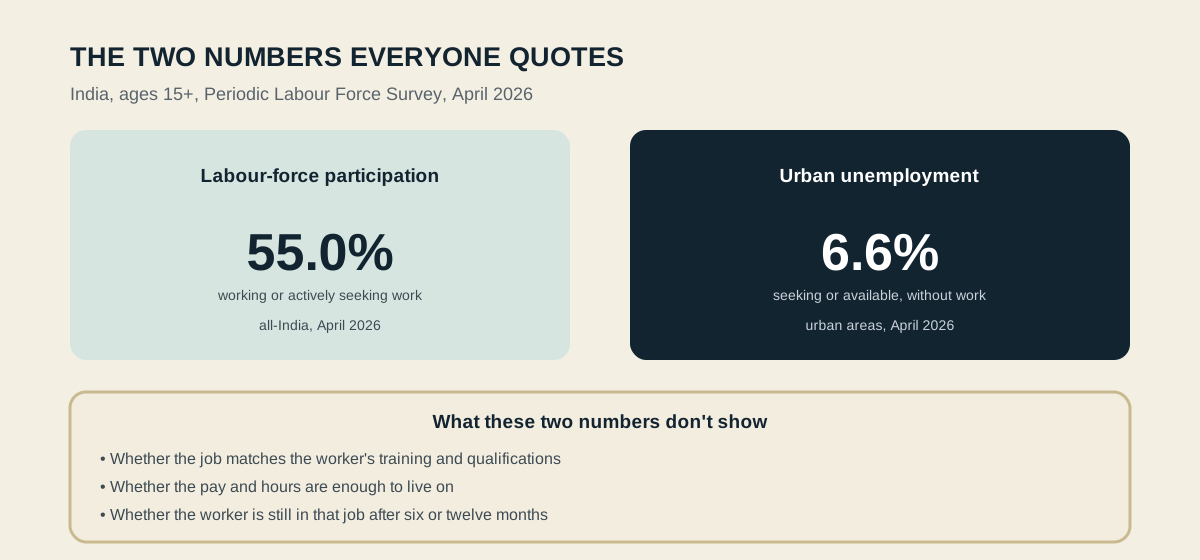
What "demographic dividend" actually means
A demographic dividend is not a prize awarded simply because a country has many young people. It is the economic gain that can occur when the share of working-age people rises relative to dependants—and when those working-age people are healthy, educated and productively employed.
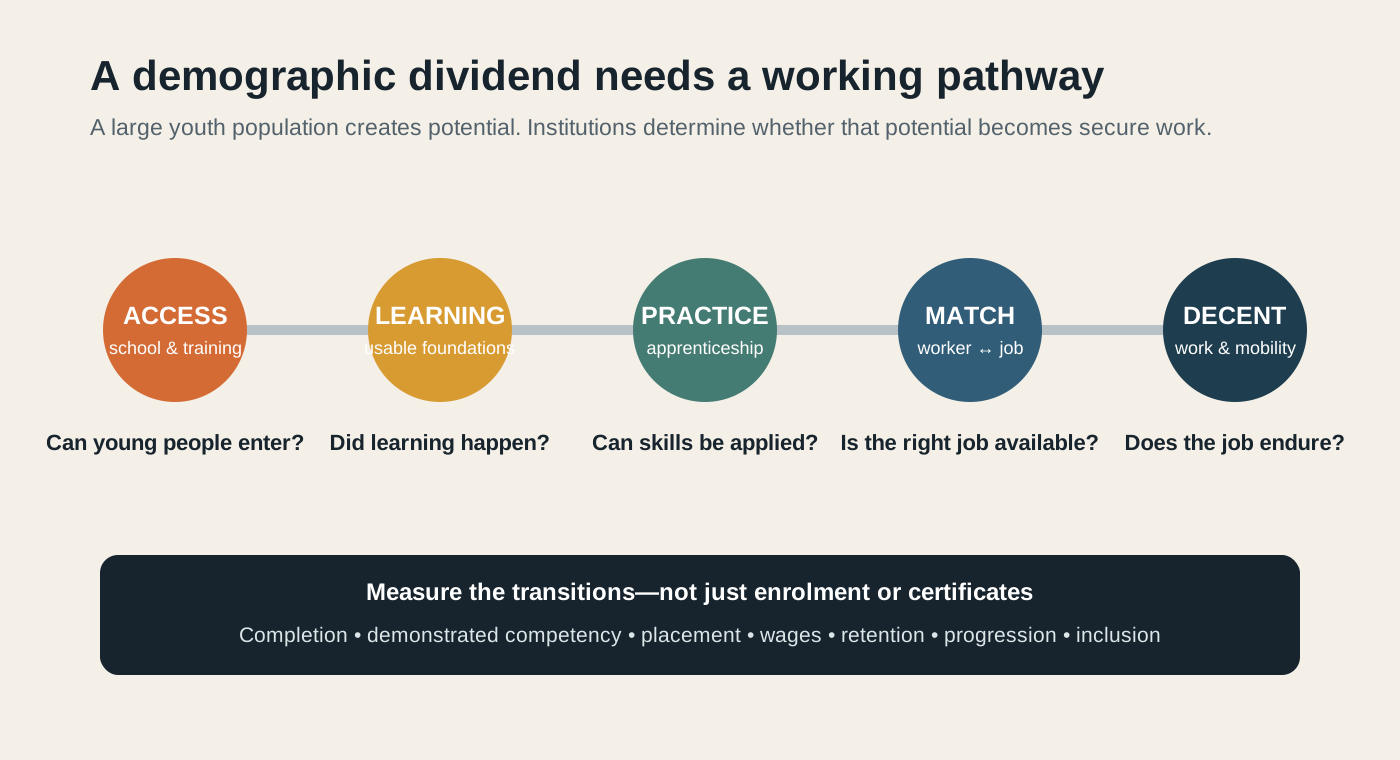
The second half of that definition matters most. Without enough suitable work, a favourable age structure remains an opportunity on paper. The real policy question is therefore not "How many young people does India have?" but "How effectively can each stage of the education-to-work pathway carry them forward?"
Why the unemployment rate cannot answer everything
India's Periodic Labour Force Survey tracks several measures that are often collapsed into a single headline. The labour-force participation rate asks what share of people are working or actively seeking work. The worker-population ratio measures those who are working. The unemployment rate covers people in the labour force who are seeking or available for work but do not have it.
These denominators create an important blind spot. Someone who wants work but has stopped searching may no longer be counted as unemployed. A person doing only a small amount of work may count as employed even if the hours or earnings are inadequate. And a graduate working in a role that does not use their training is employed, but may still represent a serious skills-matching failure.
That does not make unemployment data misleading; it means the rate must be read beside participation, hours, earnings, employment status and the match between education and occupation. MoSPI's monthly PLFS release for April 2026, for example, reported an all-India labour-force participation rate of 55.0% and an urban unemployment rate of 6.6% for people aged 15 and above. Those are useful national indicators, but they do not by themselves describe every young person's transition from study to work.
India's skilling system is large—but scale is not the final outcome
The Skill India architecture reaches different groups through different routes. Pradhan Mantri Kaushal Vikas Yojana offers short-duration training and recognition of prior learning. Industrial Training Institutes provide trade-based instruction. Jan Shikshan Sansthan targets community-level vocational learning, while the National Apprenticeship Promotion Scheme supports training connected to workplaces.
Government reporting can validly show how many candidates enrolled, trained or received certificates. But those measures describe delivery, not the whole result. A credible outcome chain asks progressively harder questions:
- Did the learner complete the programme?
- Can the learner demonstrate the skill independently?
- Did the training lead to work, self-employment or higher study?
- Was the work related to the training?
- What did it pay, and did the worker remain after six or twelve months?
- Did the job create a route to higher productivity and earnings?
A certificate may be valuable, but it is evidence of completing an assessed programme—not automatic evidence of durable employment.
The missing bridge: work experience
Employers commonly ask for experience even in entry-level roles. That creates a loop: young people need a job to acquire experience, but need experience to get the job. Apprenticeships, paid internships, supervised projects and work-integrated courses can break that loop because they let a learner apply knowledge under real constraints.
Work experience also reveals skills that a written test rarely captures: arriving reliably, diagnosing an unexpected fault, documenting work, collaborating across roles, responding to feedback and communicating with a customer. These are not "soft" extras. In many occupations they determine whether technical knowledge becomes useful output.
The gender gap can hide in participation
Young women face many of the same education-to-work barriers as young men, plus constraints involving safety, transport, unpaid care, social expectations and access to suitable local jobs. When a woman is available in principle but cannot actively search under those conditions, unemployment alone may fail to capture the lost opportunity.
That is why placement figures should be separated by gender and followed beyond the first offer. A programme can report a placement while missing whether the job was reachable, safe, compatible with care responsibilities or retained. Better transport, predictable hours, childcare, safe workplaces and credible grievance systems are labour-market infrastructure, not side issues.
What AI changes—and what it does not
Artificial intelligence is changing tasks faster than it is erasing entire occupations. Routine drafting, basic classification, standard customer responses and some entry-level coding or analysis can increasingly be assisted or automated. At the same time, organisations need people who can frame a problem, verify an output, work with domain constraints, communicate consequences and take responsibility for decisions.
The useful distinction is therefore not "technical skills versus human skills." Young workers need a combination: foundational literacy and numeracy; job-specific competence; digital and AI fluency; and judgement, teamwork and communication. The UN's World Youth Skills Day 2026 material similarly describes future readiness as a balance of technical, digital, AI, green, social-emotional and civic capabilities.
Learning one tool is not a career guarantee. Tools change. The durable capability is learning how to learn, while developing enough occupational depth to know when a machine-generated answer is wrong.
Claim versus evidence
- Claim: A young population automatically guarantees faster growth.
Evidence: A favourable age structure creates potential; health, education, participation and productive employment determine whether it becomes a dividend. - Claim: More training certificates mean the skills gap is closing.
Evidence: Certificates measure a stage in delivery. Competency, placement quality, wages, retention and progression measure later outcomes. - Claim: A lower unemployment rate proves the youth jobs problem is solved.
Evidence: The rate should be read with participation, employment status, hours, earnings and qualification–occupation matching. - Claim: AI will eliminate entry-level work.
Evidence: AI is changing task bundles unevenly. It increases the premium on verification, domain knowledge and adaptable human skills.
What young people can reasonably do now
Structural problems cannot be solved by telling individuals to "work harder." Still, students can improve the evidence they bring to an employer. A small portfolio, a documented project, an apprenticeship, a public code or design sample, a repaired device, a translated dataset or a supervised community assignment often demonstrates ability better than a list of course names.
Before paying for a programme, ask for outcome information: how placement is defined, whether jobs are related to the course, the typical salary range, how many placed candidates remain after six months and whether the provider permits contact with former learners. Treat guaranteed-job claims and unusually high starting salaries with caution.
What policymakers and employers should measure next
The most useful public scorecard would follow learners across the whole pathway. It would report enrolment and completion, but also independent competency, apprenticeship participation, placement within a defined period, job relevance, median earnings, six- and twelve-month retention, gender gaps and progression.
Employers also have a role. If every entry-level vacancy demands prior full-time experience, the system cannot create its next generation of experienced workers. Structured apprenticeships, transparent skill tests and paid trainee routes distribute the cost of learning more fairly between the worker, training provider and employer.
Frequently asked questions
What is International Youth Day 2026's theme?
The United Nations describes the 2026 theme as "Different Contexts, Common Aspirations," highlighting shared goals such as quality education, decent work, health and participation.
What is a demographic dividend?
It is the potential economic benefit from a larger working-age population relative to dependants, when people can participate in productive employment.
Does being employed always mean a worker has a good job?
No. Employment statistics can include work with inadequate hours, low earnings, insecurity or a poor match with a person's qualifications.
How should a skills programme be judged?
Look beyond enrolment and certification to demonstrated competence, relevant placement, wages, retention and career progression.
Young citizens are also affected by how representation is distributed as India changes demographically. Our Delimitation Bill 2026 tracker explains the debate over population, state representation and Parliament's future size.
For a legal rural-work option beyond the skills market, see our worker-focused guide to VB-G RAM G.
The bottom line
India does not lack aspiration, and its young people do not lack potential. The unresolved question is whether institutions connect the stages between learning and livelihood. International Youth Day is a useful moment to celebrate youth leadership—but also to insist on better evidence about who gets through that pathway, who falls out, and whether the job at the end is good enough to build a life.
Sources
- International Youth Day 2026: Different Contexts, Common Aspirations — UN DESA
- International Youth Day — United Nations
- Periodic Labour Force Survey monthly bulletin, April 2026 — Ministry of Statistics and Programme Implementation
- Jobs for skill-trained youth — Ministry of Skill Development and Entrepreneurship
- World Youth Skills Day 2026: Skills for a Shared Future — United Nations
Full forms
- AI — Artificial Intelligence
- ITI — Industrial Training Institute
- MoSPI — Ministry of Statistics and Programme Implementation
- PLFS — Periodic Labour Force Survey
- PMKVY — Pradhan Mantri Kaushal Vikas Yojana
For a current service guide, see our corrected explainer on the one-crore youth AI-skills pledge, YUVA AI and PMKVY.
For a practical offer decision, read our reviewed guide to IIT PPO rules, rejection risks and later placement evidence.
HeadlineDecoded is committed to accuracy and transparency. Read our standards or submit a correction.