AI SummaryAI-generated summary, reviewed by editors
Osho’s Hindi discourse argues that copying even a saint creates inner conflict. We examine the teaching, its historical stories and its limits.
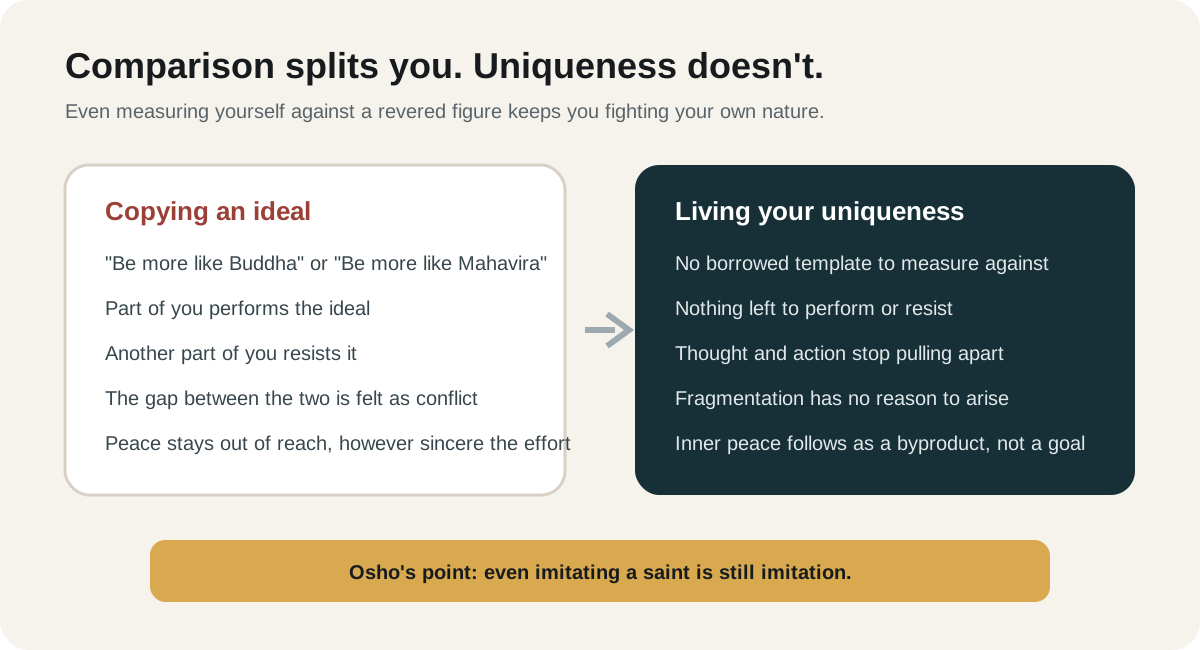
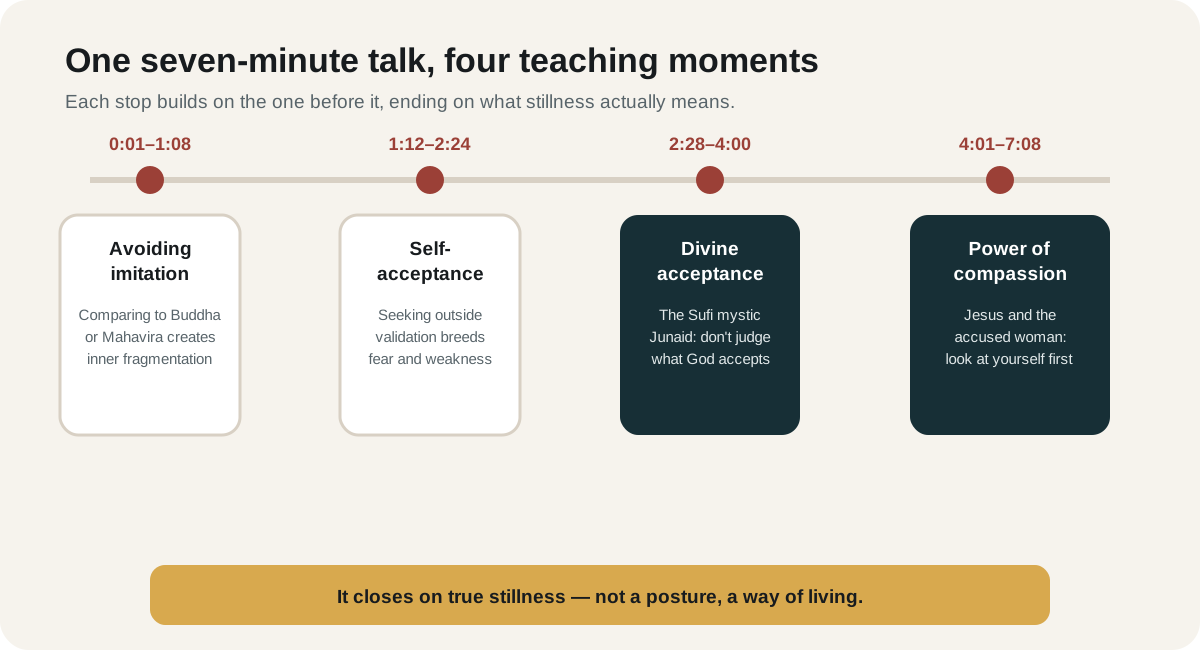
Switch to ShortsIn the Hindi discourse “Tum Jaise Ho Bas Vaise Jiyo” (“Live Just As You Are”), Osho argues that trying to become somebody else—even Buddha or Mahavira—divides a person against themselves. The useful distinction is not between ambition and passivity. It is between learning from another person and treating that person as a template that must replace your own nature.
The talk was uploaded by the verified OSHO Hindi YouTube channel on January 10, 2025. It is an evergreen spiritual teaching, not a new announcement. This explainer examines the argument, checks the history behind the stories Osho retells, and separates the content of the discourse from the documented controversies surrounding its speaker.
Verification note: The original OSHO Hindi video is linked below. The article paraphrases its teaching rather than presenting a word-for-word transcript. Historical, psychological and biographical claims are sourced separately; the illustrative stories should not be mistaken for documented eyewitness accounts.The argument in 60 seconds
- Osho says imitation creates an inner split: one part performs an ideal while another part resists it.
- He distinguishes living from one’s own awareness from seeking approval by reproducing somebody else’s identity.
- A story attributed to the Sufi teacher Junayd is used to question the impulse to judge or “repair” another person.
- The story of Jesus and the woman accused of adultery shifts attention from condemnation to self-examination.
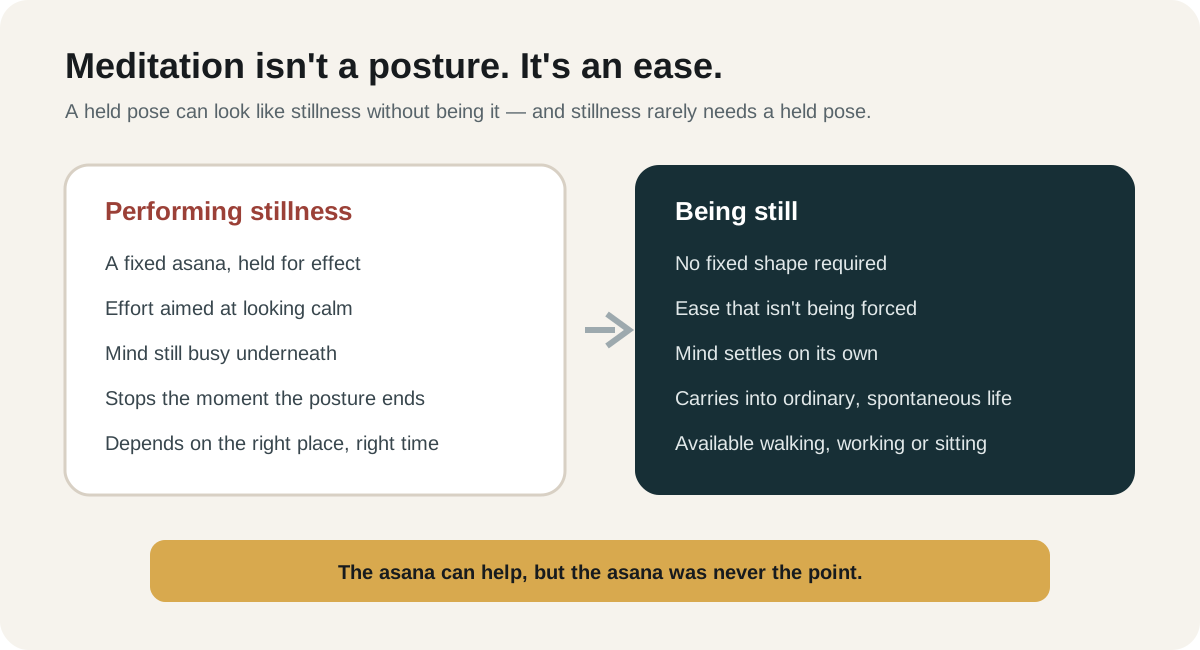
- The conclusion treats meditation as inward ease and awareness, not merely the outward appearance of a fixed posture.
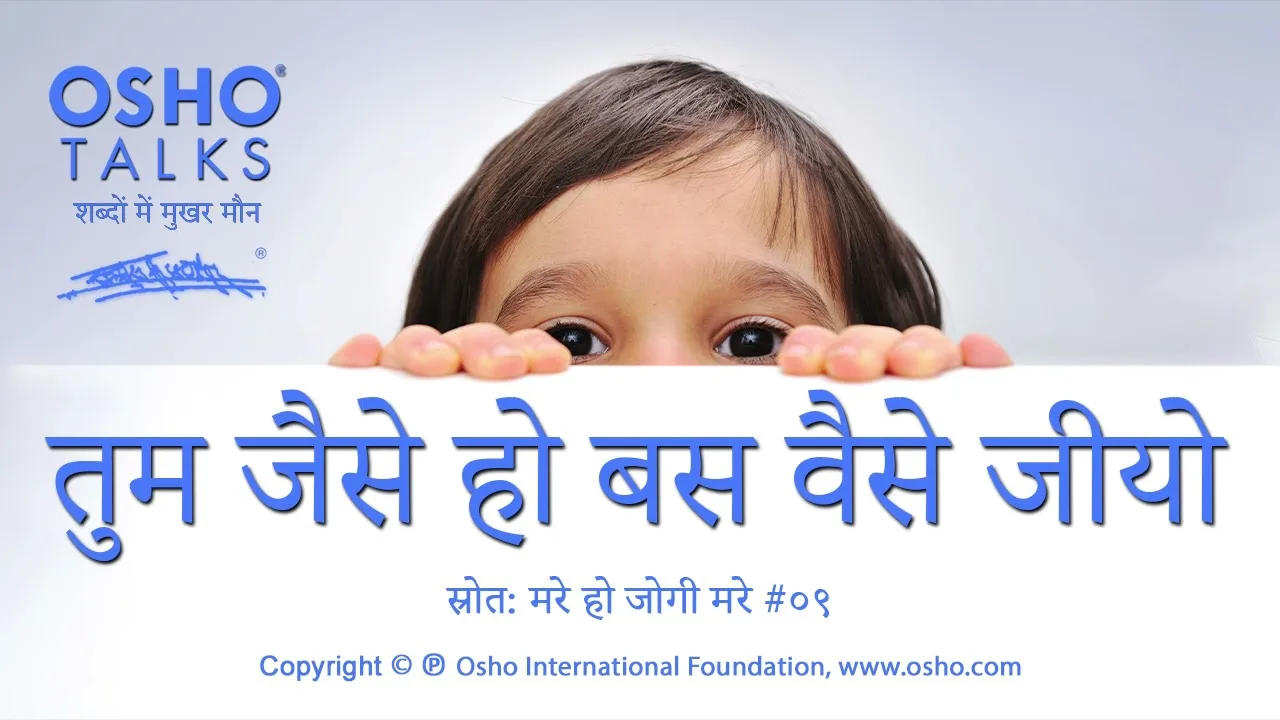
Watch the original source: “Tum Jaise Ho Bas Vaise Jiyo” on the verified OSHO Hindi YouTube channel.
What “live as you are” does—and does not—mean
The strongest reading of the talk is not “never change.” It is that change built entirely on self-rejection can become another performance. A role model can reveal a quality worth cultivating; the problem begins when admiration becomes an instruction to erase one’s own personality.
A practical test is simple. Ask: Am I learning a method, or trying to acquire another person’s identity? Studying how a disciplined person structures a day is learning. Believing peace is available only by reproducing that person’s manner, posture or public image is imitation.
Why comparison culture makes the idea relevant
Social media supplies a constant stream of selectively presented achievements, bodies and lifestyles. Research has associated appearance-based social comparison on social platforms with poorer mood and body-image concerns in some groups, while newer studies also connect upward comparison in highly curated feeds with anxiety. These findings are associations shaped by platform, population and method—not proof that every comparison harms every user.
That qualification matters. Comparison can sometimes supply information or motivation. Osho’s narrower contribution is the warning that inspiration becomes corrosive when a person treats somebody else’s finished image as the measure of their own worth.
Who may find this useful
The argument speaks directly to students comparing themselves with toppers, professionals measuring careers through LinkedIn updates, creators watching engagement numbers, and spiritual seekers performing an ideal version of calm. The ordinary-reader value is not a promise of therapy or instant peace. It is a way to notice when a useful example has turned into self-erasure.
The Junayd story: teaching tradition, not transcript
Junayd of Baghdad (also written al-Junayd or Junayd al-Baghdadi) was an influential ninth-century Sufi teacher who died in 910. He became associated with “sober” Sufism, which emphasized disciplined awareness rather than public ecstasy. Stories attributed to him circulated through later Sufi literature.
The specific exchange retold by Osho is best read as a teaching story unless a traceable early text is supplied. That does not make the parable useless; it defines the correct level of confidence. In the discourse, its function is to challenge the certainty with which one person judges another.
The woman accused of adultery: an important textual caveat
The second story is the passage commonly called the Pericope Adulterae, usually printed at John 7:53–8:11. Its best-known line invites a person without sin to cast the first stone. Modern textual scholarship notes that the passage is absent from important early manuscripts and appears in different locations in parts of the manuscript tradition.
That does not settle every theological question or show that the story appeared from nowhere. It does mean the article should describe it as an ancient and influential Christian teaching story with a disputed place in the earliest text of John—not as a forensically verified incident.
The teacher and the documented record
Osho was born Chandra Mohan Jain in 1931 and was known at different times as Acharya Rajneesh and Bhagwan Shree Rajneesh. His movement established Rajneeshpuram in Oregon in the 1980s. Senior commune members were prosecuted over the 1984 salmonella contamination of restaurant salad bars in The Dalles, an attempt to affect a local election. A U.S. Department of Justice history describes the attack and related prosecutions.
Osho was not convicted of carrying out the poisoning. He pleaded guilty to immigration-related offences in 1985, paid a fine and left the United States. Keeping those facts distinct avoids both sanitising the movement’s record and assigning him a criminal conviction he did not receive.
Stillness is not merely a pose
The discourse closes by separating meditation from its outward container. A posture may support practice, but a posture can also be performed while the mind remains tense. Osho’s point is that the appearance of stillness is not the same thing as awareness or inward ease.
A practical way to use the distinction
- Name the comparison: identify the person or image currently functioning as your standard.
- Extract the skill: write down the specific habit or method worth learning.
- Drop the identity test: do not make your worth depend on resembling the other person.
- Check the effect: useful inspiration should support action; repeated shame or paralysis is a reason to step back.
This is a reflective exercise, not mental-health treatment. Persistent anxiety, depression or severe distress deserves qualified professional support.
Related HeadlineDecoded reading
For the practice behind the idea, read how to observe the mind without chasing every thought. A related discourse is examined in Give Yourself One Quiet Hour, while this explainer on awareness in ordinary life adds the everyday-practice angle.
Questions readers ask
Does Osho reject role models?
The discourse rejects trying to become another person. Learning a skill or principle from someone does not require replacing your identity with theirs.
Does self-acceptance mean giving up improvement?
Not necessarily. The article’s interpretation is that acceptance changes the starting point: growth can come from awareness rather than disgust with oneself.
Is the Junayd story historically verified?
Junayd is historical, but the particular dialogue functions as a transmitted teaching story unless an early textual source can be established.
Was Osho convicted over the Oregon poisoning?
No. Senior commune members were prosecuted over the attack. Osho’s guilty plea concerned immigration offences, a distinction the article preserves.
Sources and attribution
- Original “Tum Jaise Ho Bas Vaise Jiyo” video — verified OSHO Hindi YouTube channel
- Al-Junayd biography — Encyclopaedia Britannica
- The Pericope of the Adulteress Reconsidered — New Testament Studies, Cambridge University Press
- Social comparisons on social media: impact on mood and body-image concerns — PubMed-indexed experimental study
- Instagram Reels, upward comparison and mental-health outcomes — PubMed-indexed cross-sectional study
- Rajneesh (Osho) biography — Encyclopaedia Britannica
- The Rajneeshee Cult and the 1984 Bioterror Attack — U.S. Attorney’s Office, District of Oregon
HeadlineDecoded is committed to accuracy and transparency. Read our standards or submit a correction.