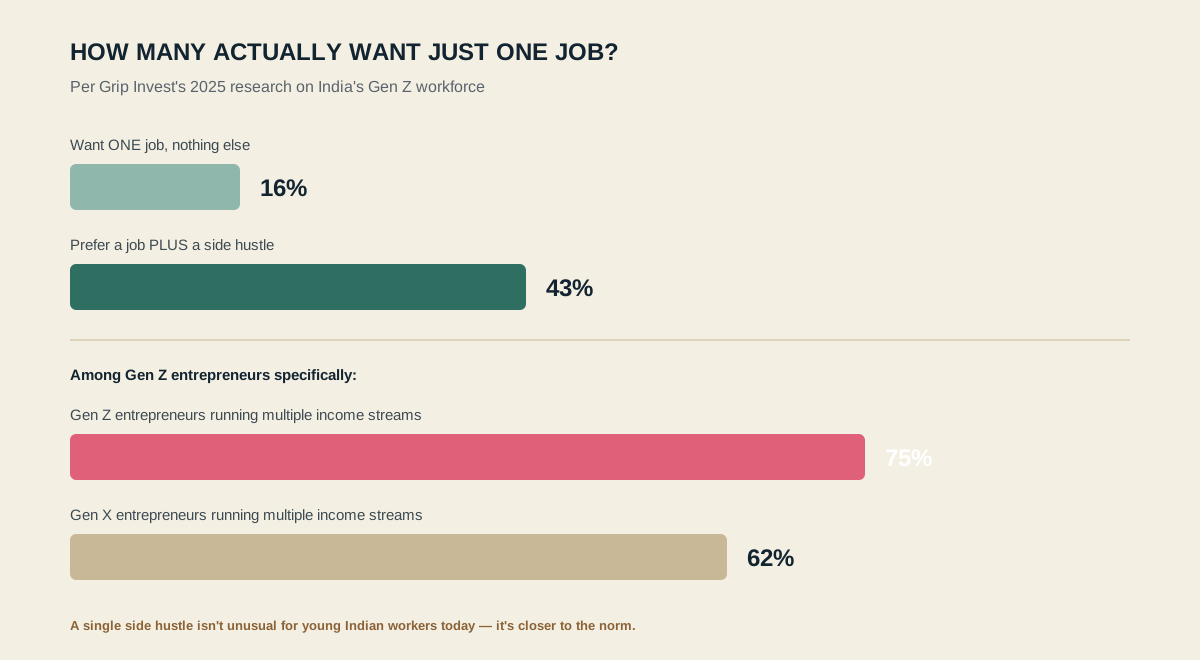
Just 16% of India's Gen Z workforce wants a single full-time job and nothing else, according to Grip Invest's 2025 research on young professionals — meaning the other 84% are either already combining income streams or open to it. That's not a generational quirk. Line up three separate 2025-26 surveys — Grip Invest, Deloitte and Deel — and the same story repeats: pay isn't matching the cost of living fast enough, and a side hustle has become the fastest lever an individual can actually pull.
The story in 60 seconds
- Only 16% of India's Gen Z professionals want just one job; 43% actively prefer a full-time role plus a side hustle, per Grip Invest's 2025 research.
- Among Gen Z entrepreneurs specifically, 75% run multiple income streams, versus 62% of Gen X entrepreneurs.
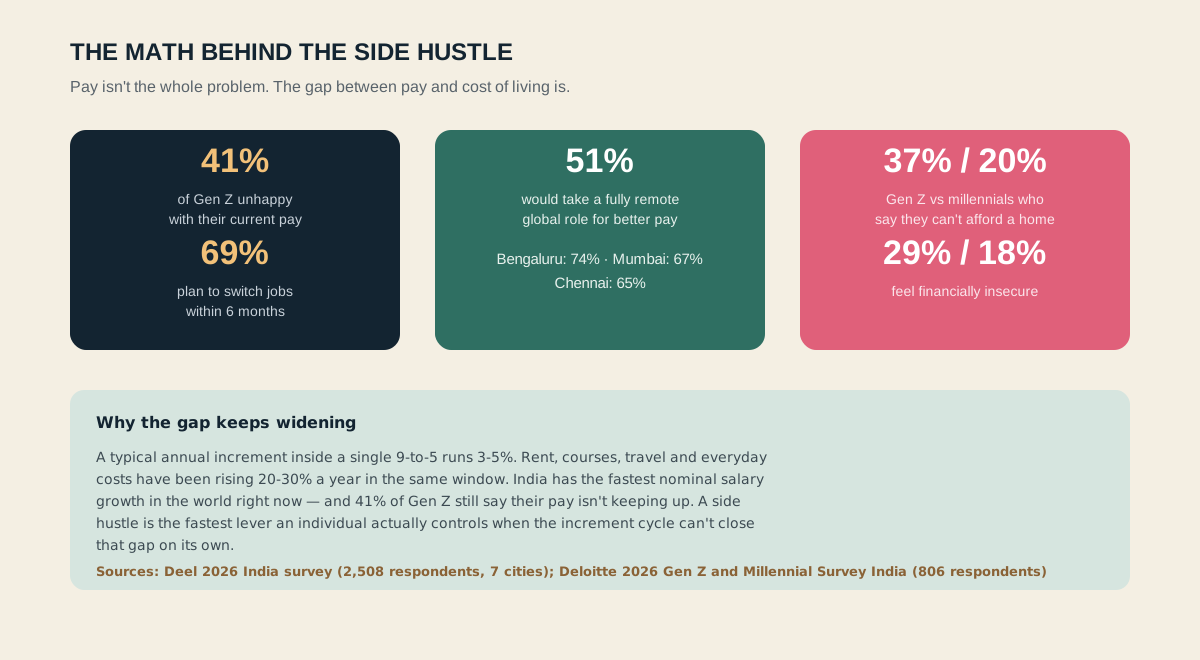
- Separately, Deel's 2026 India survey of 2,508 workers across 7 cities found 41% are unhappy with their current pay and 69% plan to switch jobs within 6 months.
- Deloitte's 2026 Gen Z and Millennial Survey India (806 respondents) found 37% of Gen Z say they can't afford a home and 29% feel financially insecure — despite 93% already using AI tools at work.
- India currently has the fastest nominal salary growth in the world, yet the dissatisfaction numbers above tell a different story on the ground — a gap this piece traces through the actual data.
- None of this means side hustles are risk-free — the same flexibility that helps with income also comes with real tax, time-management and burnout costs nobody's marketing to you.
AI SummaryAI-generated summary, reviewed by editors
It isn't hustle-culture branding. Three separate 2025-26 surveys — Grip Invest, Deloitte and Deel — line up on the same picture: young Indian workers are adding side hustles because a 3-5% annual increment can't keep pace with the actual cost of living, and 41% already say their current pay isn't cutting it.
Switch to ShortsThe number that explains everything
Grip Invest's 2025 research on India's Gen Z workforce found that only 16% want a single full-time job with nothing else. 43% actively prefer a full-time role plus a side hustle for extra income and security. Among Gen Z entrepreneurs specifically, 75% report managing multiple income streams — a meaningfully higher share than the 62% of Gen X entrepreneurs who say the same.
Grip Invest's own framing of why is blunt: a typical annual increment inside a single job runs 3-5%, while rent, course fees, travel and everyday living costs have been climbing 20-30% a year in the same stretch. Whether or not those exact percentages hold for every city and role, the direction is consistent with every other data point in this piece — take-home pay is not the constraint anymore; keeping pace with cost of living is.
It's not ambition. It's the paycheck not landing right.
Deel's 2026 survey of 2,508 Indian workers across seven cities and ten sectors found that 41% of Gen Z are unhappy with their current pay, and 69% plan to switch jobs within the next six months. That dissatisfaction persists even though India currently has the fastest nominal salary growth of any major economy — about 11% — which is exactly the disconnect worth sitting with: headline salary-growth numbers and what an individual actually feels in their bank account are not the same measurement. Cost-of-living pressure came through hardest in Delhi-NCR (55% cited it) and Mumbai (48%). Willingness to switch for pay is highest in IT (85%) and lowest, relatively, in BFSI/fintech (73%) — still a majority everywhere. Just over half (51%) said they'd take a fully remote role with a global employer if it paid better, rising to 74% in Bengaluru.
AI is both the tool and the anxiety
Deloitte's 2026 Gen Z and Millennial Survey India — 806 respondents, 506 Gen Z and 300 millennials, the 15th edition of a global study — found that 93% of Gen Z and 95% of millennials in India already use AI in their day-to-day work, with 85% and 91% respectively saying they're confident applying it. That's well ahead of the global average. And yet the same survey found 37% of Gen Z say they can't afford a home, compared with 20% of millennials, and 29% feel financially insecure against 18% of millennials. 54% of Gen Z say financial pressure has forced them to delay a major life decision — marriage, further education, moving out, starting a family.
Put together, the picture is not "AI is taking entry-level jobs, so young workers are panicking." It's closer to: young workers are already the most AI-fluent generation in the workforce, are using that fluency to try to get ahead, and are still coming up short on affordability — which is exactly the condition that makes a second income stream look less like a hustle-culture aesthetic and more like a rational response.
What a "portfolio career" actually looks like
In practice, the side hustles behind these numbers are mostly not the dramatic startup-founder story social media sells. Freelancing in an existing skill, tutoring, content or design work, and small digital products are the common, lower-drama versions — work that uses a skill someone already has, on hours they control, without requiring them to leave their primary job. The common thread across every survey here is that the primary job stays; the second stream gets added on top, not instead.
The real risk nobody's warning young earners about
None of this is a reason to treat a side hustle as risk-free. Two income streams mean two sets of tax obligations to track, two sets of deadlines, and considerably less slack time — burnout is a real cost, not a hypothetical one, when "rest" competes with a second job for the same hours. If you're weighing one, a reasonable filter is whether the hustle uses a skill you already have (lower startup cost, faster to test) versus one you'd need to learn from scratch while also working full-time (higher risk of it draining the energy your main job needs).
Questions readers are asking
Does "84% don't want a single job" mean 84% already have a side hustle?
No — it's the mathematical complement of the 16% who want only one job. Of that 84%, Grip Invest's research specifically found 43% currently combine a job with a side hustle; the rest are open to it or between situations, not all actively running a second income stream today.
Is this an India-only trend?
The underlying pressure — pay growth not matching cost-of-living growth — is global, and portfolio careers have been reported among Gen Z in the UK and US too. The specific figures in this piece are India-specific, drawn from India-focused survey samples.
Is AI making this worse or better for young workers?
Both, per Deloitte's data: 93% of India's Gen Z already use AI at work and feel confident doing so, which helps productivity and employability — but that same generation reports the highest financial insecurity and homeownership-affordability gap versus millennials. AI fluency isn't closing the affordability gap by itself.
Should I start a side hustle because of these numbers?
That's a personal financial decision this article can't make for you — but the data suggests it's now a common, not a fringe, choice among peers, and the more sustainable versions build on a skill you already have rather than starting from zero.
Abbreviations and full forms
AI — Artificial Intelligence. NCR — National Capital Region. BFSI — Banking, Financial Services and Insurance.
Sources and provenance
- AI reshapes careers for India's Gen Z as 93% use it at work — Social Samosa, citing Grip Invest's 2025 research on the 16%/43%/75%/62% income-stream figures.
- From learning to application: AI confidence builds across India's workforce — Deloitte India press room, 2026 Gen Z and Millennial Survey India (806 respondents), 20 May 2026.
- Deloitte's official LinkedIn post announcing the 2026 Global Gen Z and Millennial Survey — Deloitte, original social announcement.
- 7 in 10 Indian Gen Z Plan to Switch Jobs — Here's How Employers Can Retain Them — Deel, 2026 India survey (2,508 respondents, 7 cities, 10 sectors).
- International Youth Day 2026: India Has the Youth — Does It Have the Jobs? — HeadlineDecoded Students.
- 1 Crore Youth, One Year: PM's AI-Skilling Pledge vs. What India Has Actually Delivered So Far — HeadlineDecoded Students.
Image disclosure: the header and diagrams are newsroom-created editorial illustrations; no depiction of a real person, brand logo or platform interface. The Deloitte LinkedIn post linked above is the authenticated original social announcement for that survey — no other original social post specific to these figures could be verified, so none is embedded.
HeadlineDecoded is committed to accuracy and transparency. Read our standards or submit a correction.