If you've lost track of what tariff rate actually applies to Indian goods entering the United States right now, that isn't carelessness — it's because the rate has been set under three different laws in twelve months, two of which were later struck down by courts. The number that gets repeated in headlines today, 10%, is real. But it says almost nothing about how it got there, or what it actually covers.
The story in 60 seconds
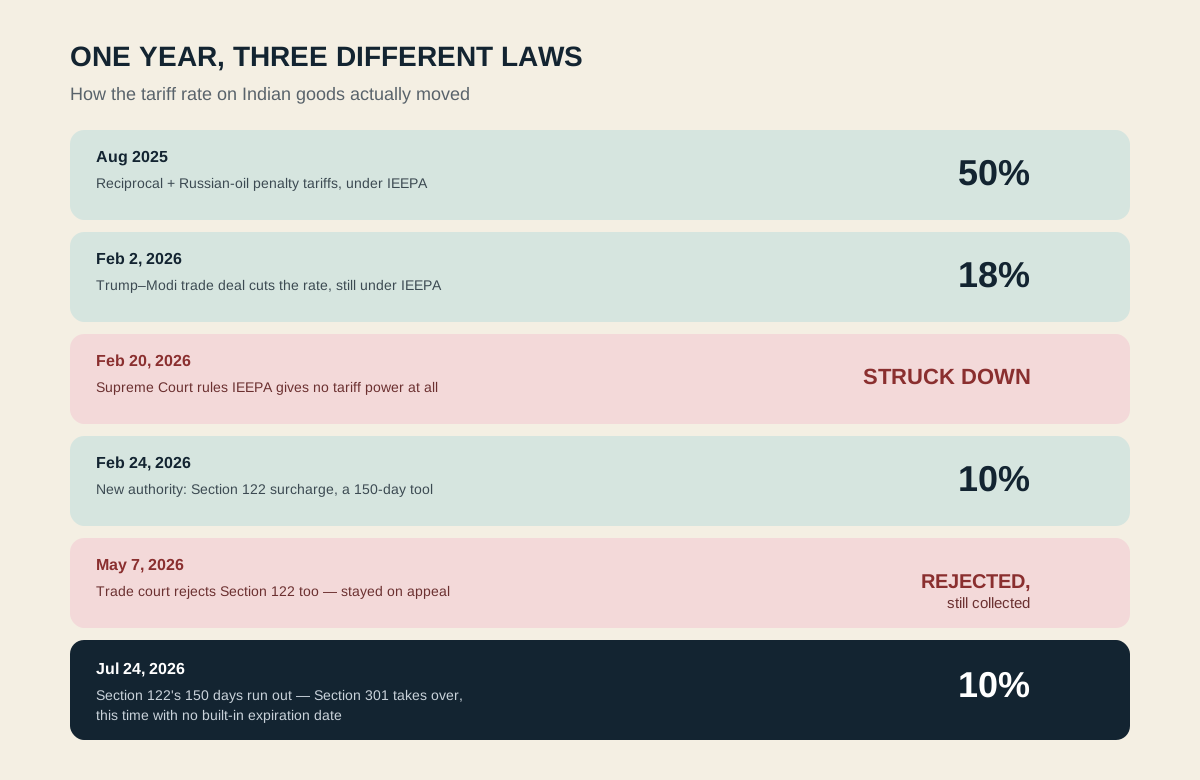
- In August 2025, the US combined a 25% "reciprocal" tariff with a 25% penalty tied to India's Russian oil purchases, taking the total to 50% under the International Emergency Economic Powers Act (IEEPA).
- On February 6, 2026, the White House and India announced an interim trade framework setting an 18% reciprocal tariff; the change took effect on February 7.
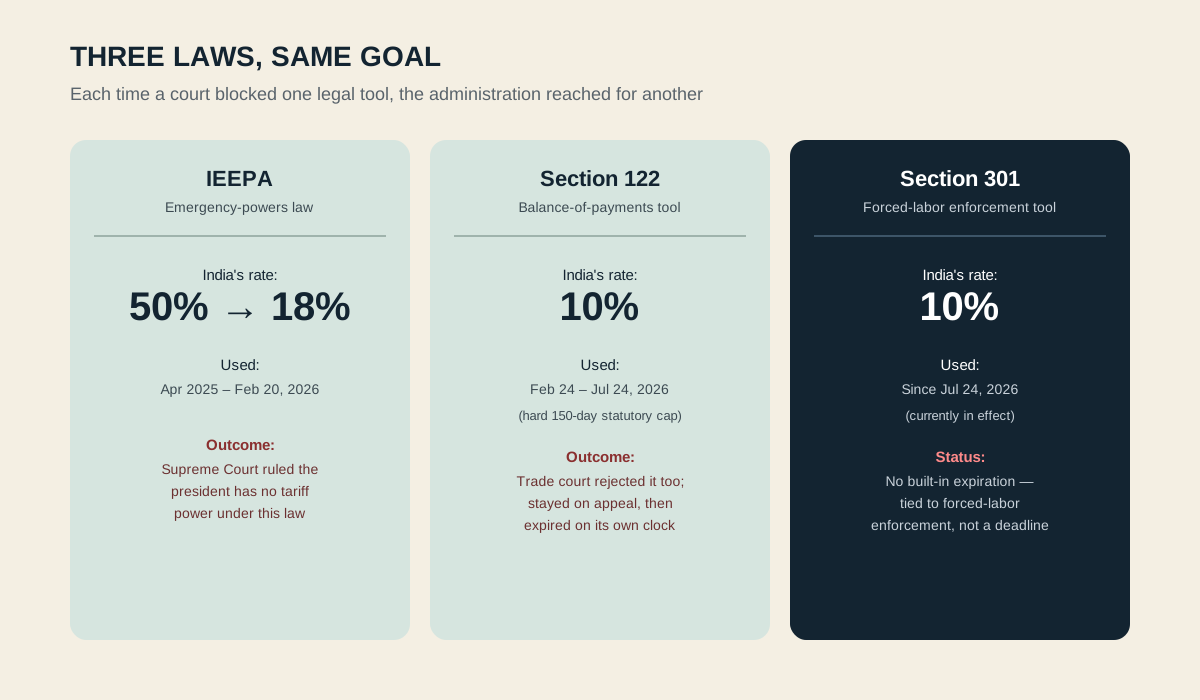
- On February 20, 2026, the US Supreme Court ruled 6-3 that IEEPA does not give the president tariff power at all, striking down the entire regime — India's 18% rate along with everyone else's.
- The administration then switched to Section 122 of the Trade Act of 1974. Proclamation 11012 imposed a temporary 10% surcharge, effective February 24, with a statutory 150-day limit.
- On May 7, 2026, the US Court of International Trade ruled that this Section 122 tariff was unlawful too, on narrower procedural grounds — but a Federal Circuit stay kept it in force while the government appealed.
- Section 122's 150-day clock ran out at 12:01 AM ET on July 24, 2026. In its place, a Section 301 "forced-labor enforcement" tariff took effect the same minute — still 10% for India, but under a legal justification with no built-in expiration date.
AI SummaryAI-generated summary, reviewed by editors
India's US tariff story moved from a 50% combined rate to 18%, then to a 10% additional duty under new legal authority. Here is the verified timeline, what the current rate covers, and why an importer's all-in duty depends on the product.
Switch to ShortsHow India got to 50%
The starting point most people remember is the worst one. Through 2025, the Trump administration used IEEPA — a law originally designed for economic sanctions during declared national emergencies — to impose "reciprocal" tariffs on dozens of countries. India's rate reached 25% by August 1, 2025. Weeks later, the administration layered on an additional 25% penalty explicitly tied to India's continued purchases of Russian oil, bringing the combined rate to 50% by the end of August 2025 — among the highest the US applied to any major trading partner.
The February deal that cut it to 18%
On February 6, 2026, the United States and India announced a framework for an interim trade agreement. The United States said it would remove the separate 25% Russian-oil tariff and apply an 18% reciprocal tariff from February 7; the joint statement also recorded India's intention to buy $500 billion in specified US goods over five years. The joint statement described Indian commitments on tariff and non-tariff barriers, while the US executive order tied removal of the oil-related tariff to India's commitment to stop buying Russian oil. Still, on paper, this looked like the resolution to a year of trade tension — a negotiated de-escalation from 50% to 18%.
It held for eighteen days.
The Supreme Court ruling that reset everything
On February 20, 2026, the US Supreme Court ruled 6-3, in an opinion by Chief Justice Roberts, that IEEPA does not authorize the president to impose tariffs at all. The ruling struck down both the "reciprocal" tariffs and a separate set of fentanyl-related tariffs built on the same legal foundation. This wasn't a ruling about whether 18% was a fair rate for India specifically — it invalidated the entire legal basis the White House had used for nearly a year, for every country covered by it.
The Court's reasoning was narrow and structural: the power to set taxes and tariffs belongs to Congress, and IEEPA's emergency language did not hand that power to the president. It was a real check on how the tariffs had been imposed — not a verdict on trade policy itself.
Round two: Section 122, and why a different court rejected that as well
On the day of the Supreme Court ruling, the administration invoked a different, narrower law — Section 122 of the Trade Act of 1974, via Proclamation 11012 — and made a flat 10% surcharge effective on February 24, India included. Section 122 exists for genuine balance-of-payments emergencies, and Congress built a hard limit into it: 150 days, extendable only by Congress itself, not the president.
That tool didn't survive intact either. On May 7, 2026, the US Court of International Trade ruled that Proclamation 11012 was unlawful because it failed to identify the specific type of "balance-of-payments deficit" the statute requires — the administration had pointed to broad measures like the overall trade deficit, while the court found Congress meant something narrower. The tariff kept being collected anyway: the Federal Circuit issued a stay pending the government's appeal, which was still unresolved as this was written. That appeal matters beyond the history books — if it ultimately goes against the administration, importers who paid the Section 122 surcharge between February and July could be owed refunds.
What actually happened on July 24
Section 122's 150-day clock is not something a president can simply reset. It expired automatically at 12:01 AM ET on July 24, 2026, with no extension legislation pending in Congress. In the same minute, a separate action from the Office of the United States Trade Representative (USTR) — built on Section 301 of the Trade Act and framed as a forced-labor enforcement measure rather than a reciprocal-trade one — took effect on roughly 60 economies. It created a two-tier structure: 12.5% for most, and a lower 10% tier for countries assessed to have taken steps against forced labor in their supply chains, including bans or partial regimes. India landed in the 10% tier.
The headline number for India — 10% — is unchanged from the day before. But the legal justification underneath it is entirely different, and that difference is not just academic: a "reciprocal trade" tariff can be renegotiated in a trade deal, the way the 50%-to-18% cut was. A forced-labor enforcement tariff is tied to a different, less negotiable condition, and unlike Section 122, it carries no built-in expiration date.
Why the headline rate is not what most exporters actually pay
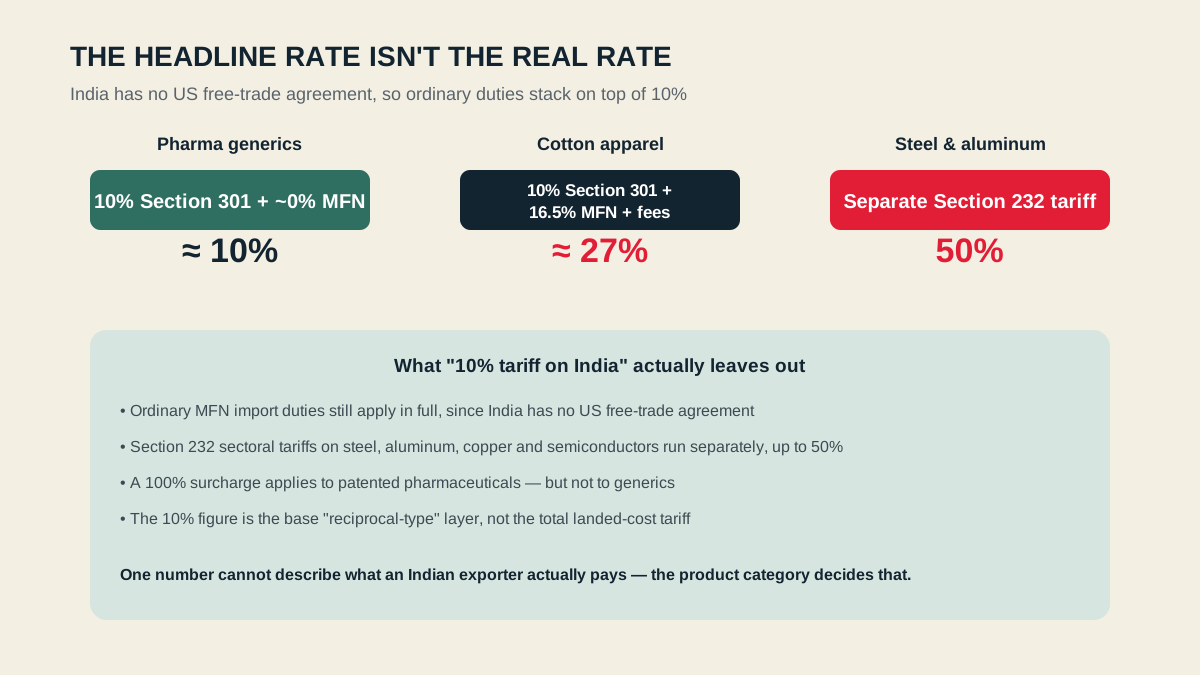
Reporting on "the" tariff rate on India tends to flatten a much messier reality. The Section 301 action is an additional duty on covered goods, so ordinary Most Favoured Nation (MFN) duties may still apply and vary by tariff classification. USTR also exempted specified products and articles already subject to Section 232 duties. The correct rate therefore depends on the product's tariff code and any applicable exclusion; 10% is not a universal all-in rate.
For an importer, the practical calculation starts with the precise Harmonized Tariff Schedule classification, then adds the Section 301 duty if the product is covered and checks for Section 232 treatment or another exclusion. There is no single all-in "tariff on India" that applies to every shipment.
Claim versus evidence
- Confirmed: India's reciprocal-type tariff rate moved from 50% to 18% to 10% over roughly a year.
- Confirmed: The Supreme Court ruled the president has no tariff authority under IEEPA.
- Confirmed: The Court of International Trade separately rejected the follow-up Section 122 tariff, though it stayed in force on appeal.
- Misleading if left out: Describing today's 10% simply as "tariffs cut" — it reflects a different legal authority than the one used a year ago, with different rules for how and whether it can end.
- Unresolved: Whether importers who paid the Section 122 surcharge between February and July will be refunded depends on the still-pending Federal Circuit appeal.
- Context-dependent: The real rate an Indian exporter pays depends heavily on the product category, not just the 10% headline figure.
What to watch next
Three things determine where this goes from here: the outcome of the Federal Circuit appeal over the now-expired Section 122 tariff, whether the new Section 301 forced-labor tariff faces its own legal challenge, and whether India and the US negotiate anything that specifically addresses the forced-labor enforcement standard the current 10% rate is now tied to. None of those are quick, predictable processes — which is exactly why the "final" rate on India has changed three times in a single year, and there's no structural reason it can't change again.
Related war context
Trade measures linked to Russia are separate from the humanitarian-law record. For that distinction, read our UN-source explainer on Ukrainian civilian detainees and the Geneva Conventions.
Sources
- United States–India Joint Statement — The White House
- Fact Sheet: The United States and India Announce Historic Trade Deal — The White House
- Supreme Court opinion on IEEPA tariff authority — Supreme Court of the United States
- Court of International Trade opinion on Proclamation 11012 — US Court of International Trade
- USTR takes final action in forced-labor Section 301 investigations — Office of the US Trade Representative
Full forms
- USTR — Office of the United States Trade Representative
- MFN — Most Favoured Nation
- FTA — Free Trade Agreement
HeadlineDecoded is committed to accuracy and transparency. Read our standards or submit a correction.