AI SummaryAI-generated summary, reviewed by editors
A UN official says more than 16,000 Ukrainian civilians remain deprived of liberty by Russia, many incommunicado and on grounds that do not comply with international law. The figure is an estimate, and civilian detention is lawful only in tightly limited circumstances.
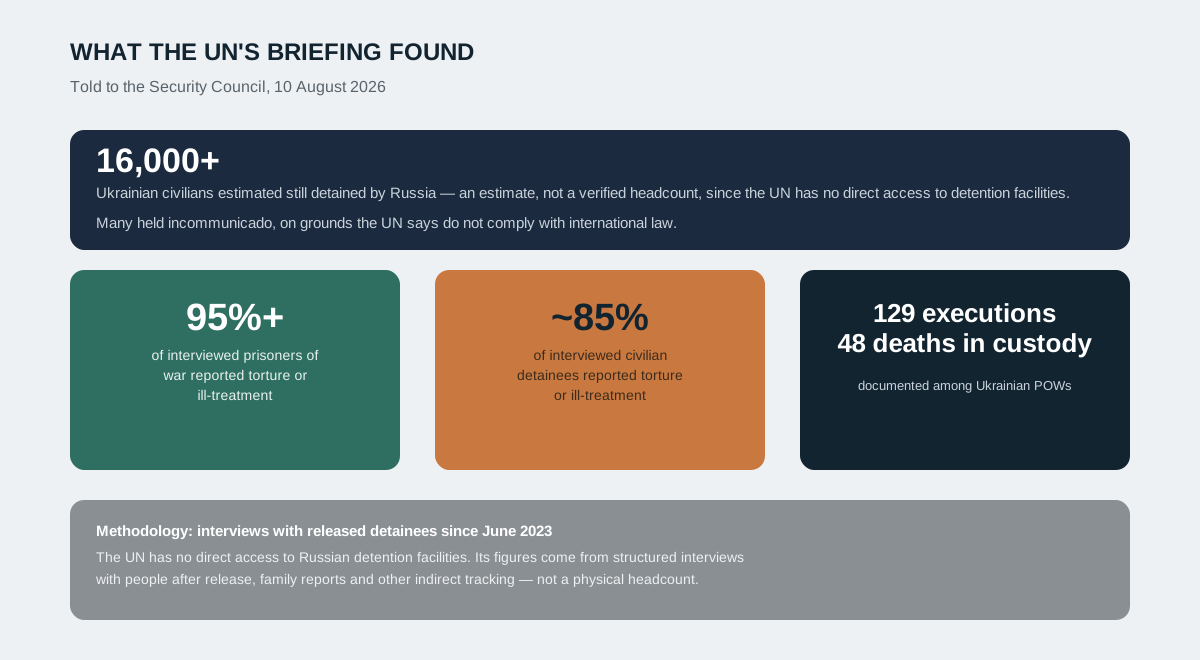
Switch to ShortsThe United Nations estimates that more than 16,000 Ukrainian civilians detained by Russia since the full-scale invasion remain deprived of liberty. At an informal UN Security Council meeting on 10 August 2026, Assistant Secretary-General for Human Rights Claudia Fuentes Julio said many are held incommunicado and on grounds that do not comply with international law. The figure is not a verified prison roll: UN monitors have not been allowed into detention facilities in Russia.
Accuracy note: “More than 16,000” is the UN estimate presented at the meeting, not a physical headcount. This report separates civilian detainees from prisoners of war and distinguishes documented findings from legal analysis.What is new
- The 10 August briefing put the number of Ukrainian civilians still held at more than 16,000.
- UN staff have interviewed 403 released Ukrainian civilian detainees and 910 released Ukrainian prisoners of war since February 2022.
- More than 95% of interviewed Ukrainian POWs and 85% of interviewed civilian detainees reported torture or ill-treatment, according to Fuentes Julio.
- The UN has documented 129 executions of Ukrainian POWs at the beginning of captivity and 48 deaths in custody linked to torture, denial of medical care or other inhumane conditions.
How strong is the 16,000 estimate?
The number was presented by a senior UN human-rights official, but its limits matter. The UN has no access to detention facilities in Russia and the estimate does not separate adults from children. Its evidence comes from interviews after release, family reports and monitoring of individual cases rather than an inspected central register.
That limitation does not erase the findings. Independent, structured interviews across hundreds of cases show recurring accounts of beatings, electric shocks, sexual violence, food deprivation and inadequate medical care. A September 2025 OHCHR report based on 215 released civilian detainees had already described torture and ill-treatment by Russian authorities in occupied territory as widespread and systematic.
Civilian detainee and prisoner of war are not the same status
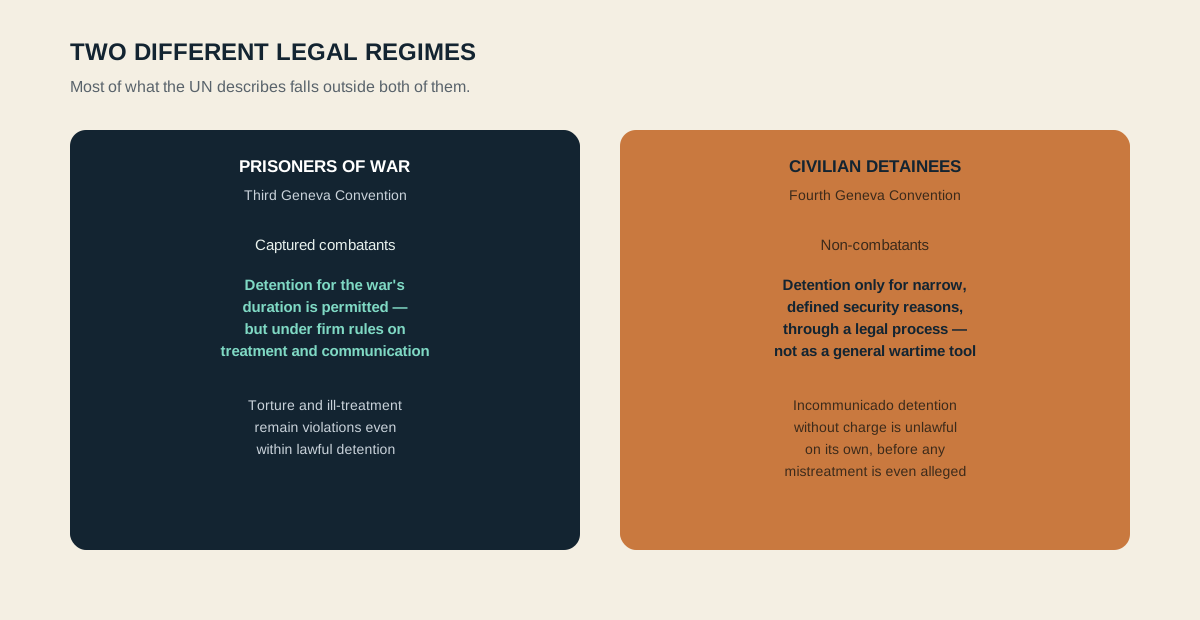
A captured member of an enemy armed force who qualifies as a POW is principally protected by the Third Geneva Convention. Detention is permitted to prevent return to the battlefield, but POWs must be treated humanely and ordinarily released and repatriated without delay after active hostilities end.
Civilians are principally protected by the Fourth Geneva Convention. Their internment is exceptional. In occupied territory, Article 78 allows it only for imperative security reasons, through a regular procedure with a right of appeal and periodic review. In a belligerent state's own territory, Article 42 uses the similarly high test of absolute necessity for security. Internment cannot lawfully be used as collective punishment, intimidation or political pressure.
This means the law does not support the earlier draft's blanket suggestion that almost every civilian detention is automatically unlawful. The defensible conclusion is narrower: where Russia cannot show an individual lawful ground and the required safeguards, the detention is arbitrary and may amount to unlawful confinement. Incommunicado detention and failure to tell families where a person is held also raise the risk of enforced disappearance.
Does “widespread and systematic” automatically prove crimes against humanity?
No. The phrase is important evidence of a pattern, but it does not by itself complete the legal test. Crimes against humanity require specified acts committed as part of a widespread or systematic attack directed against a civilian population, with knowledge of that attack. Individual criminal responsibility must be established through evidence and a competent judicial process.
OHCHR's language supports investigation and accountability; it should not be rewritten as a conviction. Torture, cruel treatment, wilful killing and unlawful confinement can also constitute grave breaches or war crimes when their separate legal elements are met.
What Russia and the UN said about the other side
Russia's deputy UN ambassador rejected the allegations at the meeting, said Russian forces comply with international humanitarian law and accused the organisers of running a disinformation campaign. Those claims do not answer the UN's interview evidence, but they belong in a fair account.
The UN also interviewed 816 Russian and 57 third-country POWs who had served with Russian forces. About half reported torture or ill-treatment, mainly during initial capture and interrogation by Ukrainian authorities. Fuentes Julio said conditions generally complied with international humanitarian law after transfer to official Ukrainian detention facilities and had improved since 2022. Abuse by one party does not excuse abuse by another.
What families and negotiators can ask for now
- Notification and contact: families should be told that a person is held and where, and detainees must be able to communicate under the applicable legal regime.
- Independent access: humanitarian monitors need access to detention sites and confidential interviews.
- Individual review: every civilian internment needs a lawful, case-specific reason, appeal and periodic review.
- Release: civilians must be freed when lawful grounds no longer exist; POW release follows the Third Geneva Convention and negotiated exchanges during hostilities.
- Investigation: deaths, torture, sexual violence and alleged executions require independent investigation and preservation of evidence.
Why this matters to readers in India
The immediate impact is on detainees and their families, not on Indian households. For Indian readers, the practical value is understanding what official casualty and detention numbers do—and do not—prove, and how the Geneva Conventions separate combatants from civilians. The war also intersects with India's trade and energy choices; our source-checked US tariffs on India timeline explains that separate policy track without treating it as evidence about detention.
Questions readers are asking
Has the UN confirmed the identity of all 16,000 people?
No. It describes the number as an estimate and lacks access to Russian detention sites.
Can civilians ever be detained during war?
Yes, but only exceptionally and on individual lawful grounds, with procedural safeguards and review. Civilians cannot be interned simply because they live in occupied territory.
Is incommunicado detention itself proof of torture?
No. It is a serious rights and protection concern and can facilitate abuse, but torture requires its own evidence. The UN's torture findings are based on interviews with released detainees.
Did the UN examine Ukrainian treatment of Russian POWs?
Yes. About half of 873 Russian and third-country POWs interviewed reported torture or ill-treatment, mainly at capture or initial interrogation.
Primary sources and methodology
- Fuentes Julio's August 2026 briefing — OHCHR; the direct page was cited by contemporaneous reporting but was not consistently retrievable during our review.
- UN Human Rights Monitoring Mission detention reports — official report index.
- September 2025 civilian-detention findings — OHCHR.
- Fourth Geneva Convention, Article 78 and the ICRC's civilian-internment explanation.
- Associated Press account of the 10 August meeting, including Russia's response and the UN's interview totals.
Image disclosure: the hero is an AI-generated, staged editorial illustration. It does not show a real detainee, detention centre, document or event.
HeadlineDecoded is committed to accuracy and transparency. Read our standards or submit a correction.