AI SummaryAI-generated summary, reviewed by editors
A statutory committee reportedly found three charges proved—not criminal guilt. Its report reached Parliament after Justice Yashwant Varma tendered his resignation, leaving an unresolved removal question.
Switch to ShortsA Judges Inquiry Committee reportedly found all three charges against Justice Yashwant Varma proved, and its report was tabled in the Lok Sabha in August 2026. That is a statutory misconduct finding, not a criminal conviction. Justice Varma had already tendered a resignation “with immediate effect” in April; later reports said presidential acceptance remained pending. Whether Parliament may or should complete the removal process in those circumstances is contested, not settled by the committee report alone.
Legal-language correction: An earlier headline used “guilty.” We have replaced it with the committee's reported formulation, “charges proved.” No criminal court conviction is reported here, and the underlying cash discovery remains an allegation when described outside the committee's specific findings.The verified timeline
- March–May 2025: the Supreme Court published material about the reported cash discovery, an in-house inquiry and its submission to the Chief Justice of India. Justice Varma disputed wrongdoing.
- 12 August 2025: the Lok Sabha Speaker announced a removal motion and constituted a three-member committee under the Judges (Inquiry) Act, 1968.
- April 2026: Justice Varma sent the President a resignation letter stating that it was with immediate effect.
- 18 May 2026: the statutory committee submitted its report to Speaker Om Birla; PIB said it would be laid before both Houses.
- August 2026: the report was tabled and news organisations reported that the committee treated all three charges as proved.
What “charges proved” means—and does not mean
The committee was constituted for the constitutional process of investigating alleged misbehaviour by a judge. Its finding can support parliamentary consideration of a removal address. It does not amount to a conviction under criminal law, does not itself remove a judge and should not be translated into the unqualified word “guilty.” A criminal case would require its own lawful investigation, prosecution and adjudication.
The full report is the best source for the exact charge wording, evidence, defence and conclusions. Until an authenticated parliamentary copy is readily accessible, descriptions of the three findings should be attributed to the report as covered by multiple news organisations rather than embellished.
Why the resignation creates a procedural dispute
Article 217 of the Constitution allows a High Court judge to resign by writing addressed to the President. Justice Varma reportedly said his resignation was immediate. Some reporting nevertheless described it as not accepted, while the statutory committee continued and submitted its report. These facts create two separate questions: whether and when he ceased to hold office, and whether Parliament retains a constitutional purpose in voting on removal after resignation.
The Constitution and Judges (Inquiry) Act describe removal of a serving judge. They do not provide a simple, express answer for every consequence of a resignation delivered during an inquiry. A political statement that Parliament should proceed is therefore not the same as a binding judicial ruling that it legally can.
What Parliament would normally need to do
If the process proceeds, each House must support an address for removal in the same session by a majority of its total membership and by at least two-thirds of members present and voting. The President then issues the removal order. Tabling the committee report is an accountability milestone, but it is not itself an impeachment vote or removal order.
Claim versus evidence
- Confirmed: a statutory Judges Inquiry Committee was constituted and submitted its report on 18 May 2026.
- Reported from the tabled report: the committee found all three charges proved.
- Confirmed by published resignation text: Justice Varma tendered a resignation described as immediate.
- Not established: that he was criminally “found guilty.”
- Legally unsettled: whether a removal vote can validly continue after this resignation and what practical consequence it would have.
What happens next
- Publication of the authenticated committee report and complete parliamentary record.
- Clarity from Rashtrapati Bhavan or another authoritative record on the resignation's legal status and effective date.
- A decision by the presiding officers and Houses on whether to schedule removal motions.
- Any court challenge, which could produce a binding interpretation of the resignation/removal interaction.
What is new here?
This page separates four frequently blurred events: an in-house Supreme Court inquiry, the statutory parliamentary inquiry, a resignation letter and a possible removal vote. It also corrects “guilty” to the narrower and legally accurate “charges proved.”
Primary and specialist sources
- Submission of the Supreme Court in-house inquiry report — Supreme Court of India
- Lok Sabha proceedings establishing the statutory inquiry — Parliament of India
- Committee report submitted to the Lok Sabha Speaker — PIB/Lok Sabha Secretariat
- Procedural chronology and legal background — Supreme Court Observer
- Report tabled in Parliament — The Tribune
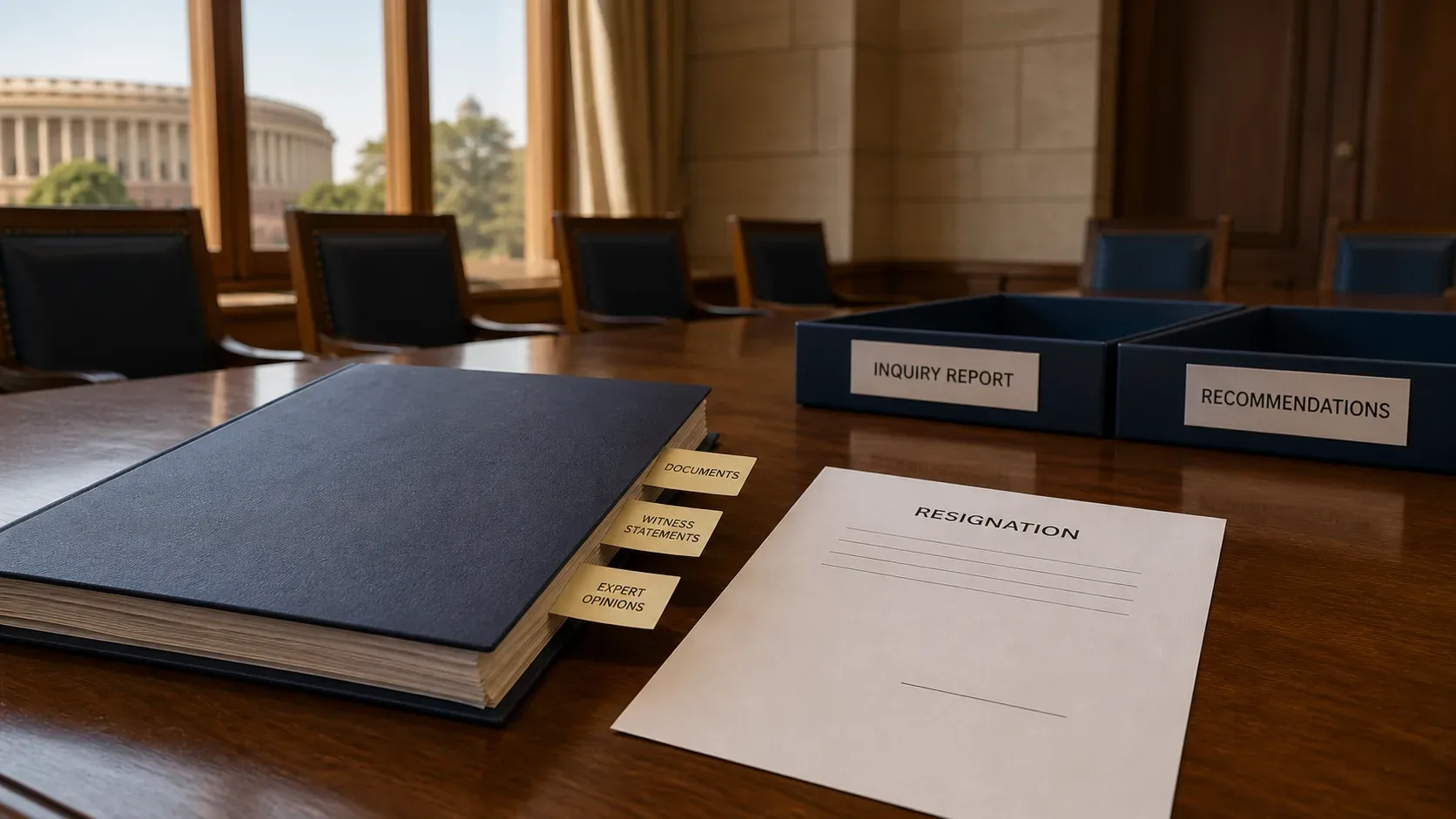
Image note: the hero is an AI-generated conceptual editorial illustration. It does not depict the committee, Justice Varma or an actual parliamentary proceeding.
HeadlineDecoded is committed to accuracy and transparency. Read our standards or submit a correction.