The May 2026 NEET-UG paper leak was not the result of one dramatic breach. Central Bureau of Investigation (CBI) findings and testimony before a parliamentary committee point to a set of ordinary, unglamorous security gaps inside the National Testing Agency's (NTA) confidential section — gaps that, together, made it possible for a single insider to hand-copy exam questions undetected.
The story in 60 seconds
- NTA officials admitted before a parliamentary committee, chaired by Congress MP Digvijaya Singh on May 21, 2026, that "lapses" and "mistakes" occurred in conducting the exam.
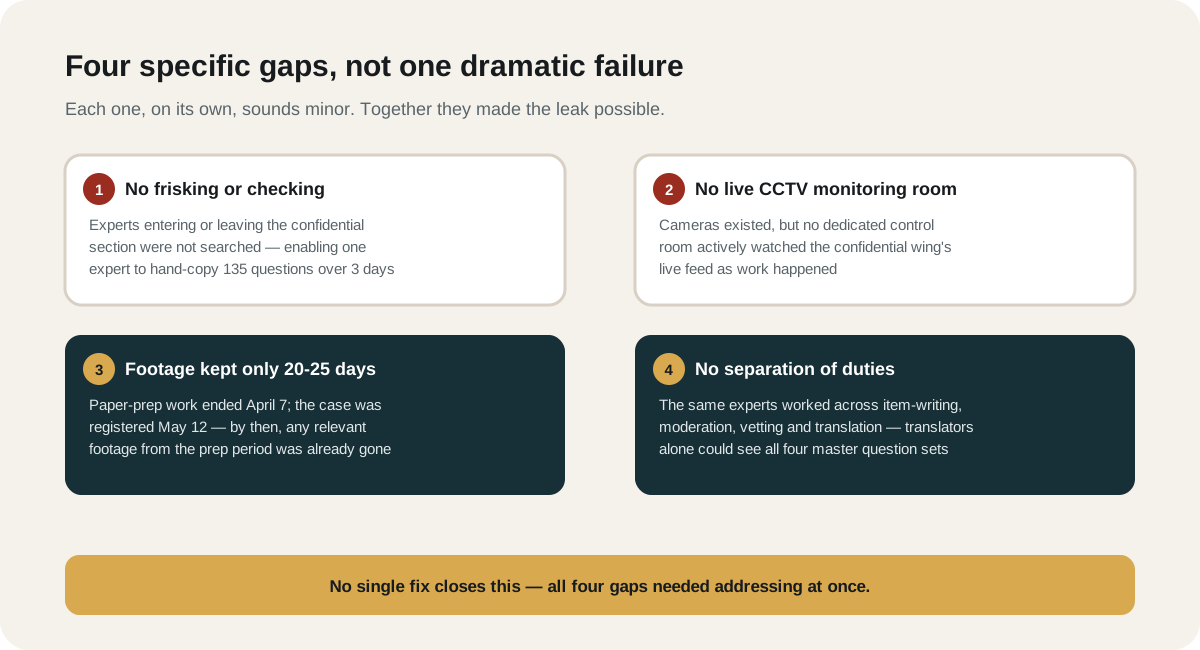
- CBI investigators found no practice of frisking or checking experts entering or leaving NTA's confidential section, where question papers are finalised.
- There was no dedicated control room actively monitoring the confidential wing's CCTV feed in real time, even though cameras existed.
- NTA retained CCTV footage for only 20-25 days; since paper-preparation work ended April 7 and the case was registered May 12, relevant footage from the critical period was already gone by the time investigators looked for it.
- CBI flagged a lack of "compartmentalisation": the same experts worked across item-writing, moderation, vetting and translation, meaning translation staff alone could view all four master question sets.
- These gaps reportedly let one chemistry expert transcribe 135 questions onto paper and smuggle them out over three days — the starting point of a leak that ultimately affected roughly 23 lakh aspirants.
AI SummaryAI-generated summary, reviewed by editors
CBI investigators found no frisking of experts, no live CCTV monitoring, footage kept only 20-25 days, and no separation of duties inside NTA's confidential section. Together, these gaps are what let the May 2026 NEET-UG leak happen.
Switch to ShortsFour specific gaps, not one dramatic failure
Each individual lapse CBI identified sounds almost mundane on its own. No frisking of exam experts sounds like a minor oversight. A CCTV system without a live-monitoring control room sounds like a budget or staffing gap, not a scandal. A 20-to-25-day footage retention window sounds like an ordinary IT policy. Experts working across multiple stages of paper preparation sounds like a simple efficiency choice. None of these, alone, reads as catastrophic — which is exactly why, together, they went unaddressed long enough to matter.
How the gaps were actually used
According to CBI's findings, a chemistry expert with legitimate access to the confidential section — where NTA's translation and finalisation work happens — used the absence of physical checks to transcribe 135 exam questions onto small pieces of paper over three days, without being searched on the way out. Because the confidential wing's cameras were not being actively monitored in real time, and because the relevant footage had already aged out of NTA's 20-to-25-day retention window by the time the case was formally registered on May 12, investigators had no video record of the period when the copying reportedly happened.
The lack of compartmentalisation compounded the problem. In a system where question-paper stages are properly separated, an expert at any single stage — item-writing, moderation, vetting, or translation — should not have visibility into a complete, finalised paper. CBI found that was not the case here: translation experts, in particular, could see all four master question sets rather than only the material relevant to their specific task.
What NTA has acknowledged
Before the parliamentary committee — which also heard from the NTA Chairperson and the Secretary of the Higher Education Ministry, in a session lasting nearly three hours — NTA officials acknowledged that lapses had occurred and that mistakes had been made in conducting the exam, while maintaining they had attempted to run it fairly. NTA pointed to the June 21 re-examination, held at no additional cost to affected candidates, as part of its remedial response.
What remains less clear from public reporting is a specific, itemised account of exactly which structural changes — beyond the one-time re-examination — have been made to the confidential section's physical security, CCTV monitoring practice, footage retention policy, and staff compartmentalisation, to prevent a repeat. That is the natural follow-up question this investigation leaves open.
Why this matters beyond one exam cycle
NTA administers far more than NEET-UG — it conducts entrance exams that determine the academic paths of millions of students annually. Security gaps of this kind are not specific to a single exam's content; they are structural weaknesses in how any high-stakes paper is prepared, stored and transported. Understanding precisely where this system failed matters less for assigning blame after the fact than for judging whether the same four gaps — access control, live monitoring, footage retention, and duty separation — have actually been closed before the next exam cycle relies on the same process.
Sources
- CBI flags oversight in NTA's confidential section for NEET — Siasat
- NTA admits lapses in NEET paper leak case before parliamentary panel — Kerala Kaumudi
- CBI flags lapses in NEET paper preparation at NTA office — The Tribune
- NEET leak was designed to leave no trace, until accused 'recreated paper' and left digital trail — ThePrint
Full forms
- NTA — National Testing Agency
- CBI — Central Bureau of Investigation
- CCTV — Closed-Circuit Television
Primary-source visual check
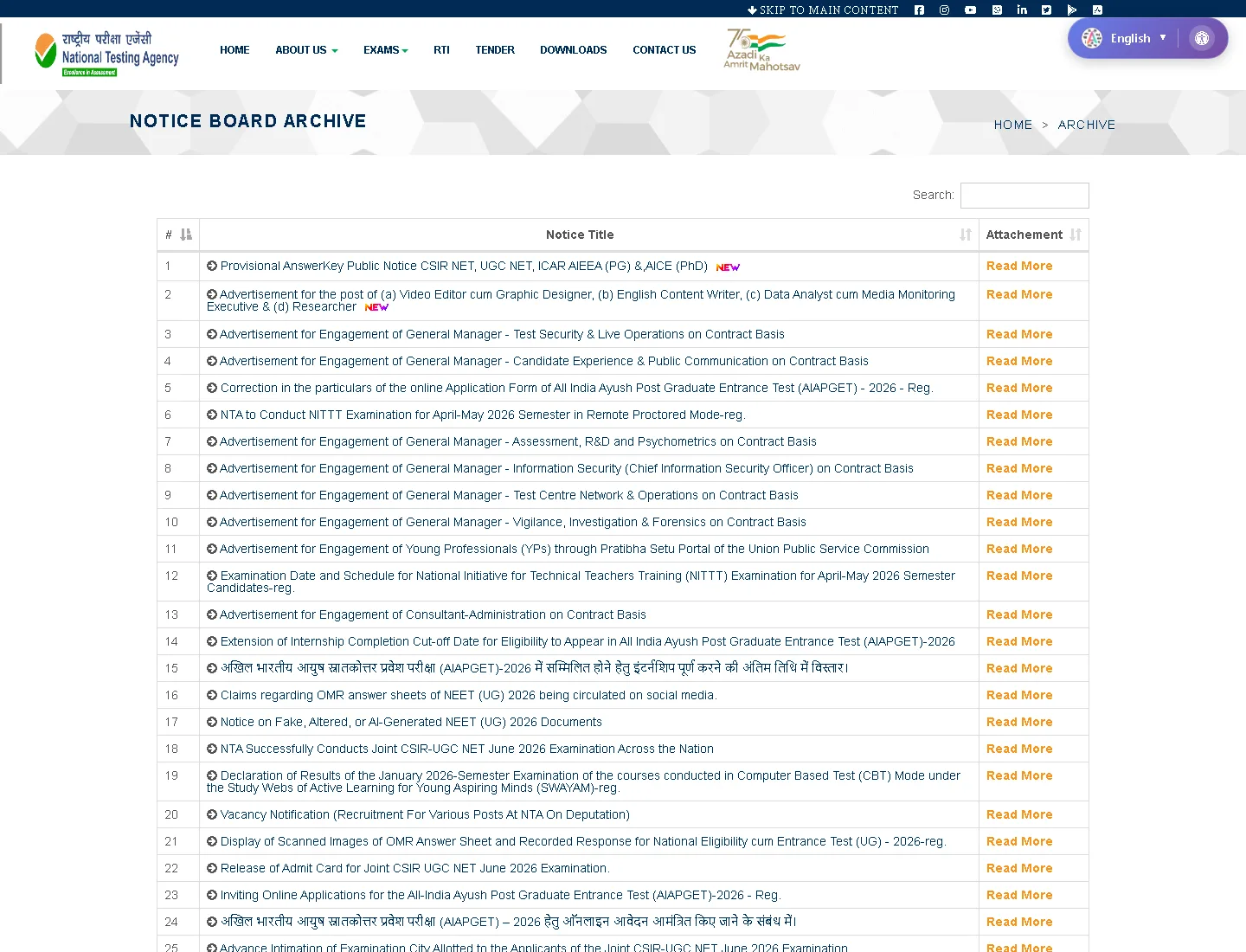
Update, August 12, 2026: We added this documentary capture from an authoritative source. Open the official source. The capture supports the verification route described here; it is not evidence for claims beyond what the linked source states.
HeadlineDecoded is committed to accuracy and transparency. Read our standards or submit a correction.