
Late Thursday night, water and debris tore into an under-construction tunnel at the Vishnugad-Pipalkoti Hydroelectric Project in Uttarakhand's Chamoli district, trapping 22 workers inside. By Friday afternoon, seven were confirmed dead, most of the rest had been pulled out, and three remained unaccounted for as rescue teams pushed through a tunnel section still choked with sludge and standing water. It's a tragedy in its own right. It's also, uncomfortably, a repeat — the third major tunnel disaster to hit Uttarakhand's hydropower and infrastructure push in five years. Here's what's actually confirmed, and why the pattern matters as much as the incident itself.
The story in 60 seconds
- An under-construction tunnel at THDC's Vishnugad-Pipalkoti Hydroelectric Project near Pipalkoti, Chamoli, was inundated by a sudden surge of water and debris late on Thursday, 13 August 2026, trapping 22 workers.
- As of Friday afternoon, at least seven workers are confirmed dead. Wire reports converge on 19 of the 22 trapped workers having been accounted for through the rescue operation, with three still missing.
- Rescue operations are being carried out jointly by the NDRF, SDRF, ITBP and district disaster response teams, working through a tunnel section still partly flooded with water and sludge.
- Injured survivors are being treated at the district hospital in Gopeshwar. Union Defence Minister Rajnath Singh and other officials have issued statements expressing condolences and calling for a thorough rescue effort.
- This is the third major Uttarakhand tunnel disaster since 2021 — after the 2021 Tapovan hydropower tunnel deaths and the 41-worker, 17-day Silkyara tunnel rescue in 2023 — reviving longstanding warnings about tunnelling safety standards in the state's fragile Himalayan geology.
AI SummaryAI-generated summary, reviewed by editors
A wall of water and debris tore through an under-construction hydropower tunnel in Uttarakhand on Thursday night, killing at least seven workers and leaving three still missing as rescue teams fight through flooded, sludge-filled passages. It's the third major tunnel disaster to hit the state in five years. Here's what
Switch to ShortsWhat's actually confirmed so far
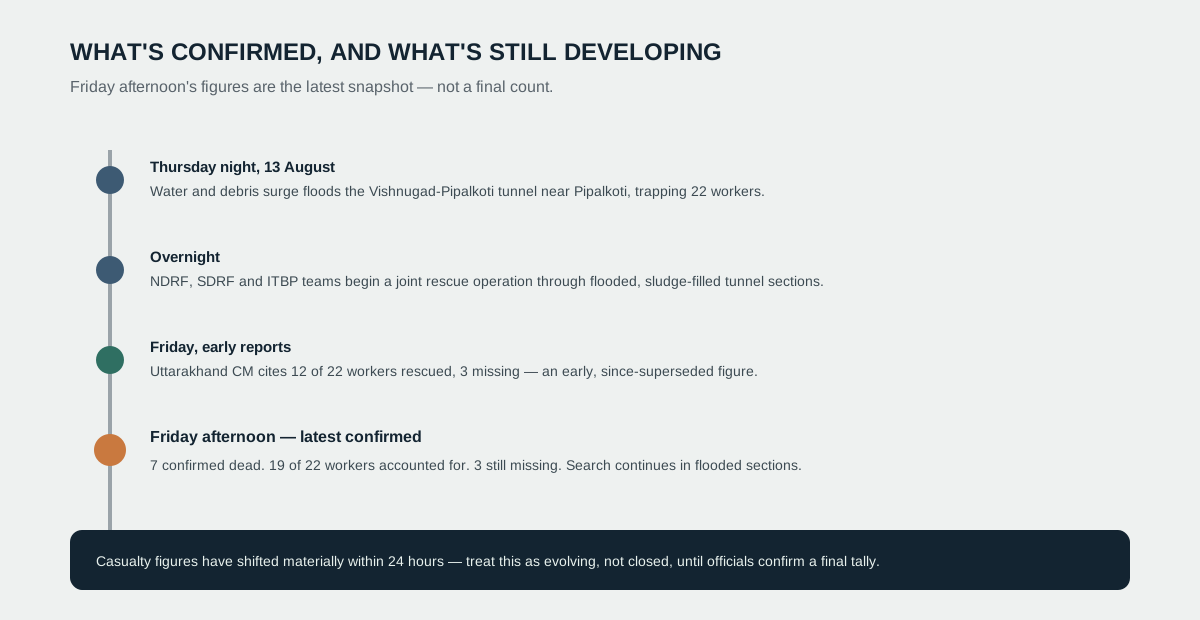
Strip this down to what multiple independent reports agree on, and the confirmed sequence is straightforward, if grim: late Thursday night, a rush of water and debris entered the under-construction tunnel at the Vishnugad-Pipalkoti site, trapping the 22 workers who were inside at the time. THDC — the Tehri Hydro Development Corporation, the state-run company building the project — confirmed the deaths and the ongoing rescue effort. Multi-agency teams, including the National Disaster Response Force, State Disaster Response Force and Indo-Tibetan Border Police, have been working through the night and into Friday to reach the section of tunnel still submerged in water and sludge, where the search for the three still-missing workers is concentrated. That part of the story is not in dispute.
Why the numbers keep shifting
If you've seen different casualty figures in different places, that's not confusion for its own sake — it's what happens in the first 24 hours of any disaster response, when a chaotic rescue site is still being worked through in real time. Thursday night's earliest reports, including a statement from Uttarakhand Chief Minister Pushkar Singh Dhami, cited 12 workers rescued and three missing out of 22. By Friday, converged wire reporting put the figure at seven confirmed dead and 19 of the 22 accounted for, with three still missing — a meaningfully different picture from twelve hours earlier. Treat Friday afternoon's numbers as the latest available snapshot, not a final count. Rescue operations of this kind routinely revise their figures more than once before they're done, and the honest thing to do is report what's confirmed right now rather than pretend an evolving number is settled.
The pattern nobody in charge seems to be acting on
Here's the part of this story that deserves more attention than a single-incident news brief usually gives it: this is not Uttarakhand's first major tunnel disaster, or even its second. In February 2021, a glacial-lake burst triggered flash floods down the Rishiganga and Dhauliganga valleys that killed over 200 people, including as many as 37 workers trapped in the tunnels of NTPC's Tapovan Vishnugad hydropower project. In November 2023, a 57-metre section of the under-construction Silkyara road tunnel collapsed without warning, trapping 41 workers for 17 days in a rescue that became international news. Investigators later found that tunnel had no escape shaft and had been built across a geological fault line — safety gaps flagged well before the collapse happened.
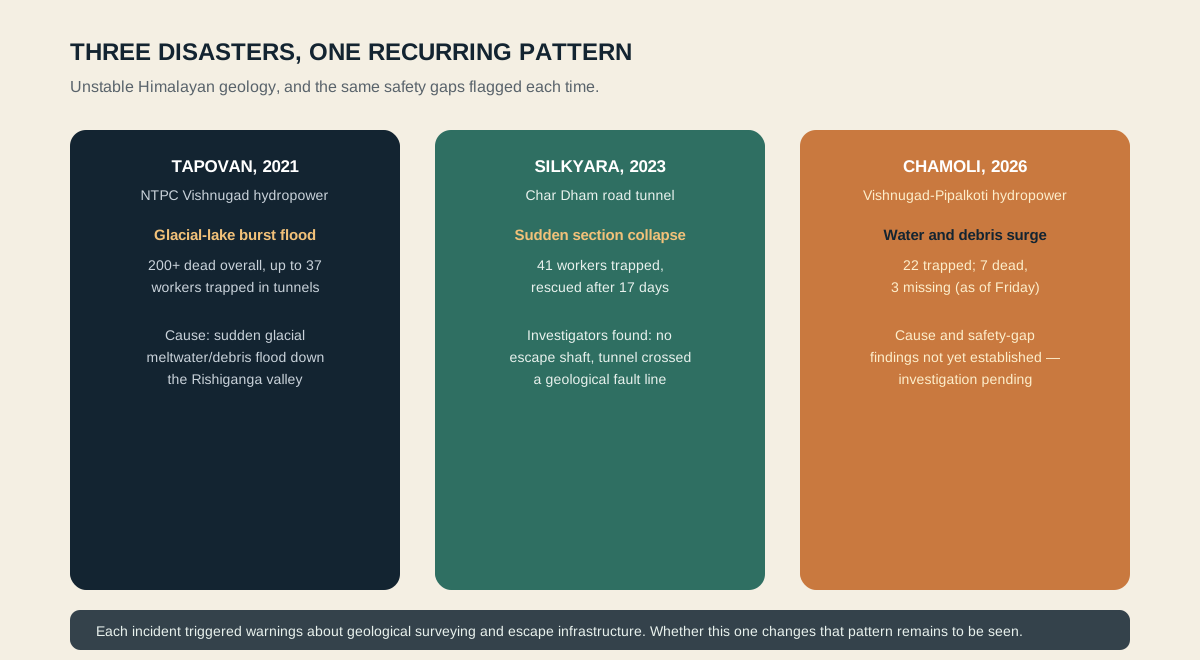
The common thread across all three incidents isn't bad luck. It's young, geologically unstable Himalayan terrain, criss-crossed by fault lines and saturated by monsoon rain and glacial meltwater, being tunnelled through at a pace that infrastructure researchers and disaster-management reviews have repeatedly warned outstrips the safety planning built into these projects — escape shafts, real-time water-ingress monitoring, and geological surveying that actually matches the terrain being cut through. Each time, the response is a rescue operation, an inquiry, and a round of promises. Whether the inquiry into this collapse produces anything different is the question worth watching, not just how the current rescue concludes.
Claim versus evidence
- Confirmed: A tunnel at THDC's Vishnugad-Pipalkoti Hydroelectric Project near Pipalkoti, Chamoli, was flooded by water and debris late on 13 August 2026, trapping 22 workers.
- Confirmed: At least seven workers have died. Multi-agency rescue teams (NDRF, SDRF, ITBP, district disaster response) are working through a flooded, sludge-filled tunnel section.
- Evolving, not final: The exact count of rescued versus missing has shifted between Thursday night's initial reports (12 rescued, 3 missing, per the Uttarakhand CM) and Friday afternoon's converged wire figure (19 of 22 accounted for, 3 missing). Treat this as a developing figure, not a closed count, until officials confirm a final tally.
- Confirmed: This is the third major Uttarakhand hydropower/infrastructure tunnel disaster since 2021, after Tapovan (2021) and Silkyara (2023).
- Documented pattern, not yet applied to this incident specifically: Independent reviews of the Silkyara collapse found missing escape shafts and construction across a geological fault line. Whether either factor contributed to this collapse has not yet been established and is a matter for the pending investigation.
Frequently asked questions
How many people died in the Chamoli tunnel collapse?
At least seven workers are confirmed dead as of Friday afternoon, with three still missing. These figures have shifted since the incident began Thursday night and should be treated as the latest available snapshot rather than a final count.
Which project was this, and who runs it?
The tunnel is part of THDC's (Tehri Hydro Development Corporation's) Vishnugad-Pipalkoti Hydroelectric Project, near Pipalkoti in Uttarakhand's Chamoli district.
Is this connected to the 2021 Tapovan disaster or the 2023 Silkyara collapse?
Not directly — they are three separate incidents at three different project sites. But all three fall within the same broader pattern of tunnel disasters tied to Uttarakhand's unstable Himalayan geology and the pace of hydropower and infrastructure tunnelling in the region.
What caused the water and debris surge?
The specific cause has not yet been officially established. It follows a broader, well-documented pattern in the region of water ingress, unstable rock and geological fault lines complicating tunnel construction, but attributing this specific collapse to any one cause would be getting ahead of the investigation.
The bottom line
Rescue operations like this one get judged, understandably, by how the current emergency ends — how many more of the missing are found alive. But Uttarakhand has now had three major tunnel disasters in five years, each one followed by the same warnings about geological surveying, escape shafts and construction pace that apparently weren't fully acted on after the last one. Watching whether this incident's inquiry changes that pattern is, in the long run, at least as important as today's rescue count.
Sources
- Tunnel collapses at an Indian hydropower project, killing at least 7 — The Washington Post
- Uttarakhand tunnel collapse: 7 killed; search on for missing workers — The Week
- Deeply saddened by tragic loss of lives at tunnel collapse in Chamoli: Rajnath Singh — ANI
- Uttarakhand: More tunnelling disasters in store as norms are disregarded amid infrastructure push — Scroll.in
Full forms
- THDC — Tehri Hydro Development Corporation Limited
- NDRF — National Disaster Response Force
- SDRF — State Disaster Response Force
- ITBP — Indo-Tibetan Border Police
- NTPC — National Thermal Power Corporation
HeadlineDecoded is committed to accuracy and transparency. Read our standards or submit a correction.