AI SummaryAI-generated summary, reviewed by editors
Road damage appeared less than two weeks after NE-6 opened, but NHAI disputes claims of a structural cave-in. We verify the cost, timeline, tolling technology and the allegations that remain unsupported.
Switch to ShortsThe claim: A widely shared account says the ₹4,200-crore Lucknow–Kanpur Expressway caved in three weeks after its inauguration, after being presented as India’s first barrier-less expressway. It also says toll collection was suspended and contractor PNC Infratech faces possible exclusion from future NHAI work.
HeadlineDecoded verdict: The project details and the occurrence of localized road damage are supported, but the viral framing overstates or leaves out important facts. The damage was reported about 13 days after the July 13 inauguration—not three weeks. NHAI disputed that the expressway had structurally “caved in,” saying an approximately 40-metre stretch of the upper wearing course slipped and was repaired. We found no authoritative public record supporting the claims that toll collection was suspended because of this incident or that PNC Infratech was proposed for debarment from future NHAI projects.
What is the Lucknow–Kanpur Expressway?
National Expressway 6 is a roughly 63-kilometre, access-controlled corridor intended to cut the road journey between Lucknow and Kanpur. It opened as a six-lane road that can be expanded to eight lanes. Defence Minister Rajnath Singh inaugurated it in Unnao on July 13, 2026, alongside Union Road Transport and Highways Minister Nitin Gadkari and Uttar Pradesh Chief Minister Yogi Adityanath. Traffic was opened to the public the following day.
A Government of India infrastructure summary listed the project’s total capital cost at ₹4,219 crore. Dividing that figure by 63 kilometres gives about ₹67 crore per kilometre. That is only a corridor-level average: it should not be interpreted as a construction-only or lane-kilometre rate because the total may cover structures, land, systems and other project costs. Contemporary reports gave estimates ranging from about ₹4,200 crore to ₹4,700 crore, so comparisons should identify which cost basis they use.
“Barrier-less” does not mean toll-free
The road was promoted for Multi-Lane Free Flow tolling. The system uses FASTag data and automatic number-plate recognition so vehicles can be charged without stopping at a conventional barrier. Calling it barrier-free is therefore reasonable; calling it a road “designed with no toll collection” would not be. Some launch reports also referred to five tolling locations or plazas, while describing the intended collection system as free-flow.
The corridor was also presented as a pilot for Automated and Intelligent Machine-Aided Construction, using machine-guidance and digital quality-control systems. That technology claim does not, by itself, establish either that every layer was defect-free or that the observed damage was structural.
What happened after the rain?
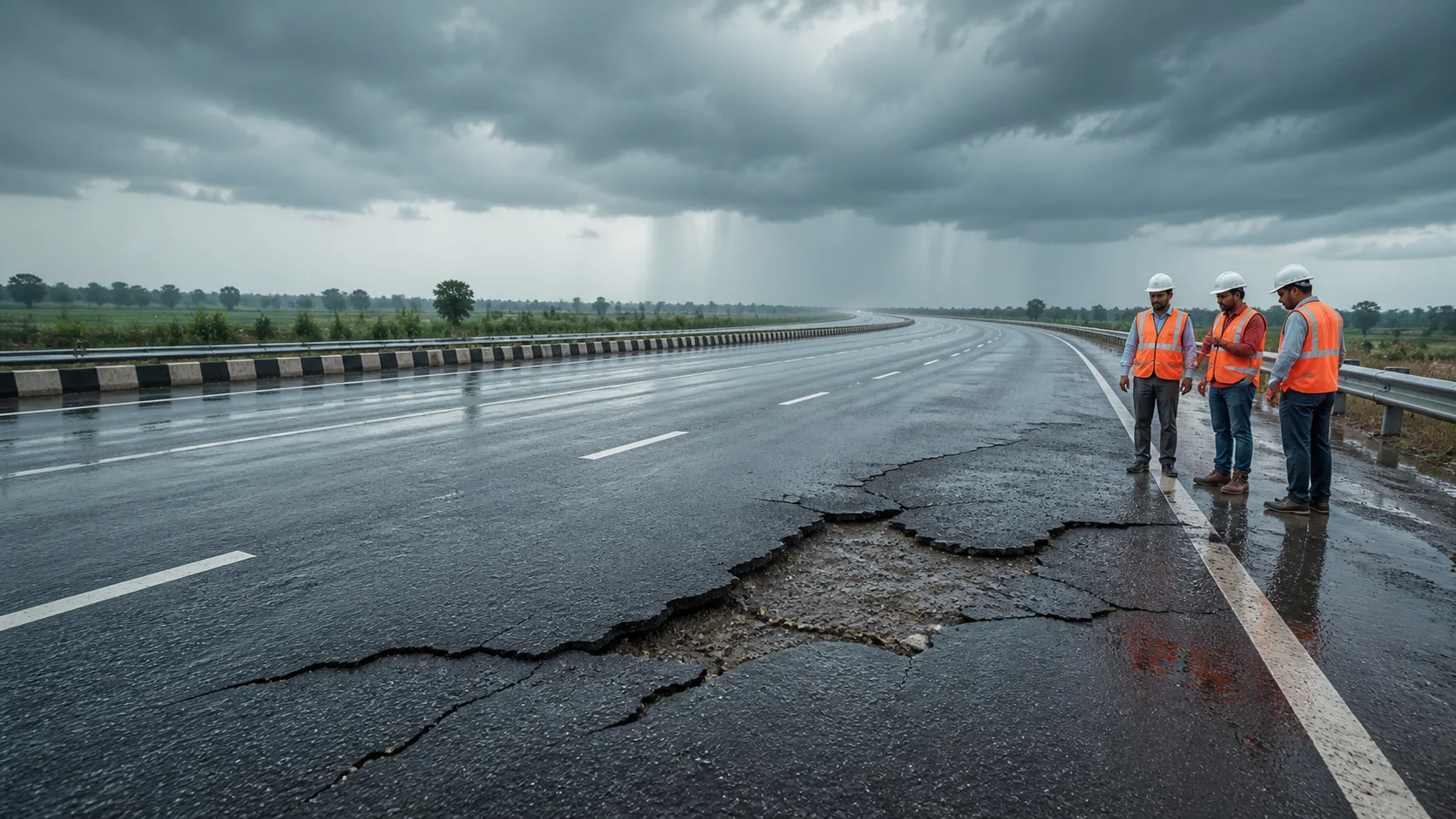
On July 26, reports and video from the Korari area of Unnao showed damage to the newly opened roadway after heavy rain. Several reports described a portion as sinking or caving in and the images prompted questions about construction quality.
NHAI’s project director gave a narrower account. According to a PTI report carried by Hindustan Times, the authority said there was no cave-in and that the upper wearing coat had slipped over about 40 metres. NHAI said the affected surface was repaired within hours, traffic continued normally and, at that point, no separate inquiry had been ordered.
Those accounts agree that visible damage occurred soon after opening. They differ on its technical severity. Without a published engineering assessment—including layer tests, drainage findings and failure-depth measurements—it is not responsible to convert a visual description into a definitive claim of structural collapse.
Where PNC Infratech fits
PNC Infratech was associated with the project through two NHAI packages, and company and government project documents connect it to the corridor’s development. That establishes the contractor relationship. It does not independently prove negligence or a contractual breach in the affected section.
The specific claims that NHAI suspended toll collection because of the damage and proposed barring PNC Infratech from future projects could not be verified in an NHAI order, Ministry release, exchange filing or other authoritative public document reviewed for this article as of August 9, 2026. They should not be stated as settled fact unless the underlying notice or order is produced.
Claim-by-claim assessment
- ₹4,200 crore and 63 kilometres: Substantially correct. An official project summary listed ₹4,219 crore and 63 km.
- Inaugurated July 13 by Rajnath Singh, Nitin Gadkari and Yogi Adityanath: Correct.
- India’s first barrier-less expressway: Needs precision. Reports described the corridor as using or piloting barrier-free MLFF toll collection; it is not toll-free.
- It caved in three weeks later: Misleading. Damage was reported about 13 days later, and NHAI disputes “cave-in,” describing localized wearing-course slippage.
- Toll collection was suspended: Not independently verified from an authoritative public record.
- PNC Infratech may be barred from future NHAI projects: Not independently verified from an authoritative public record.
What would establish accountability?
The most useful next evidence would be the repair and inspection report for the Korari stretch, laboratory results for the pavement layers, drainage-design and rainfall data, the relevant concession obligations, and any formal show-cause, penalty, toll or debarment order. Publishing those records would let the public distinguish a localized surface failure from a deeper structural defect and identify who bears the repair cost.
Sources and methodology
This fact check compared an official project-cost summary and project documentation with launch coverage and reports carrying NHAI’s response to the road damage. Claims for which no primary notice or corroborating authoritative report was found are labelled unverified rather than repeated as fact.
- Press Information Bureau: infrastructure project summary
- The Indian Express: inauguration and project features
- Hindustan Times: corridor, tolling and contractor details
- Hindustan Times/PTI: NHAI response to damage reports
- PNC Infratech: concession agreement announcement
HeadlineDecoded is committed to accuracy and transparency. Read our standards or submit a correction.