AI SummaryAI-generated summary, reviewed by editors
In a 1980 discourse, Osho maps desire across body, mind, heart and turiya. The self-observation method is useful; its hierarchy and gender claims need scrutiny.
Switch to ShortsA student — addressed here as Krishna — asks a simple question: "What do I want?" Osho's response is to refuse the question outright, and the refusal itself is the interesting part. You cannot answer what someone wants, he argues, without first knowing where they're standing — because desire changes shape entirely depending on whether a person is identified with the body, the mind, the heart, or a fourth, transcendental state beyond all three. It's a sharp move, and worth taking seriously on its own terms. It's also doing more rhetorical work than it lets on.
The teaching, in brief
- Desire isn't fixed — it's a symptom of which "plane" a person is currently identified with.
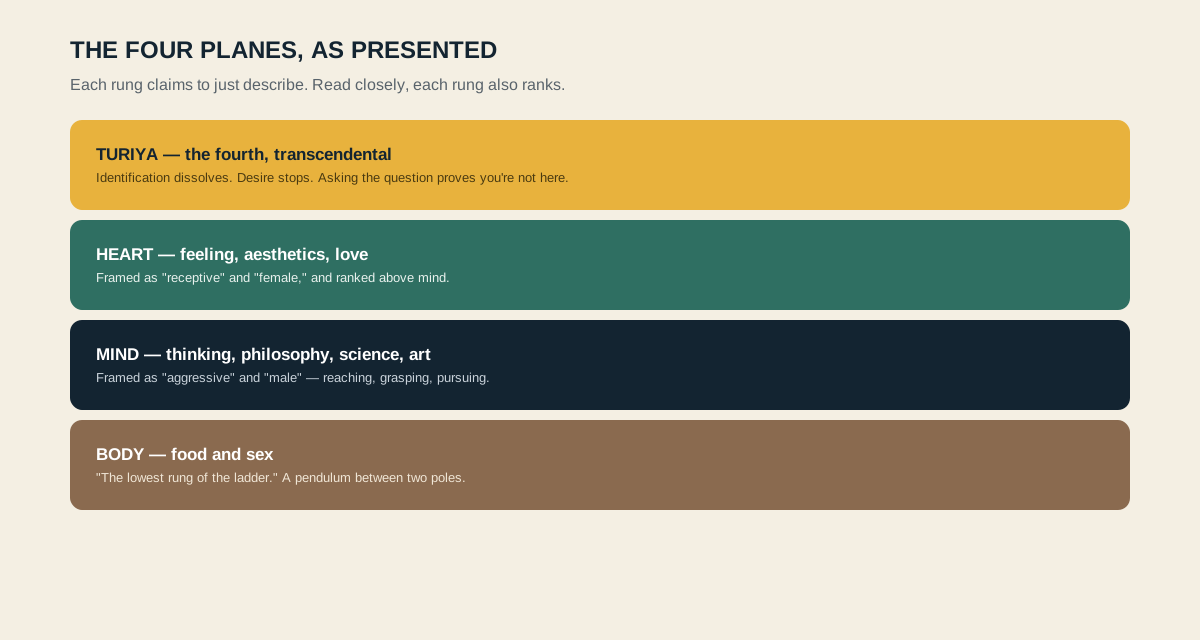
- Body: food and sex. Described as "the lowest rung of the ladder," though Osho insists this isn't a value judgement, just a description of the body's narrow, pendulum-like range.
- Mind: thinking, philosophy, science, art — endless dimensions of interest. Characterised as "aggressive" and "male."
- Heart: feeling, aesthetics, love, sensitivity — ranked above mind. Characterised as "receptive" and "female."
- Turiya (the fourth): the transcendental state, borrowed from classical Vedanta's four states of consciousness. Here, identification dissolves entirely and desire simply stops.
- The punchline: asking "what do I want" proves you're not at the fourth — because in that state, there'd be nothing left to ask. So rather than answering, Osho asks Krishna to locate himself instead.
What actually holds up here
Give credit where it's due first. The self-referential trap — the question can't be honestly answered from the state it's asking about — isn't just a clever debating trick. It's a genuine piece of insight, and it has real teeth outside any spiritual framework too: plenty of questions carry their own answer inside their asking. And underneath the mysticism sits a genuinely practical method: instead of handing someone a prescription for what they should want, Osho hands them an observation exercise. Watch where your actual time and energy go. If it's appetite and sex, you're body-identified. If it's ideas, mind. If it's feeling and connection, heart. That's a better piece of self-inquiry advice than most of what passes for self-help — because it describes rather than prescribes.
Where "I am not evaluating" quietly stops being true
Here's the first crack. Osho explicitly disclaims judgement — "I am not condemning them by calling them lowest... I am just stating a fact" — and then immediately uses language that does exactly the judging he's disclaiming. "Lowest rung of the ladder" is not a neutral description; a ladder has a direction, and lowest is not a value-free position on it. This is a familiar move in teaching of this kind: announce impartiality, then smuggle a ranking in through word choice. It doesn't wreck the argument, but it's worth naming rather than letting it slide past unquestioned.
A gender framework the argument doesn't actually need
Mind is cast as "aggressive" and "male," heart as "receptive" and "female" — a fairly dated piece of pop-Jungian gender essentialism, characteristic of the era this style of teaching comes from. Strip it out entirely and the body-mind-heart-Turiya structure works exactly the same way. The gendering adds nothing to the logic of the argument; it's decoration that happens to import a set of assumptions about men and women that don't hold up well against scrutiny.
Ranking heart above mind is a sectarian bet, not a neutral fact
The hierarchy quietly assumes that feeling and aesthetic sensitivity sit on a higher rung than sustained thought — philosophy, science, mathematics. That's not a universal truth being reported; it's a specific commitment of devotion-centred (bhakti) spiritual traditions. A teacher from a knowledge-centred (jnana) tradition would rank the same two planes in the opposite order, with no less internal consistency. Presenting one sectarian ordering as simply "how it is" is the same move as the "lowest rung" language above — description doing the work of evaluation.
What turiya means in this discourse—and in its older source
Osho uses turiya, Sanskrit for “the fourth,” as the point at which identification and desire disappear. The term is older than this four-rung model. The Mandukya Upanishad discusses waking, dreaming and deep sleep before describing the fourth as non-dual and beyond ordinary description. Osho adapts that vocabulary to a practical ladder of desire; readers should distinguish his 1980 teaching device from the Upanishad's own analysis of consciousness.
The questioner being addressed as Krishna does not, by itself, make this a dialogue with the Bhagavad Gita or authorize a comparison with Krishna's teaching to Arjuna. The earlier draft made that unsupported leap; it has been removed.
The one problem with an argument that can never lose
Last crack, and it's the structural one. "The fact that you're asking proves you're not there yet" is unfalsifiable by design — it can wave away literally any question, forever, without ever being wrong. That doesn't make it false. It does mean the framework is built so it can never be tested against a counterexample, which is worth being a little suspicious of, the same way you'd be a little suspicious of any claim that's constructed so nothing could ever count against it.
What to keep, and what to hold loosely
The diagnostic method — stop asking to be told what you want, go watch where your attention actually spends itself — is genuinely worth keeping, spiritual framework or not. The four-tier hierarchy, the gendered mind/heart split, and the quiet slide from "just describing" to "obviously ranking" are the parts worth holding at arm's length. And if you're reading this specific discourse against the Gita it invokes by name, it's worth knowing the two texts aren't actually agreeing with each other, even though the borrowed authority makes it sound like they are.
Source and provenance
The passage comes from question three of “You Are the Question,” chapter 4 of Come, Come, Yet Again Come, delivered on 30 October 1980 in Buddha Hall. The archive lists code 8010300 and identifies audio and video as available. This establishes the quotation's context; it does not turn the teaching's spiritual or psychological claims into scientifically verified facts.
Related HeadlineDecoded reading
For another source-based examination of Osho's advice, read “Live as You Are”: self-acceptance without passivity.
Sources checked
- “You Are the Question,” chapter 4, archive code 8010300 — Osho discourse archive
- Mandukya Upanishad, verse 7 and commentary — text and translation
Image note: the hero is an AI-generated conceptual editorial illustration. It does not depict Osho, the questioner or the 1980 discourse.
HeadlineDecoded is committed to accuracy and transparency. Read our standards or submit a correction.