AI SummaryAI-generated summary, reviewed by editors
LSE recorded Yogendra Yadav and Srđa Popović discussing nonviolent movements during its 2016 India Summit. The public record confirms the conversation—but not later operational coordination.
Switch to ShortsAt the LSE India Summit in Goa in January 2016, Yogendra Yadav and Serbian activist Srđa Popović recorded a conversation about political theory and nonviolent mass movements. The exchange is genuine and documented by the London School of Economics. But the record reviewed by HeadlineDecoded does not show that Popović trained, financed or directed Yadav—or any later Indian protest movement.
Correction, 13 August 2026: An earlier version repeatedly called this exchange a “conference panel” and said it was open to anyone who registered. LSE describes it more precisely as an additional recorded conversation between summit participants, held during a pause in the conference. The summit had more than 300 attendees, but the available sources do not establish the audience or access arrangements for this particular recording.The answer in 60 seconds
- LSE’s South Asia Centre held its first India Summit at Cidade de Goa from 28–30 January 2016.
- LSE says more than 300 people attended the three-day summit. Its programme included lectures, panels and shorter recorded conversations.
- Popović delivered the opening lecture on nonviolent strategy. During a pause in the conference, he and Yadav recorded a separate conversation about political theory and building nonviolent mass movements.
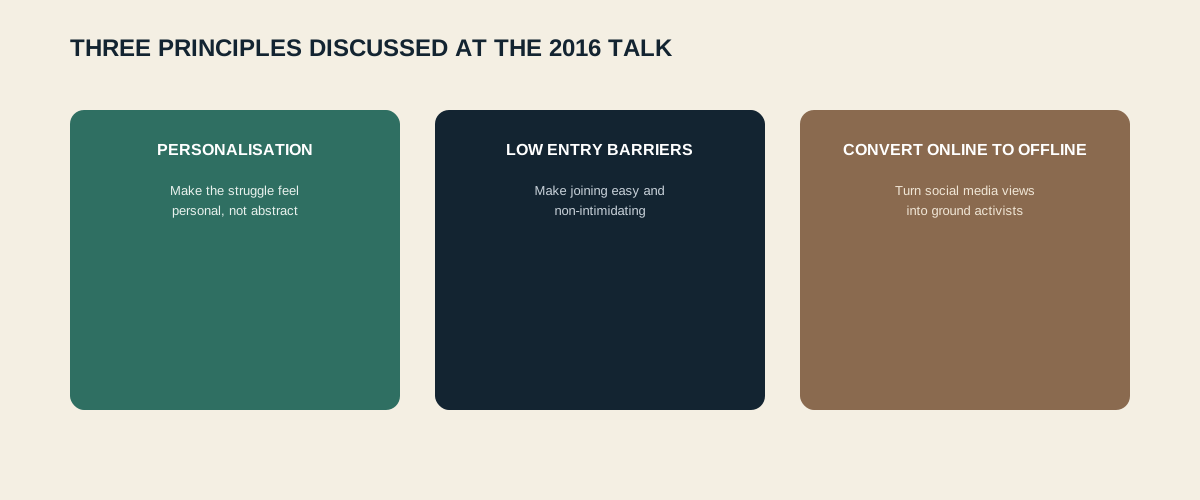
- LSE published an audio recording and an edited transcript. They discussed personalising an issue, lowering barriers to participation, humour in protest and turning online attention into real-world participation.
- The conversation proves that the two men met and discussed these subjects. By itself, it does not prove a continuing relationship or operational involvement in a later movement.
What happened at the summit
The LSE South Asia Centre’s official summit page identifies the venue and dates and says the event drew more than 300 attendees from the media, academia, business, diplomacy and the LSE alumni community. The programme included two special lectures, four panel discussions, an exhibition and shorter conversations between participants.
Popović’s opening lecture was titled “People Power: How Non-Violent Strategies are Shaking and Shaping the World.” LSE’s summit report says it covered his experience with Serbia’s Otpor movement, why nonviolent protests succeed or fail, India’s history of nonviolent protest, and the importance of planning, discipline and unity.
The Yadav–Popović exchange was not one of the four listed panels. LSE’s contemporary account says the speakers met “during a pause in the conference” for a recorded conversation. That distinction matters: the recording is part of the summit’s public documentary record, but it should not be mislabeled as a panel or described as publicly accessible at the time without evidence.
What Yadav and Popović discussed
The transcript is a discussion of broad movement-building principles, not a plan for a named campaign. Popović argued that movements grow when people experience an issue personally; he used Gandhi’s salt campaign as an example. The exchange also covered making participation easy, using humour or “laughtivism,” and the difficulty of converting online supporters into people willing to act offline.
Yadav approached the subject from his experience as a political scientist and activist. LSE described him at the time as a professor at the Centre for the Study of Developing Societies (CSDS), a founding member of the Aam Aadmi Party, and a founder-member of Swaraj Abhiyan and Jai Kisan Andolan. A later CSDS biography describes him as a former senior fellow.
What the evidence proves—and what it does not
- Established: Yadav and Popović attended the same LSE summit and recorded a substantive conversation about nonviolent movement strategy.
- Established: LSE published the audio, transcript, photographs and summit report.
- Not established by these records: a training relationship, financial link, continuing partnership or operational role in a later Indian protest.
- What would be needed: authenticated communications, contracts, financial records, travel or training records, or on-the-record testimony tied to the specific later movement.
This evidentiary boundary is central to HeadlineDecoded’s fact-check of the Cockroach Janta Party foreign-training claim. For related background, see our explanation of the HRF–CANVAS Freedom Fellowship and our guide to Gene Sharp’s 198 methods of nonviolent action.
Frequently asked questions
Was the conversation secret?
No evidence reviewed supports calling it secret: LSE recorded it and published the audio and transcript. That does not tell us precisely who could watch the recording in person.
Was it an official conference panel?
No. LSE lists four other panel discussions and describes this as an additional conversation recorded during a pause in the conference.
Does the recording prove later coordination?
No. It proves a documented conversation in January 2016. A claim about coordination in another campaign requires evidence connecting the people, conduct and dates involved in that specific campaign.
What is new here?
This review corrects the event format and unsupported access claim, distinguishes the summit from the separate recorded conversation, adds the original audio and official summit report, and sets out the evidence required before a 2016 discussion can be linked to a later political movement.
Original-media and social check
LSE’s contemporary page contains the edited transcript, event photographs credited to Sonali Campion and Tim Aldcroft, and a link to the original LSE South Asia Centre audio. Those authentic materials establish the conversation and its public documentation. We did not republish the LSE photographs because their reuse licence was not established, and no original social post was needed to authenticate an event already documented by its organiser.
Primary sources
- LSE India Summit 2016 — LSE South Asia Centre
- Srđa Popović in conversation with Yogendra Yadav — LSE South Asia Blog transcript
- Original LSE audio recording — LSE South Asia Centre on SoundCloud
- Report on the LSE India Summit 2016 — LSE South Asia Blog
- Yogendra Yadav biography — CSDS
- CANVAS team biography for Srđa Popović — CANVAS
Image note: the hero is an AI-generated HeadlineDecoded editorial illustration. It is not a photograph of the 2016 event and does not depict either participant.
HeadlineDecoded is committed to accuracy and transparency. Read our standards or submit a correction.