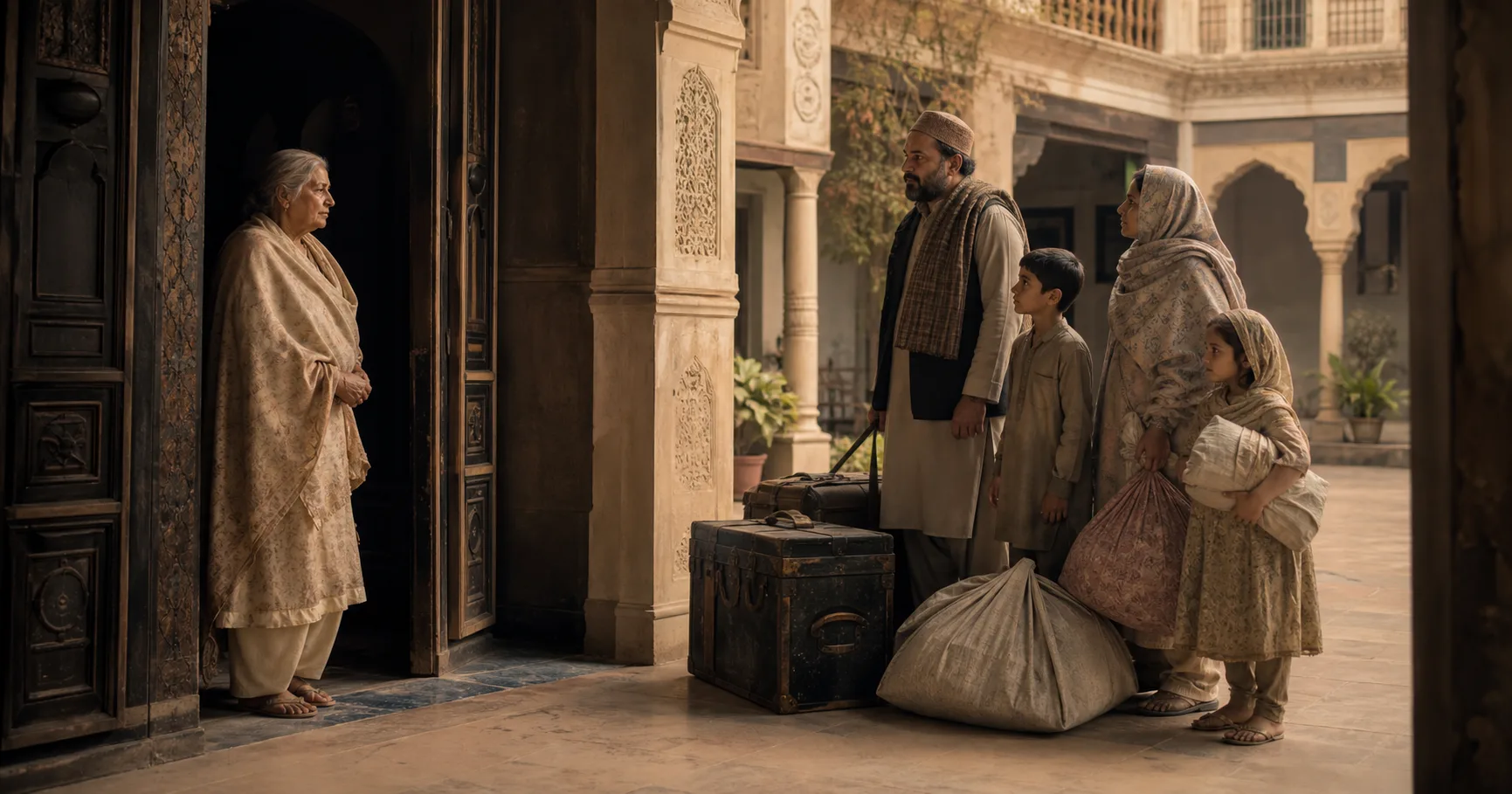
The trailer for Batwara 1947 begins with freedom and quickly turns to rupture: a Muslim family reaches Lahore after Partition, receives a haveli, and discovers that an elderly Hindu woman still considers it home. The house is fictional. The collision of loss, migration and competing claims to home is not.
The story in 60 seconds
- Batwara 1947, directed by Rajkumar Santoshi and produced by Aamir Khan Productions, is scheduled for theatrical release on August 14, 2026.
- The trailer features Sunny Deol, Preity Zinta and Shabana Azmi and presents a Muslim refugee family entering a Lahore house occupied by an elderly Hindu woman.
- The film is inspired by Asghar Wajahat's play Jis Lahore Nai Vekhya, O Jamya E Nai, not by one documented family case.
- The historical foundation is real: Punjab was divided, religious minorities fled in opposite directions, and homes left behind became part of refugee resettlement.
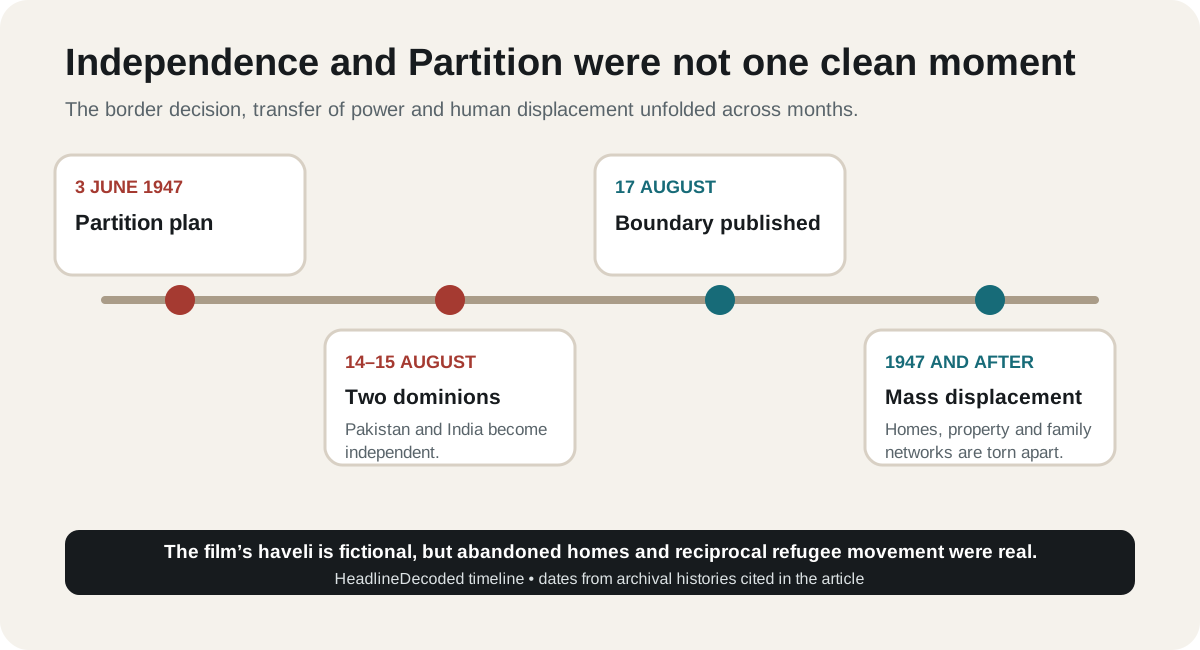
- The Radcliffe boundary was published on August 17—after India and Pakistan had already celebrated independence.
- A trailer can reveal themes and imagery, but it cannot establish the finished film's historical accuracy scene by scene.
AI SummaryAI-generated summary, reviewed by editors
The trailer turns one Lahore haveli into a story about borders, refugees and belonging. Here is what comes from Partition history, what comes from Asghar Wajahat's play, and what remains cinema.
Switch to ShortsWhat the trailer actually shows
The official trailer presents Sunny Deol and Preity Zinta as members of a Muslim family displaced into the newly created Pakistan. In Lahore, the family is allotted a large house, but Shabana Azmi's character—an elderly Punjabi Hindu woman—has remained behind. The conflict shifts from possession to protection as communal hostility grows around them.
That premise reverses the familiar direction associated with Deol's Gadar image. The central Muslim character is not crossing into India to rescue a loved one; he is in Pakistan, defending a Hindu woman whose home has been administratively assigned to his displaced family. The trailer still promises action, but its most important question is quieter: when the state changes the legal owner of a house, who gets to call it home?
The source is a play, not a recovered case file
Reports and the film's credits identify Asghar Wajahat's celebrated play Jis Lahore Nai Vekhya, O Jamya E Nai as the source. The play centres on a Muslim family uprooted from Lucknow and resettled in a Lahore haveli whose elderly Hindu resident refuses to leave. Over time, the figure known as Mai becomes part of the family's moral world.
The drama uses one household as a compressed stage for a much larger historical experience. Its characters should not be presented as direct portraits of named survivors unless the filmmakers provide evidence for that claim. Its truth is thematic: people displaced in opposite directions could simultaneously be refugees, beneficiaries of somebody else's loss and guardians of memories that political categories could not contain.
What really happened to Punjab in 1947?
British withdrawal did not simply divide one country on a single night. The June 3 plan accepted the partition of British India, including the division of Punjab and Bengal. Cyril Radcliffe, a British barrister new to India, chaired boundary commissions working under extreme time pressure. Pakistan became independent on August 14 and India on August 15, but the boundary award was made public on August 17.
That delay mattered. Communities celebrated independence without knowing with certainty which country their district would enter. Political decisions, rumours, militia activity, the collapse of local protection and retaliatory violence accelerated movement across Punjab.
Muslims travelled west into Pakistan; Hindus and Sikhs moved east into India. Other migrations unfolded across Bengal, Sindh, Delhi and beyond. Historians' death estimates vary widely, which is why responsible accounts avoid presenting one disputed number as exact. More than 14 million people are commonly estimated to have crossed the new borders, making Partition one of the largest forced migrations of the twentieth century.
Could a refugee family really be allotted somebody else's home?
Yes, in broad historical terms. Departing families left houses, businesses, land, furniture, papers and neighbourhood networks. The new states developed systems for administering property classified as evacuee property and for resettling incoming refugees. A Muslim family arriving in Lahore could therefore occupy a home left by a Hindu or Sikh family, while a displaced Hindu or Sikh family could receive property abandoned by Muslims in India.
That does not mean every transfer happened neatly, lawfully or immediately. Records, possession and compensation could be contested for years. Some people expected to return. Others left keys with neighbours. Houses could be occupied before formal allotment, divided among families, looted or absorbed into bureaucratic systems that valued property differently on either side.
The film's haveli is therefore a powerful dramatic device rooted in a real material problem: two families could have honest attachments to homes on opposite sides of a border neither family drew.
Lahore was not culturally simple before Partition
The trailer's Hindu woman in Lahore is not an anachronism. Pre-Partition Lahore was a major centre of Punjabi, Urdu and multilingual cultural life, with Muslim, Hindu and Sikh residents participating in its educational, commercial, literary and artistic institutions. Religious identity mattered, but it did not place every community inside a separate city.
Partition transformed that social composition with extraordinary speed. Hindus and Sikhs were driven from or fled Lahore, while Muslim refugees arrived from areas that became India. To show a Hindu resident who experiences Lahore as inseparable from herself is therefore historically plausible. Her refusal also exposes the weakness of treating migration as an automatic expression of religious preference: many people moved because remaining had become dangerous, not because they freely stopped loving their homes.
What the trailer gets right
- Freedom and fear arrived together. Independence was celebrated while violence and uncertainty were already reshaping Punjab.
- Migration ran in both directions. The new border made refugees of Muslims, Hindus and Sikhs.
- A house could carry rival losses. Refugee rehabilitation often placed one displaced family inside property left by another.
- Religion did not erase local belonging. Language, neighbourhood, food and memory could bind a person to Lahore more deeply than a new national category.
- Communal violence was not one-sided. Atrocities, dispossession and coercion occurred across communities and territories.
What should be treated as cinema?
The trailer compresses political decisions, migration, property allocation and communal conflict into a hero-driven narrative. Individual fights, speeches, confrontations and the exact sequence inside the haveli belong to the adaptation unless corroborated independently. Marketing also foregrounds Sunny Deol's action persona; that emphasis may differ from the source play's theatrical balance.
The trailer cannot tell us whether the final film will give equal historical weight to British withdrawal, competing political projects, provincial dynamics, gendered violence, Bengal's partition or the experiences of people outside its central Lahore story. Absence from a trailer is not proof of absence from the film, but viewers should not mistake one family's arc for a complete history of 1947.
Why the August 14 release date matters
The release is scheduled for August 14, Pakistan's Independence Day and the eve of India's Independence Day. That timing makes the film part of the annual public conversation about freedom and Partition. It may increase attention, but traffic or box-office growth is not guaranteed: audience response, reviews, competing releases and distribution still matter.
The more useful question is what viewers do with that attention. A film can open the door to history, but survivor testimony, archival records and serious scholarship are needed to walk through it.
What to remember after watching the trailer
Batwara 1947 is not valuable because one fictional haveli explains all of Partition. It is valuable if the haveli helps viewers understand that Partition was lived at the scale of rooms, keys, courtyards, missing relatives and neighbours suddenly labelled outsiders.
The historically grounded reading is not “one community lost and another won.” It is that millions inherited states while losing homes—and sometimes entered homes carrying somebody else's absence.
Abbreviations and full forms
UKUnited KingdomSources
- Official trailer listing and release date — Bollywood Hungama
- Trailer, cast and source-play details — Cinema Express
- Trailer and production details — The Week
- Partition of British India archival learning collection — The National Archives, UK
- Indian independence, Radcliffe boundary and oral histories — The National Archives, UK
- First-person accounts of forced migration from Lahore — The 1947 Partition Archive
HeadlineDecoded is committed to accuracy and transparency. Read our standards or submit a correction.