Google released Gemini 3.7 Flash on August 13, 2026, and if you don't build software for a living, the announcement probably passed you by entirely. That's worth fixing, because "Flash" releases like this one are quietly the AI models most people actually interact with day to day — the fast, cheap tier that powers a huge share of everyday AI features, even when nobody markets it by name. Here's what actually changed, in plain terms, and who should care.
The story in 60 seconds
- Google DeepMind released Gemini 3.7 Flash on August 13, 2026, an update to its fast, low-cost model tier.
- Coding performance jumped meaningfully — its FrontierCode 1.1 benchmark score rose from 34.4% to 43.6%.
- Output speed reaches up to 340 tokens per second, well above average for models in its price tier.
- Introductory pricing is $0.75 per million input tokens and $3.75 per million output tokens through December 31, 2026 — half the original 3.6 Flash cost — before rising to a standard $1.50/$7.50.
- It's built for fast, multi-step "agentic" tasks: planning, tool use, and coding assistance that requires fewer manual corrections.
AI SummaryAI-generated summary, reviewed by editors
Google released Gemini 3.7 Flash on August 13, 2026 — a faster, cheaper, notably better-at-coding update to its budget-tier model line. The coding benchmark jumped from 34.4% to 43.6%, output speed hit up to 340 tokens per second, and introductory pricing is half the previous Flash tier's cost. Here's what a 'Flash' re
Switch to Shorts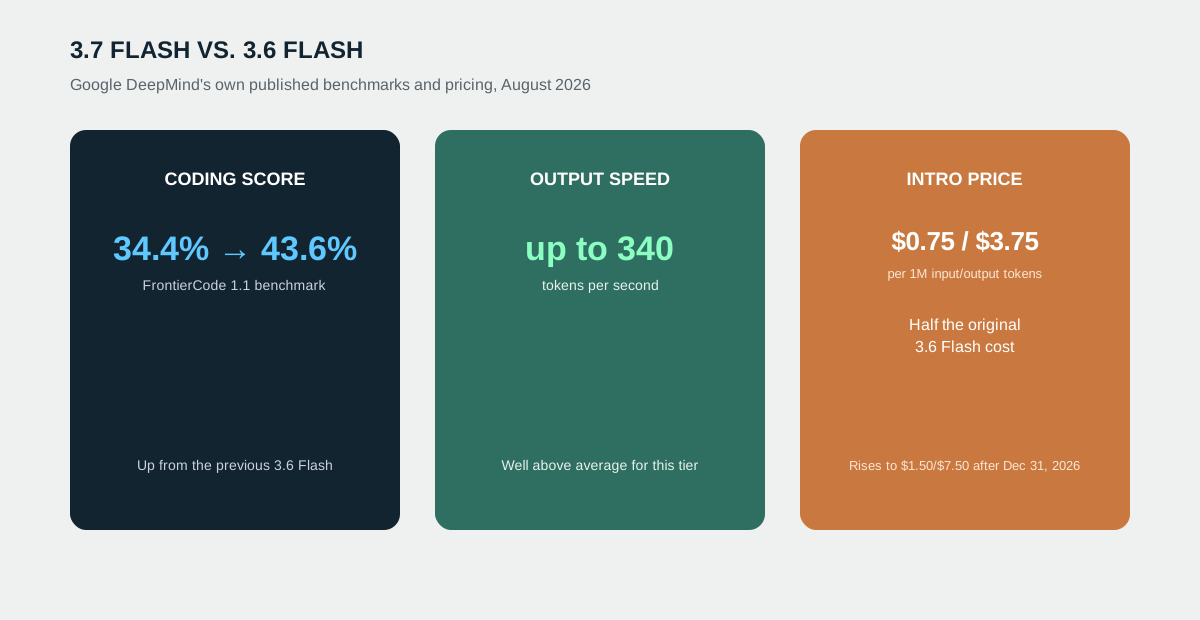
What "Flash" actually means
Google's Gemini line isn't one model — it's a family with different tiers built for different jobs. The flagship "Pro" tier is built for maximum capability, generally slower and pricier. "Flash" is the fast, cheap, high-volume tier, designed for tasks where speed and cost per request matter more than squeezing out the absolute best possible answer. It's the tier that quietly runs behind a lot of consumer-facing AI features — quick summaries, chat responses, background automation — because it's cheap enough to run at scale without every request being financially painful for whoever's building on it.
That's why a "Flash" release, even though it rarely makes headlines the way a flagship model launch does, often matters more practically: it's the version of the technology actually running behind the scenes of tools people use constantly.
What's genuinely better this time
The coding jump is the clearest, most checkable improvement: Gemini 3.7 Flash's score on the FrontierCode 1.1 benchmark rose from 34.4% to 43.6% compared to 3.6 Flash — a meaningful gain, not a marginal tweak, on a test specifically designed to measure real coding capability rather than simple pattern-matching. Google also reports improved planning and tool-calling for multi-step tasks, meaning the model handles jobs that require several sequential steps — look something up, use that result to do a calculation, format the output correctly — with less manual correction needed along the way. That specifically targets "agentic" use: AI systems that don't just answer one question, but carry out a short sequence of actions toward a goal.
Speed and price moved together in the right direction too: output generation reaching up to 340 tokens per second is well above average for models in this price bracket, and the introductory pricing — half of what the previous Flash tier cost — makes it meaningfully cheaper to run at scale, at least through the end of 2026 before the standard rate kicks in.
Who should actually care about this
If you're a developer or anyone building tools on top of AI models, this is a genuine, checkable upgrade worth evaluating directly — better coding performance and lower cost is a real combination, not marketing language. If you're a regular user of a Google AI product, you likely won't see "Gemini 3.7 Flash" mentioned anywhere in the interface, but you may notice underlying features get faster or handle multi-step requests more smoothly over the coming weeks, as products built on Google's stack quietly adopt the newer tier. If you're comparing chatbots casually, this specific release isn't really the one to weigh — it's an infrastructure-tier update, not a new flagship assistant experience.
Claim versus evidence
- Confirmed fact: Gemini 3.7 Flash was released August 13, 2026, per Google DeepMind's own model card.
- Confirmed fact: The FrontierCode 1.1 score, speed figures, and introductory-vs-standard pricing are as published by Google DeepMind and independently tracked by model-benchmarking sites (Artificial Analysis, OpenRouter).
- Our analysis: The characterization of "Flash" tier models as more practically impactful than flagship releases for most everyday users is our editorial framing, based on how these tiers are typically deployed — not a claim Google itself makes in these terms.
Frequently asked questions
Is Gemini 3.7 Flash better than ChatGPT or Claude?
That's not really the right comparison — Flash is a fast, low-cost tier within Google's own model family, not Google's flagship competitor to other companies' top-tier assistants. A fair head-to-head would compare it against similarly-priced, similarly-fast models from other providers, not against a rival's most capable option.
Do I need to do anything to start using it?
If you use Google products with AI features built in, you likely don't need to do anything — the underlying model tier updates on Google's side. Developers building directly on the API would need to specify the new model version themselves.
Why does the price double after December 2026?
Google has structured this as introductory pricing through the end of 2026, after which the standard rate ($1.50/$7.50 per million tokens) applies — a common pattern for new model releases to encourage early adoption and testing.
The bottom line
This isn't the kind of AI release built to grab headlines, and it mostly hasn't — but it's arguably more consequential for daily AI usage than most flagship launches, precisely because Flash-tier models are what quietly runs behind the scenes of tools people already use. A real jump in coding capability, meaningfully faster output, and lower cost is a genuine upgrade for anyone building on it. For everyone else, the honest answer is: you'll feel it indirectly, in tools getting a bit faster and a bit more capable, without ever seeing the model name attached to the improvement.
Sources
- Gemini 3.7 Flash - Model Card — Google DeepMind
- Gemini 3.7 Flash - Intelligence, Performance & Price Analysis — Artificial Analysis
- Gemini 3.7 Flash - API Pricing & Benchmarks — OpenRouter
Full forms
- AI — Artificial Intelligence
- API — Application Programming Interface
HeadlineDecoded is committed to accuracy and transparency. Read our standards or submit a correction.