The story in 60 seconds
- Most of the EU AI Act became applicable on 2 August 2026, and EU-level and national authorities moved into their enforcement roles.
- There is no blanket rule saying every use of AI must announce itself. Disclosure duties apply to specified systems and types of synthetic content.
- Chatbots, deepfakes and some AI-generated public-interest material are among the cases covered by transparency rules, with important exceptions.
- A company does not escape the Act simply by being based outside Europe; defined links to the EU market or intended use of an output in the EU can bring it within scope.
- For students and young workers, the most visible effects may appear in admissions, assessment, recruitment, workplace training and the labelling of synthetic media.
AI SummaryAI-generated summary, reviewed by editors
The EU’s landmark AI law became broadly applicable on 2 August 2026. Its disclosure rules are targeted, not universal—and companies outside Europe can still fall within scope.
Switch to ShortsAI summary
The 2026 milestone makes the EU AI Act operational across much more of the economy, but “all AI must self-disclose” is an inaccurate shortcut. The Act combines bans on a narrow group of unacceptable practices, stricter controls for listed high-risk uses, and targeted transparency requirements. What matters is the system’s intended purpose, the role of the organisation using it, and its connection to the European Union—not merely whether AI appears somewhere in a workflow.
What changed on 2 August 2026?
The Artificial Intelligence Act entered into force on 1 August 2024 and was designed to apply in stages. Rules on prohibited practices and AI literacy started applying in February 2025. Obligations for general-purpose AI models followed in August 2025. From 2 August 2026, most of the remaining Act became applicable, including the targeted transparency rules, while the European AI Office and national authorities assumed wider supervision and enforcement responsibilities.
That does not mean every provision began on the same day. Some obligations—particularly those connected to certain high-risk systems embedded in products governed by existing safety law—follow a later timetable. A proposed delay or amendment is also not the same as an adopted change. Businesses must check the law and current implementing guidance rather than rely on a single social-media deadline.
The rule is risk-based, not “AI equals illegal”
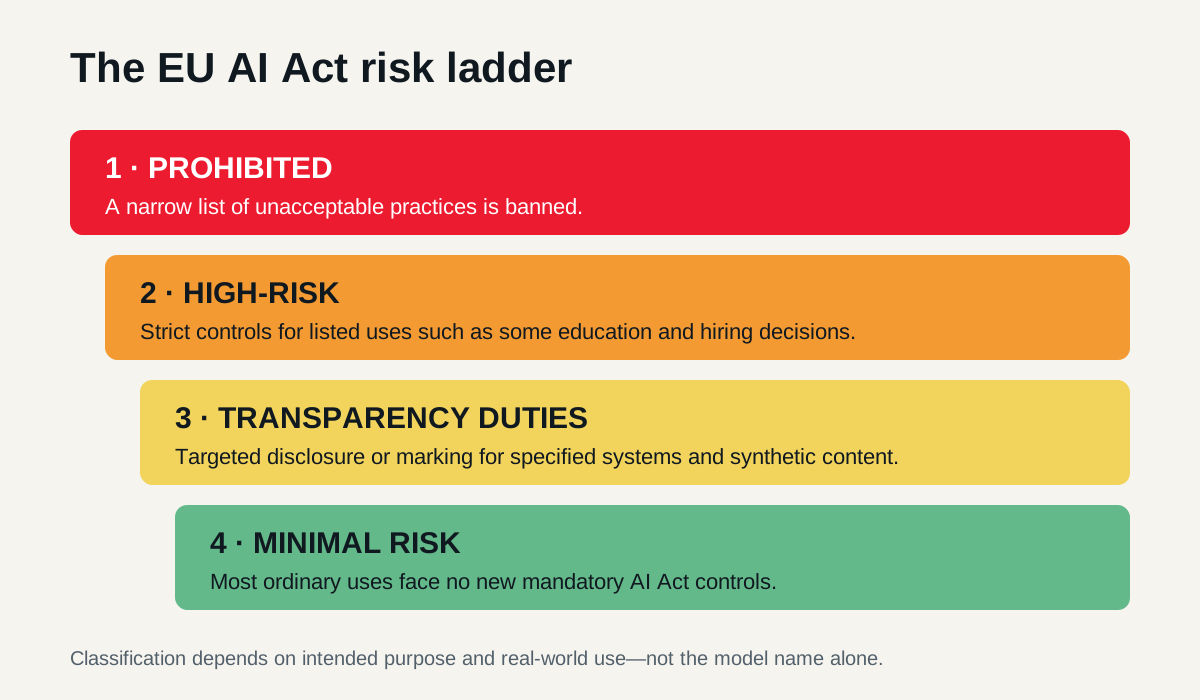
The Act works like a ladder. A limited set of practices is prohibited. Listed high-risk uses face requirements covering areas such as risk management, data governance, documentation, logging, human oversight, accuracy and cybersecurity. Certain systems and synthetic media carry transparency duties. Most minimal-risk uses do not acquire a new mandatory control merely because they use AI.
Context is crucial. A model used to improve grammar in a draft is not automatically regulated like a system used to rank university applicants. The same underlying technology can sit in different legal categories depending on its intended purpose and how it affects people.
Does every AI system have to identify itself?
No. Article 50 creates specific duties rather than universal self-disclosure. In simplified terms:
- Direct interaction: people generally need to be informed when they are interacting with an AI system, unless that is obvious to a reasonably informed and attentive person.
- Synthetic output: providers of systems that generate or manipulate text, audio, images or video must make outputs identifiable in a machine-readable way, subject to technical feasibility and stated exceptions.
- Deepfakes: deployers must disclose when image, audio or video has been artificially generated or manipulated in a way that resembles real people, objects, places or events and could falsely appear authentic.
- Public-interest text: AI-generated or manipulated text published to inform the public on matters of public interest generally requires disclosure. An important exception applies where there has been human review or editorial control and a person or organisation holds editorial responsibility.
- Emotion recognition and biometric categorisation: people exposed to specified systems must be informed, alongside applicable data-protection requirements.
This is why “mandatory AI self-disclosure” is too broad. The legal question is which system or content category applies, who is the provider or deployer, and whether an exception is available.
Why a company in India, the US or elsewhere may still care
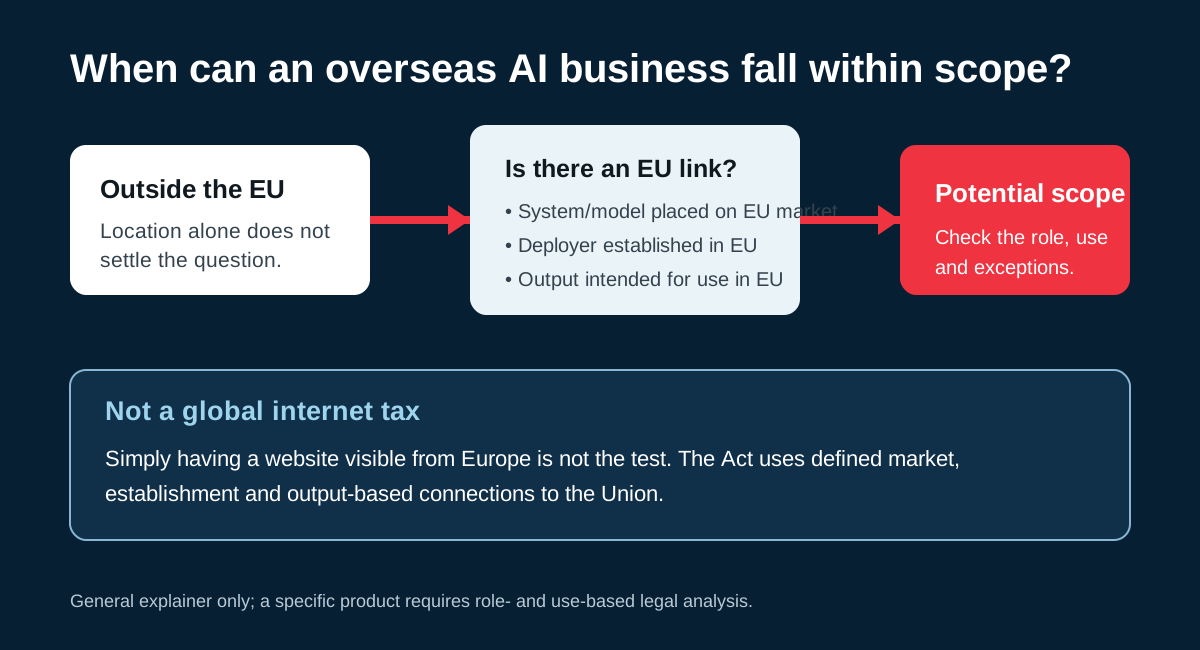
The Act has defined reach beyond the EU. It can apply to providers placing AI systems or general-purpose AI models on the EU market, to deployers established in the EU, and to providers or deployers in a non-EU country when the output produced by the system is intended to be used in the EU.
That does not turn the Act into a rule for every website visible from Europe. A real connection to the EU described in the law is required. An Indian startup selling an admissions-screening system to an EU university presents a much clearer EU link than a local prototype that is neither offered in Europe nor producing output intended for use there.
Global product teams may nevertheless adopt EU-style controls more widely because maintaining one labelling, documentation or oversight process can be simpler than operating several regional versions. That is a business choice, not proof that EU law directly governs every user worldwide.
What students and early-career workers may notice
Admissions and assessment
Some AI systems used to determine access or admission to education, evaluate learning outcomes, assign people to educational levels, or monitor prohibited behaviour during tests can be high-risk. The category does not cover every classroom assistant or spell-checker. The function and effect of the system matter.
Recruitment and work
Systems used for recruitment, candidate filtering, promotion, termination, task allocation or monitoring can also fall into high-risk categories. For a job applicant, useful questions include: Was AI used to rank me? What data influenced the result? Was a human genuinely able to review it? How can I challenge an error?
AI literacy
Providers and deployers must take measures to ensure a sufficient level of AI literacy among staff and others operating AI systems on their behalf. The Act does not prescribe one universal certificate. Training should reflect people’s knowledge, the context of use and the individuals or groups who may be affected.
Creating and sharing media
A student using AI to brainstorm privately is not in the same position as an organisation publishing a realistic synthetic video or automated public-interest report. Disclosure, copyright, privacy, platform rules and an institution’s academic-integrity policy may overlap. Compliance with one rule does not cancel the others.
A practical checklist
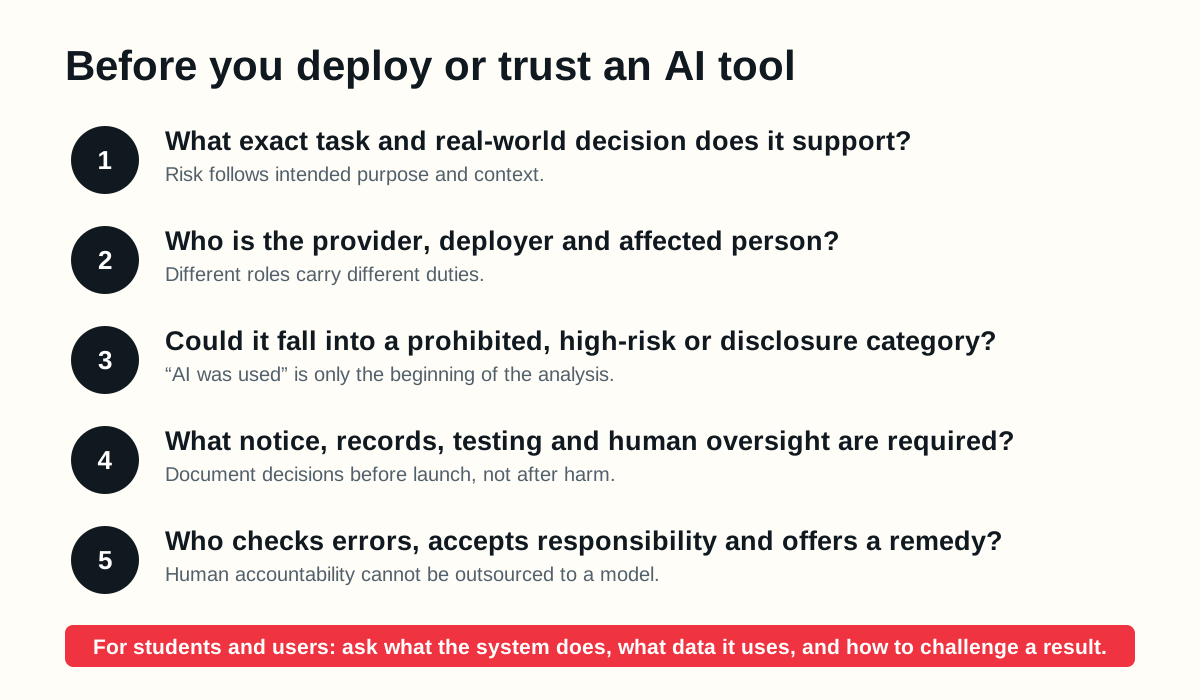
- Define the task: write down what the system actually does and which real-world decision it influences.
- Map the roles: identify the provider, deployer, importer, distributor and people affected. Duties differ by role.
- Classify the use: check prohibited practices, high-risk use cases and targeted transparency duties before launch.
- Document the controls: record data sources, limitations, testing, human oversight, notices, incident handling and routes to challenge a result.
- Check the EU connection: examine the target market, where the deployer is established and where the output is intended to be used.
- Keep a human accountable: a disclosure label is not a substitute for accuracy, fairness, privacy, security or a remedy.
What the law still will not tell you at a glance
A headline cannot determine whether a particular system is high-risk. Classification may depend on the product’s intended purpose, its actual deployment, sector-specific law and evolving guidance from the Commission and national authorities. Enforcement practice will also develop through supervision, investigations and court decisions.
The durable takeaway is simpler: the EU has moved from broad AI principles to enforceable, role-specific obligations. For users, the strongest habit is to ask what the system is doing, what evidence supports its result, who is responsible and how an affected person can obtain an explanation or correction.
Abbreviations and full forms
AIArtificial Intelligence EUEuropean Union GPAIGeneral-Purpose Artificial IntelligenceSources
- Regulation (EU) 2024/1689 — Artificial Intelligence Act — EUR-Lex
- European AI Act regulatory framework — European Commission
- Commission starts enforcing AI Act rules and new transparency requirements — European Commission
- Guidelines on transparency obligations for providers and deployers of AI systems — European Commission
HeadlineDecoded is committed to accuracy and transparency. Read our standards or submit a correction.